

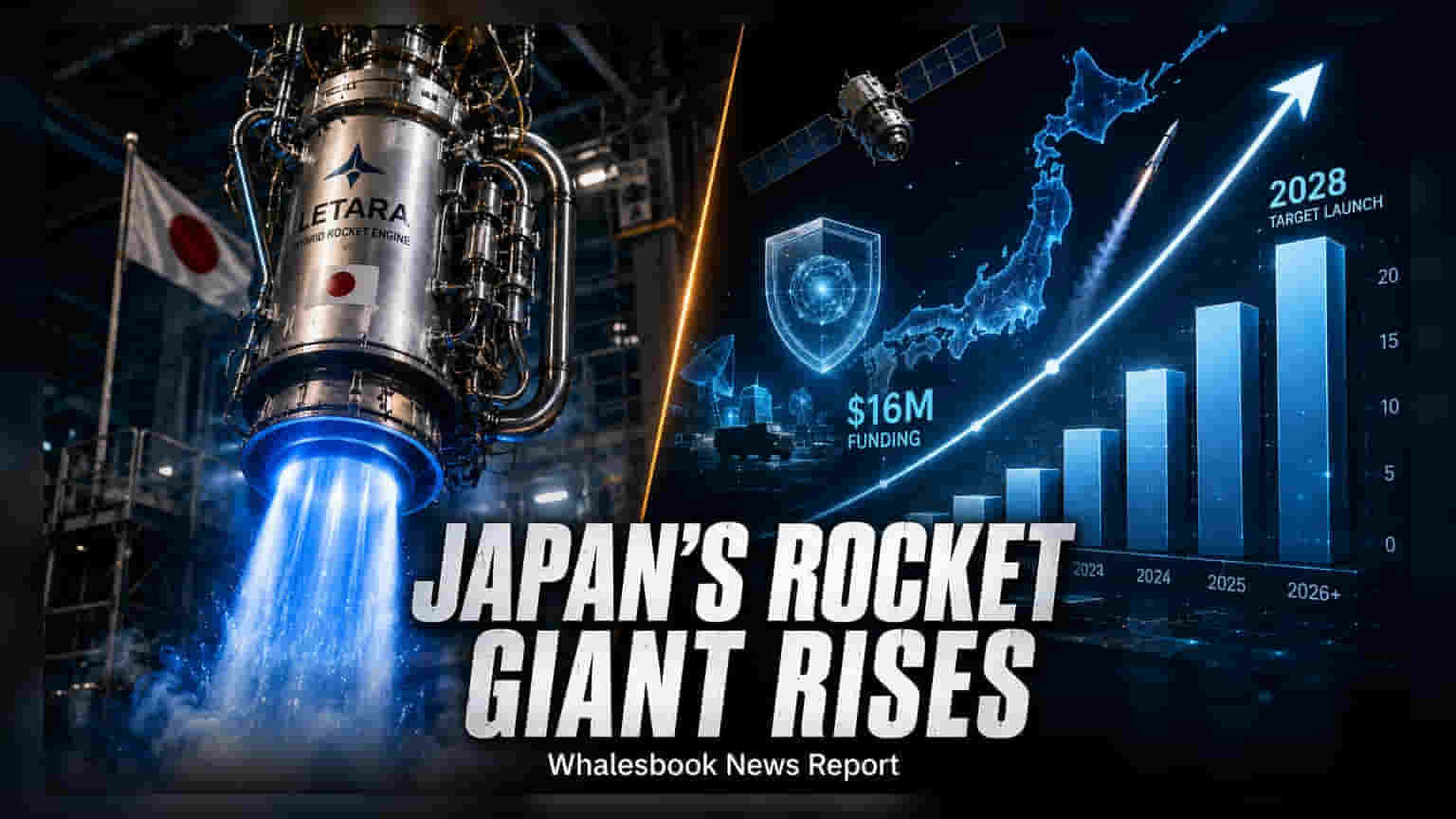
Japanese startup Letara has secured $16 million from investors including Headline Asia and JIC Venture Growth to scale its hybrid rocket propulsion systems. The company plans to expand from satellite thrusters to larger rocket engines using cost-effective fuels like plastic. This move signals a push into the space, defense, and security markets as the firm prepares for future launch missions.
Letara, a Sapporo-based space technology company, has successfully closed a funding round of approximately $16 million (around ¥2.6 billion). The round was led by Headline Asia, JIC Venture Growth Investment, and Incubate Fund. Several strategic investors also participated, including Toyoda Gosei, which is part of the Toyota Group, and energy firm NES Corporation. This capital injection marks a key step for the company as it transitions from a focus on small satellite thrusters to the development of larger rocket systems.
Founded in 2020 as a spinout from Hokkaido University, Letara specializes in hybrid rocket propulsion. Unlike traditional rocket systems that rely on complex liquid or solid fuel setups, Letara’s technology uses solid fuel made from cost-effective materials like plastic and rubber combined with a liquid oxidizer. The company aims to make rocket engines safer, simpler, and more affordable to manufacture. By controlling the combustion of these materials, the firm intends to address historical issues with hybrid rockets, such as insufficient thrust and stability.
Strategic Expansion and Partnerships
The funding will support the company’s broader ambitions in the space, defense, and security sectors. A significant part of this plan involves moving toward larger-scale launch vehicle engines. To support this goal, Letara has entered a strategic partnership with Innovative Space Carrier Inc. The collaboration is focused on developing engines for a planned space launch by 2028. This partnership is critical as it provides a testing ground for Letara’s technology to prove it can handle the demands of larger spacecraft and launch vehicles.
Market Context and Execution Risks
The space and defense sectors are seeing increased investment globally, with many countries, including Japan, looking to build domestic capabilities. However, investors and industry observers often track several challenges for deep-tech companies like Letara. A primary hurdle is the risk of delay or cost increase when scaling from small thrusters to large rocket systems. Rocket technology requires rigorous testing and long development cycles, which can strain a startup’s capital if milestones are not met on time.
Additionally, the company operates in a highly regulated environment. Developing systems for defense and security purposes involves strict government oversight and lengthy certification processes. While the use of recycled or simple materials like plastic offers a potential cost advantage, the firm must prove that these systems can match the performance and reliability of established aerospace technologies. Supply chain stability and the ability to maintain quality control during mass production will also be essential factors for the company’s long-term viability.
Next Steps for the Company
For investors and industry followers, the next important update will be the progress of the engine development for the planned 2028 launch. The company’s ability to demonstrate successful in-orbit firing tests and to build a repeatable, reliable manufacturing process will be the key monitorable in the coming quarters. Success in these areas will determine whether Letara can effectively compete with established aerospace players and secure its place in the growing global market for launch services.