 Whalesbook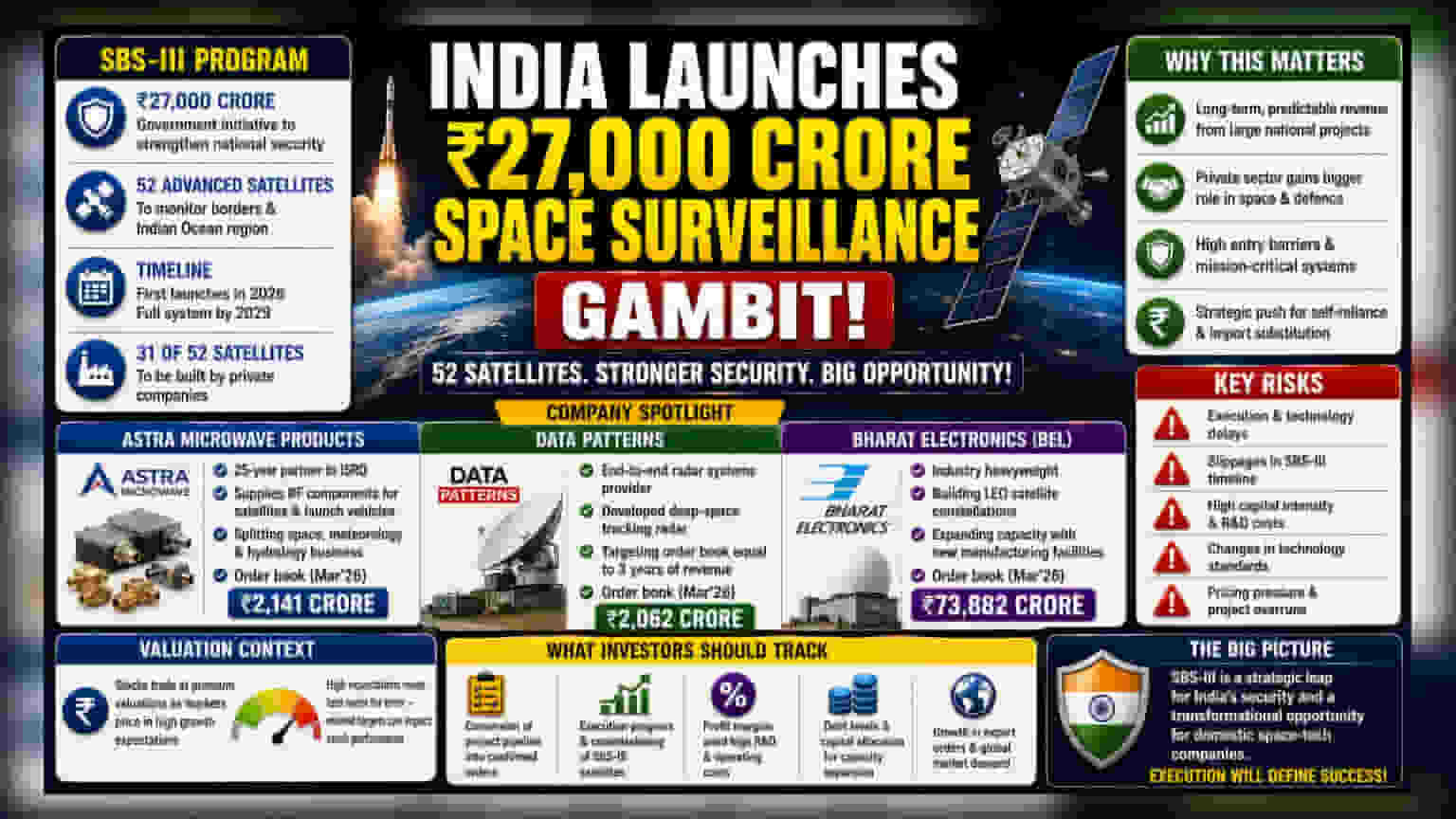


India is launching a major ₹27,000 crore satellite program to boost border monitoring. With 31 of the 52 planned satellites to be built by private firms, companies like Astra Microwave, Data Patterns, and Bharat Electronics are in the spotlight. This initiative marks a shift in defense manufacturing, creating long-term revenue visibility for space-tech players.
What Happened
India has officially launched the ambitious ₹27,000 crore Space-Based Surveillance (SBS)-III program. This government initiative aims to strengthen national security by creating a constellation of 52 advanced satellites, which will be used to monitor borders and the Indian Ocean region. The project, which received approval in late 2024, is scheduled to see its first satellite launches in 2026, with the full system expected to be operational by 2029.
A major highlight of this program is the government's decision to hand over the construction of 31 of these 52 satellites to private companies. This move is part of a broader strategy to increase private sector involvement in India’s high-tech defense and space manufacturing.
Why This Matters For Investors
For investors, the SBS-III program represents a move toward more predictable, long-term revenue for defense and space-tech companies. Historically, the Indian Space Research Organisation (ISRO) managed most satellite manufacturing in-house. The transition toward private participation changes the business model for several listed companies, allowing them to participate in large-scale national infrastructure projects.
However, it is important to remember that these projects are complex and capital-intensive. While the opportunity is large, companies must prove they can manufacture high-precision equipment on time and within budget to benefit from these contracts.
Company-Specific Context
Astra Microwave Products has established itself as a long-term partner to ISRO, with a 25-year history of supplying radio frequency components used in satellites and launch vehicles. The company is currently planning to split its space, meteorology, and hydrology businesses into a separate, focused entity. As of March 2026, it held a standalone order book of ₹2,141 crore and is aiming for significant new order bookings in the coming year.
Data Patterns is positioning itself as a provider of complete, ready-to-use radar systems. The company has developed its own deep-space tracking radar technology and aims to capture business that requires deep technical expertise. Management has indicated that they are targeting a long-term order book that matches three years of revenue to ensure growth consistency. Its order book recently reached ₹2,062 crore, marking a significant milestone.
Bharat Electronics (BEL) acts as the industry heavyweight in this sector. Unlike smaller players, BEL is already focused on large-scale infrastructure, including developing Low Earth Orbit (LEO) satellite constellations. With a massive order book of ₹73,882 crore as of March 2026, BEL is looking to expand its capacity with new manufacturing facilities for satellite parts. Its scale allows it to take on much larger projects, often involving collaborations and joint ventures.
The Valuation and Risk Question
Investors should note that while the growth potential is high, the market often prices these stocks at a premium compared to traditional manufacturing companies. This happens because investors expect high future earnings. If the company fails to secure expected orders or faces delays in executing its projects, this valuation can come under pressure.
Another risk factor is execution. Building satellites involves extremely high technical standards. Delays in design, testing, or raw material procurement are common in the space sector. Any delay in the SBS-III timeline could affect the revenue recognition of the participating companies.
What Investors Should Track
Moving forward, the primary focus for shareholders should be the actual conversion of the project pipeline into confirmed orders. A project is only profitable when the order is won, executed, and the bill is paid. Investors may monitor the profit margins of these companies, as space-tech projects require high spending on research and development. Finally, the ability of these firms to manage their debt while investing in new manufacturing capacity will be a key factor in their long-term financial health.