 Whalesbook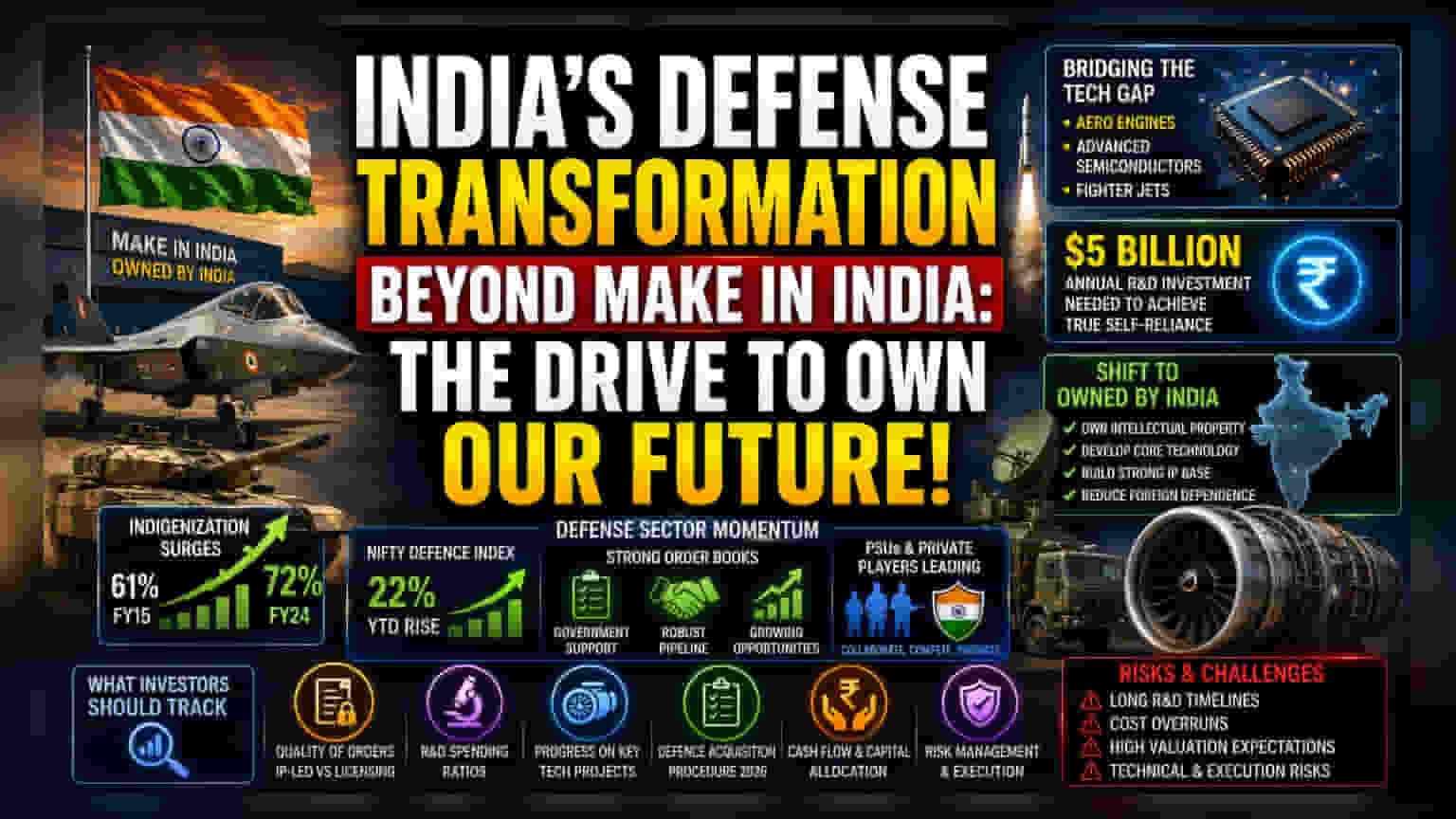
A recent Kotak Institutional Equities report highlights that India needs an additional $5 billion in R&D spending to move from importing critical defense tech to owning it. While the defense sector has shown strong indigenization progress, the shift toward 'Owned by India' involves significant innovation challenges. For investors, this means monitoring which companies can successfully develop intellectual property, manage long-term R&D costs, and sustain profit margins in a highly competitive manufacturing landscape.
What Happened
A recent analysis by Kotak Institutional Equities has highlighted a major milestone in India's defense transformation. While the country has successfully increased its indigenization level from 61% in fiscal 2015 to 72% in fiscal 2024, significant technological gaps remain. The brokerage suggests that to reduce dependence on foreign equipment—specifically in high-tech areas like aero engines, advanced semiconductors, and fighter jets—India needs an additional $5 billion in annual research and development (R&D) expenditure.
The Shift to 'Owned by India'
The core message for investors is a change in the industry's strategy. Until now, much of the 'Make in India' success has been centered on manufacturing and assembly under technology transfer agreements. The next phase, outlined by policies like the Defence Acquisition Procedure 2026, focuses on moving toward an 'Owned by India' framework. This means moving beyond licensed production to owning intellectual property (IP) and core technology. This shift is essential for India to gain true independence in its defense supply chain.
Why This Matters For Investors
For shareholders, the drive for R&D has a direct impact on company financials. Traditionally, defense manufacturing has been about high-volume, low-margin assembly work. Building local R&D capabilities involves significant upfront spending, which may create short-term margin pressure for defense companies. However, companies that successfully develop and own their technology can eventually command better pricing power and higher margins compared to those acting solely as contract manufacturers. Investors should observe how companies balance these heavy research costs with their existing production commitments.
Peer and Sector Context
The Indian defense sector has seen significant interest, with the Nifty Defence Index rising approximately 22% year-to-date. This rally reflects high optimism regarding government order books. While public sector giants like Hindustan Aeronautics Limited (HAL) and Bharat Electronics Limited (BEL) lead in scale, the move toward specialized technology is also opening doors for private sector firms. Unlike the past, where PSUs dominated, the current landscape is increasingly competitive, with private players now bidding for complex electronics, drones, and communication systems.
Risks and Execution Challenges
While the goal of self-reliance is clear, the path is not without hurdles. The primary risk for investors is execution. Developing high-end technologies like aero engines is a long, complex process prone to delays and cost overruns. There is no guarantee that R&D spending will immediately translate into finished, sellable products. Furthermore, with the sector's current valuation premium, the market has already priced in high expectations for growth. Any delay in major projects or failure to meet technical standards could lead to volatility in stock prices.
What Investors Should Track
Going forward, the key monitorable is not just the total order book size, but the quality of orders. Investors may want to track which companies are moving toward IP-led products versus those still dependent on foreign technology transfers. Other important factors include the actual R&D spending ratios reported in quarterly results, progress on major projects like jet engine development or advanced communication platforms, and updates on the Defence Acquisition Procedure 2026. Understanding how companies manage their cash flow while funding these long-term R&D projects will be essential for assessing their long-term viability.

