

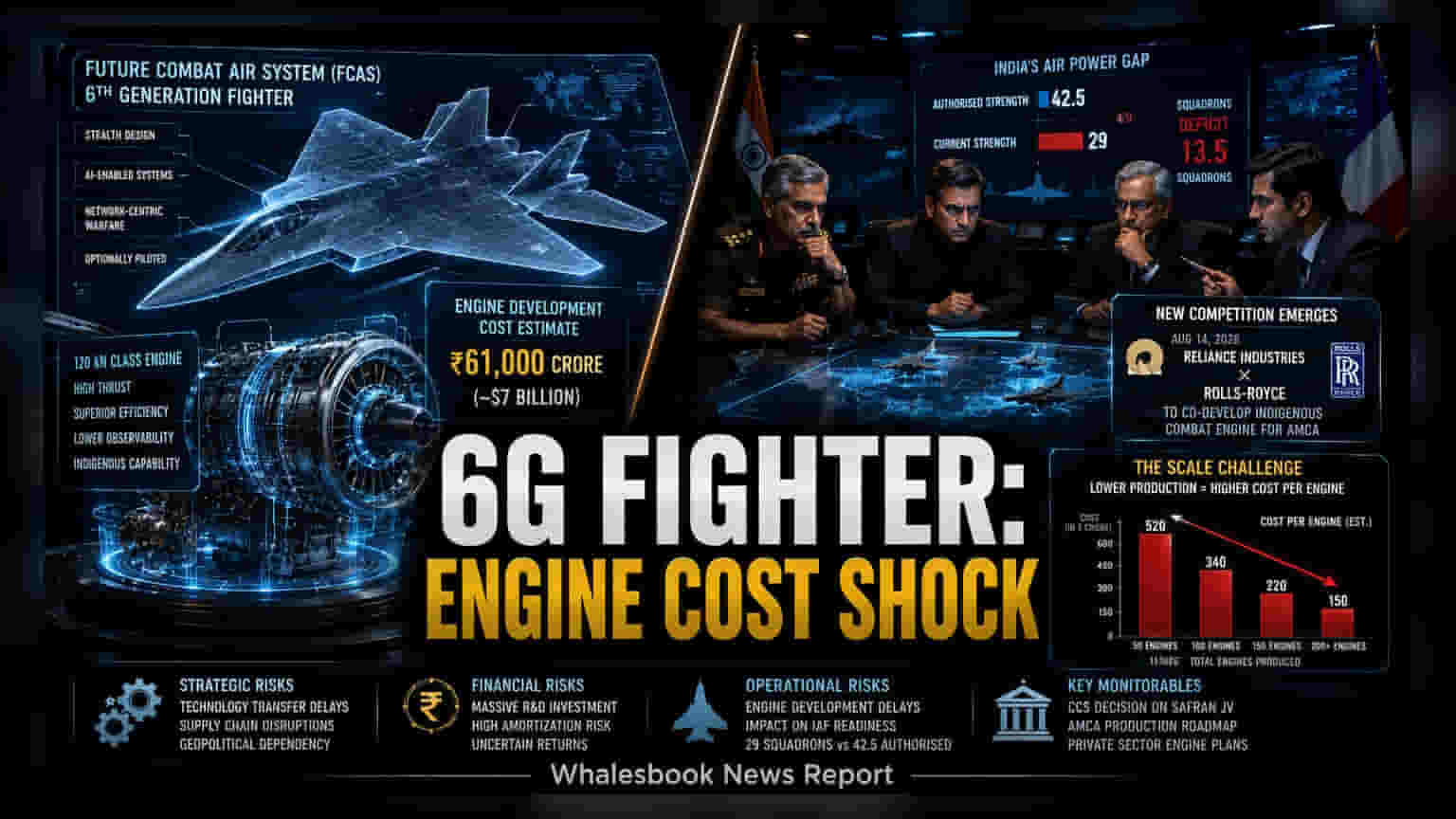
India’s move to join France’s 6G fighter program and build indigenous engines faces major economic questions. With a proposed $7 billion Safran joint venture awaiting government approval and a new private-sector entry from Reliance and Rolls-Royce, the key challenge is ensuring the production scale justifies these heavy investments.
India’s recent confirmation of its interest in joining the French-led Future Combat Air System (FCAS), a program designed to develop sixth-generation fighter jets, has brought the country's fighter engine strategy under the spotlight. While the move is a strategic step toward modernizing air power, it highlights a complex financial and operational dilemma: how to fund and justify the development of high-thrust jet engines when production volumes remain uncertain.
The Engine Economics Dilemma
The central challenge is one of scale. India is currently pushing for technology transfer and local production of the GE F414 engine to power its Light Combat Aircraft Mk2 and initial AMCA (Advanced Medium Combat Aircraft) models. However, supply chain issues and rising costs have created a clear need for a more permanent, indigenous solution. The government is currently weighing a massive, proposed ₹61,000 crore (approximately $7 billion) joint venture with France’s Safran to develop a 120 kN high-thrust engine.
For investors and policy observers, the financial risk lies in the amortization of this cost. Research and development in aerospace is extremely expensive. If the total number of aircraft produced—and therefore the total number of engines manufactured—is too low, the cost per engine becomes prohibitively high. If the program does not achieve a long-term, large-scale production run, the billions spent on R&D may not offer a fair return on investment for the state.
New Private Sector Competition
The strategic landscape shifted significantly on August 14, 2026, when Reliance Industries and Rolls-Royce announced their strategic intent to co-develop an indigenous combat engine for the AMCA. This development introduces a new variable into the equation. While competition can often drive efficiency and innovation, it also risks splitting the country's limited resources and focus between multiple engine programs. For the government, the challenge is to decide whether to double down on the state-led Safran partnership, integrate private sector players, or manage these as separate, parallel tracks, all while keeping a close eye on budget efficiency.
Strategic and Operational Risks
Beyond the cost of development, there are significant execution risks. The Indian Air Force is currently operating with 29 fighter squadrons, well below its authorized strength of 42.5. This creates an urgent need for new platforms. Delays in engine development—whether due to complex technology transfers, intellectual property negotiations, or the lengthy government approval process—could directly impact the operational readiness of the Air Force.
Furthermore, the reliance on foreign technology transfer means that India remains vulnerable to supply chain disruptions and shifting geopolitical priorities. The goal is to achieve true 'sovereign' capability, but the road to that involves high-risk capital expenditure and the technical difficulty of achieving performance standards that match global leaders.
What Investors Should Monitor
The next major milestone to watch is the decision from the Cabinet Committee on Security (CCS) regarding the Safran joint venture. Investors and stakeholders should also track the clarity provided on the production roadmap for the AMCA and the 6G fighter. The viability of these massive investments will depend on official government projections for aircraft production numbers and whether the state can successfully integrate new private-sector engine initiatives without creating redundant, cost-inefficient programs.