

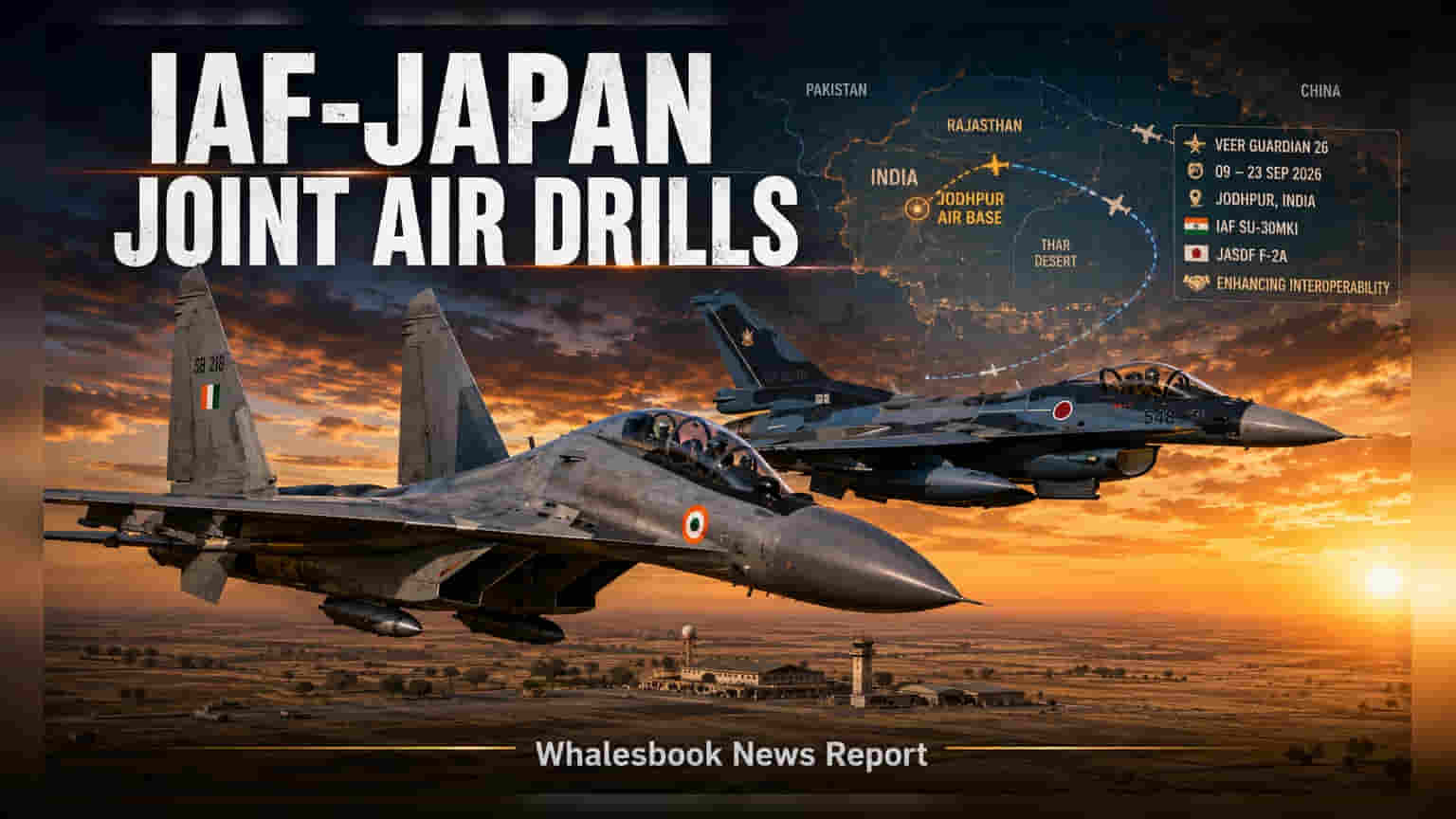
The Indian Air Force will host Japan’s F-2A fighter jets for the 'Veer Guardian 26' exercise starting September 9, marking the first time Japanese fighter assets operate from an Indian base. This deepening defense cooperation highlights the growing scale of India's military interoperability and underscores the strategic focus on the domestic defense sector's modernization and global partnerships.
The Indian Air Force (IAF) is preparing to host the Japan Air Self-Defense Force (JASDF) for the 'Veer Guardian 26' exercise, set to begin on September 9, 2026. This deployment marks a historic milestone in Indo-Japanese defense ties, as it is the first instance of Japanese fighter jets—specifically the F-2A aircraft—operating from an Indian airbase for joint training.
The exercise, which will take place in Jodhpur, involves approximately 110 personnel from the 8th Air Wing based at Tsuiki Air Base. For the Indian defense ecosystem, these joint maneuvers serve as more than just a training event; they represent a deliberate effort to stress-test air-combat integration and tactical coordination protocols. As the IAF moves toward higher levels of technological complexity in its air fleets, the ability to operate seamlessly alongside advanced foreign platforms is becoming a critical benchmark for the service.
Impact on the Defense Sector
For investors and market participants, these exercises act as a reflection of the broader trend in India's defense manufacturing and services sector. The government's push for 'Atmanirbhar Bharat' (self-reliant India) has accelerated the need for indigenous capability building, which often involves the maintenance, repair, and overhaul (MRO) of sophisticated fighter platforms. Companies such as Hindustan Aeronautics Ltd (HAL) and Bharat Electronics Ltd (BEL) remain central to this landscape, as they manage the domestic supply chain, avionics, and radar systems that form the backbone of the IAF's combat readiness.
While this specific exercise focuses on training, the increased frequency of multinational engagements like 'Veer Guardian' and the upcoming 'Tarang Shakti 2026' exercise creates a consistent requirement for logistical support and localized technological maintenance. This activity profile is generally viewed as a supporting factor for the long-term order books of major domestic defense contractors, as it validates the reliability and sophistication of the platforms they support.
Operational Risks and Security Context
These maneuvers also bring into focus the operational complexity of managing high-altitude exercises along India's western frontier. Military planners have marked specific sectors in Rajasthan for intense activity, with flight paths potentially operating in close proximity to international boundaries. The logistical undertaking required to host foreign air units while maintaining high combat readiness is a significant test for the IAF's administrative and strategic planning capabilities.
From a regional security perspective, the deepening defense partnership with Japan has been closely monitored by international observers, particularly regarding tensions in the Asia-Pacific region. While the primary objective of these drills is interoperability, the high-stakes nature of the environment means that any escalation in regional security or shifts in geopolitical alignments can have indirect consequences for defense spending priorities. Investors in the aerospace and defense sector typically monitor how such international collaborations might influence future technology transfer agreements, joint production possibilities, and the overall pace of military modernization in India.