

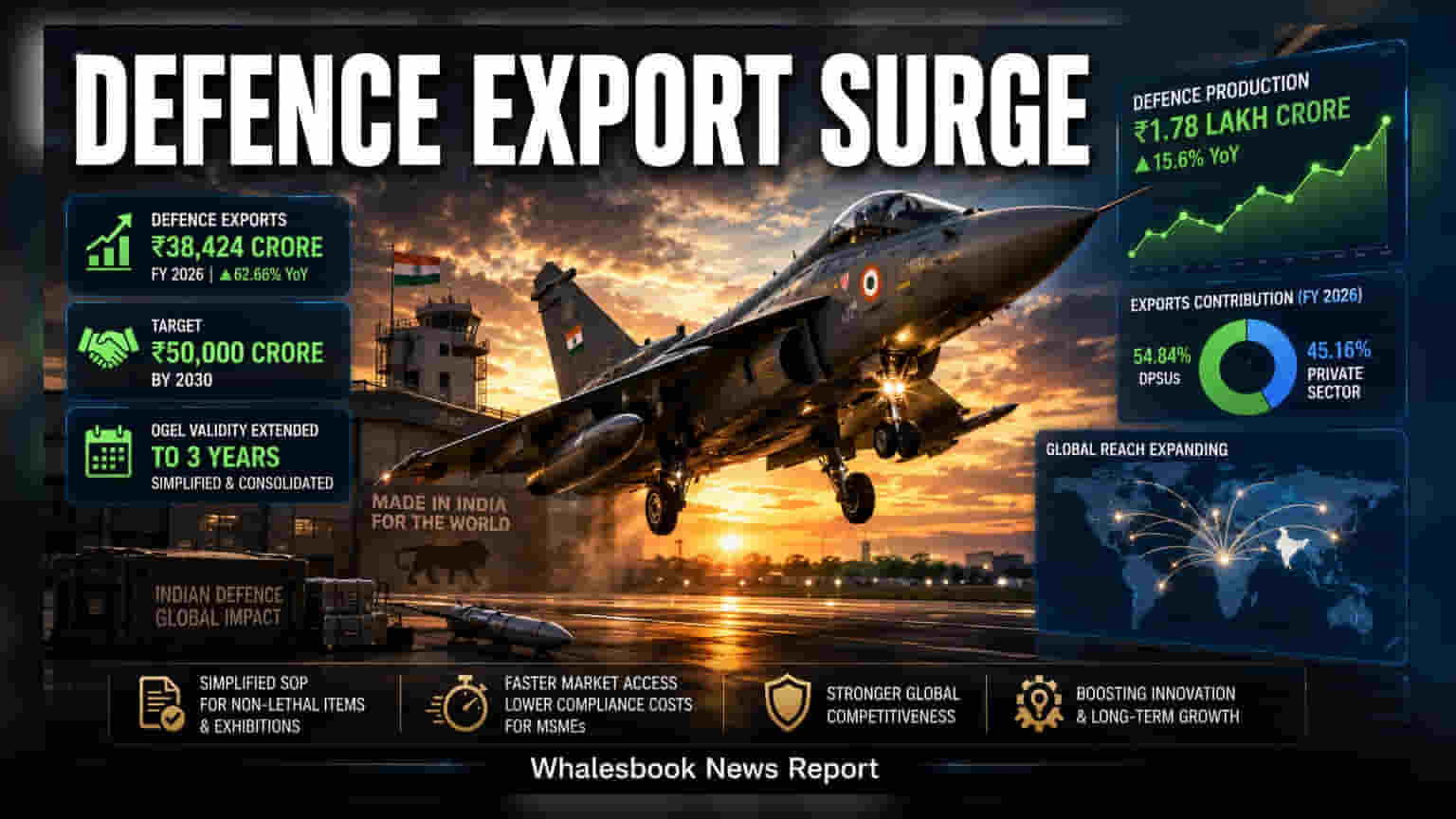
The government has simplified defence export procedures by extending licence validity to three years and cutting red tape. With exports rising 62.66% to ₹38,424 crore in FY26, this move aims to boost private sector participation, though investors should balance the growth outlook against persistent import dependencies and R&D costs.
The Indian government has launched a significant overhaul of its defence export framework to accelerate global market access for domestic manufacturers. By modifying the Standard Operating Procedure (SOP), the government has eliminated mandatory stakeholder consultations for the export of non-lethal defence items and equipment intended for international exhibitions. This administrative streamlining is designed to help domestic firms, including MSMEs, participate in global tenders with fewer delays and lower compliance costs.
Consolidation of Export Licences
A central feature of this update is the revision of the Open General Export Licence (OGEL) framework. Previously, the system was split across multiple policies, creating confusion for companies dealing in various platforms, parts, and technology transfers. The government has now consolidated these into a single, unified policy and extended the licence validity from two years to three. This extension provides manufacturers with greater certainty when negotiating long-term contracts with foreign original equipment manufacturers, as they face fewer hurdles for frequent renewals.
Sector Performance and Growth Context
These policy changes follow a year of strong growth for the sector. In the 2026 fiscal year, India’s total defence exports grew by 62.66% year-on-year to reach ₹38,424 crore. Public sector units (DPSUs) accounted for 54.84% of these exports, while the private sector contributed 45.16%. Additionally, overall domestic defence production rose by 15.6% to ₹1.78 lakh crore. The government has set a target to reach ₹50,000 crore in annual defence exports by 2030, and these new procedures are intended to bridge the gap toward that goal.
Operational Risks and Market Realities
While the simplified procedures support ease of doing business, the sector faces structural challenges. India remains the world’s second-largest arms importer, underscoring a continued dependence on foreign technology and components. For investors, it is important to note that export revenue in the defence sector can be volatile, as it often relies on a limited number of large-value delivery contracts rather than steady, small-scale sales.
Furthermore, private defence companies are under pressure to invest heavily in Research and Development (R&D) to compete with global players. While necessary for long-term growth and intellectual property development, these costs can weigh on operating margins in the short term. Additionally, Indian defence firms currently generate fewer patents per dollar of revenue compared to many global competitors, indicating a need for faster innovation to sustain high-value exports.
Investors should monitor whether these policy changes translate into consistent order book growth for private manufacturers and how effectively companies manage the balance between R&D spending and profit margins.