 Whalesbook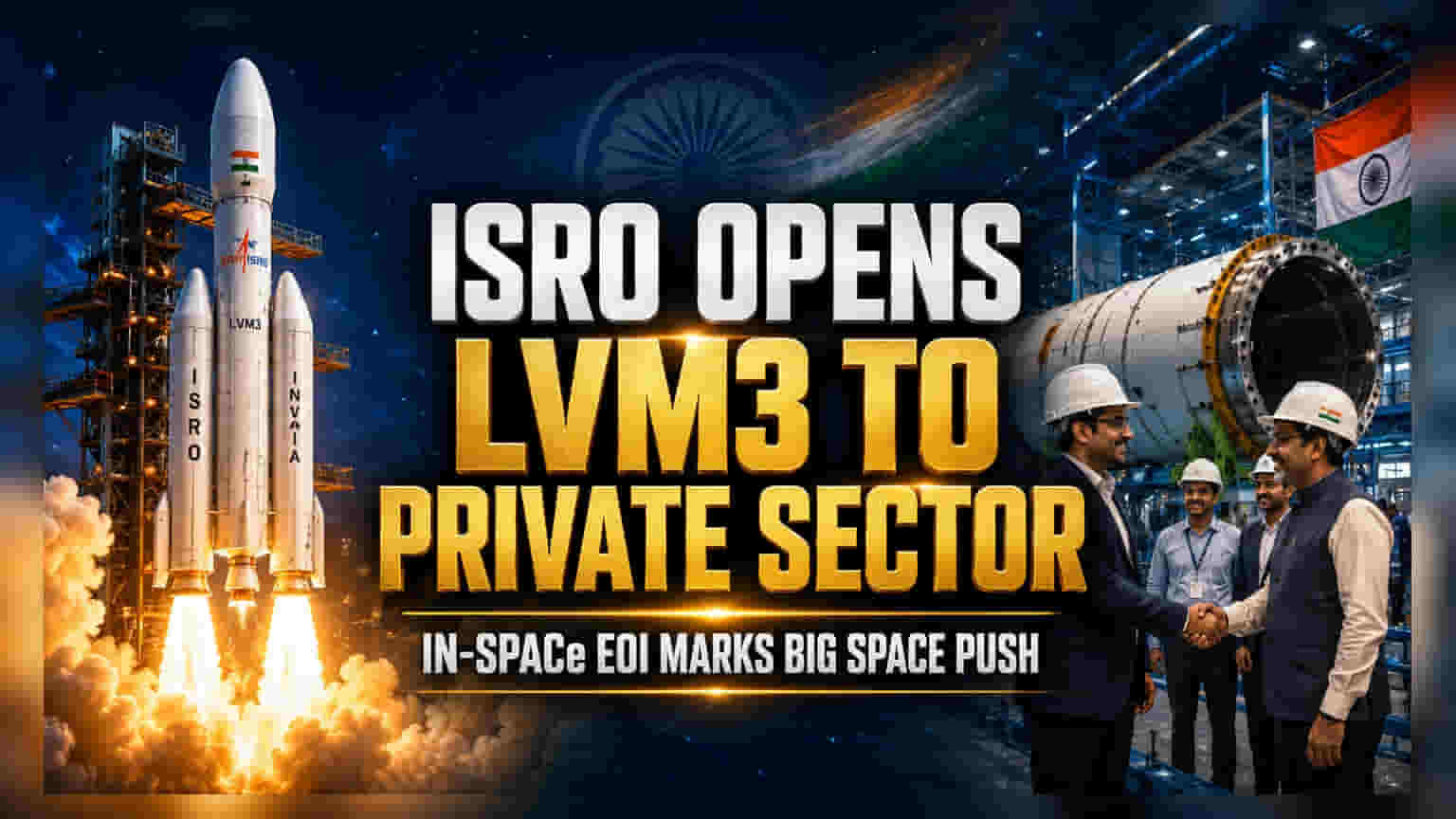


ISRO’s nodal agency, IN-SPACe, has invited private companies to manufacture the powerful LVM3 rocket. This technology transfer aims to boost India's satellite launch capacity and compete in the global commercial market. With strict financial eligibility criteria, the initiative is expected to attract large industrial groups or consortia capable of long-term investment.
What Happened
The Indian Space Research Organisation (ISRO), through the Indian National Space Promotion and Authorisation Centre (IN-SPACe), has launched an Expression of Interest (EoI) to transfer technology for its LVM3 rocket. Known as 'Bahubali' due to its immense payload capacity, the LVM3 is India's premier medium-lift launch vehicle. This move allows private sector companies to manufacture, operate, and commercialize the rocket, marking a shift toward greater private industry involvement in heavy-lift space missions.
Why This Matters For Investors
The move is a strategic step to scale up launch frequency. Historically, ISRO handled the entire production cycle. By involving private players, the agency aims to create a sustainable manufacturing ecosystem that can serve global satellite launch demands. For investors, this signals that the space manufacturing sector in India is moving from a government-led model to one where large private industrial groups can play a permanent, revenue-generating role.
Eligibility and Financial Hurdles
IN-SPACe has set strict criteria for participation, ensuring that only companies with significant financial and operational strength are eligible. Interested applicants must have at least seven years of operational experience. For consortia, at least one member must have five years of experience in the aerospace sector. From a financial standpoint, companies must demonstrate an average annual turnover of over ₹800 crore in at least three of the last five years, or a market valuation of at least ₹2,000 crore. These high thresholds indicate that the opportunity is targeted at established engineering and manufacturing conglomerates rather than small startups.
The Bigger Business Context
This initiative follows the successful technology transfer model used for the Polar Satellite Launch Vehicle (PSLV). In the past, companies like Hindustan Aeronautics Limited (HAL) and Larsen & Toubro (L&T) have been key partners for ISRO. The shift to LVM3 technology suggests that the government is confident in the private sector’s ability to handle more complex and larger launch vehicles. This is crucial for India’s future missions, including the human spaceflight program and scientific deep-space missions, which require reliable heavy-lift capabilities.
How Investors May Read This
While the prospect of entering the space manufacturing sector is attractive, investors should be aware of the business risks involved. Building rockets is a complex, capital-intensive business with long gestation periods. Companies will need to spend heavily on specialized infrastructure, precision engineering equipment, and highly skilled human capital. Unlike standard manufacturing, there is limited room for error in aerospace, and execution delays can lead to significant cost overruns. Furthermore, the commercial success of these companies will depend on their ability to secure launch orders in a competitive global market where rivals like SpaceX and other global players already have established launch records.
What Investors Should Track
The primary monitorable for investors will be the selection of the winning consortium and the specific terms of the technology transfer. Investors may track how companies manage their capital spending plans to accommodate this new business line without straining their balance sheets. Additionally, updates on the construction of dedicated launch infrastructure and the timeline for the first privately manufactured LVM3 launch will be critical. The market will also look for management commentary from major aerospace engineering firms regarding their strategy to integrate this technology into their existing revenue streams.