

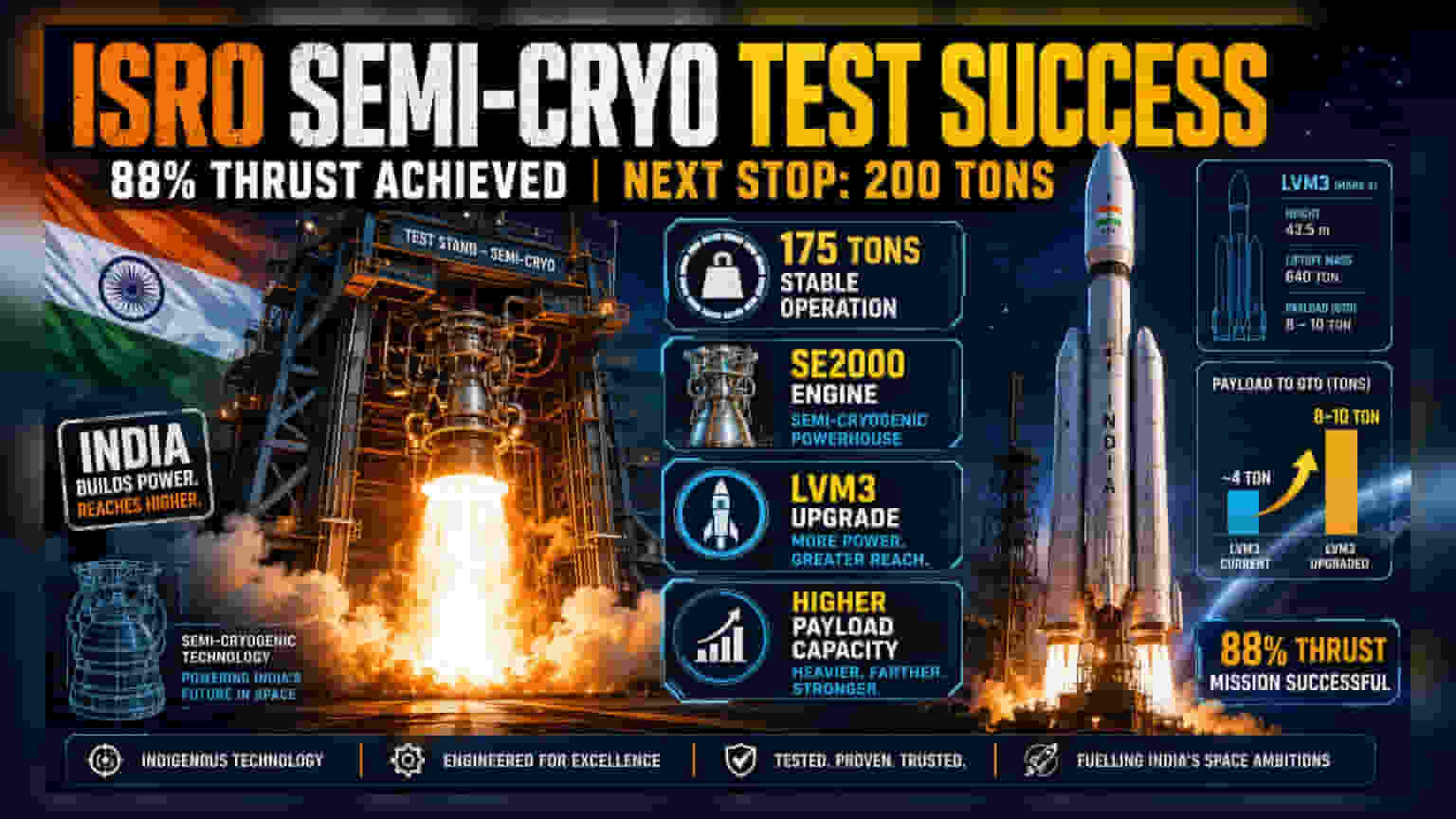
India's space agency ISRO successfully tested a next-generation semi-cryogenic rocket engine, reaching 175 tons of thrust. This critical milestone paves the way for an upgraded LVM3 launch vehicle, promising increased payload capacity and enhanced operational efficiency for future space missions.
The Indian Space Research Organisation (ISRO) has successfully completed a crucial hot test of its semi-cryogenic engine's power head, marking a significant advancement in India's space propulsion capabilities. The test, conducted on June 24 at the ISRO Propulsion Complex in Tamil Nadu, achieved 88% of its target thrust, demonstrating stable operation at 175 tons.
Milestone Achieved
This successful trial follows earlier tests at 47% and 60% thrust levels. ISRO stated that this latest achievement provides "sufficient confidence" to proceed towards a full-thrust demonstration aiming for 200 tons. The development is vital for India's ambition to enhance its space launch capabilities.
LVM3 Upgrade
The semi-cryogenic propulsion stage is being developed as a replacement for the current L110 core stage on India's LVM3 (Launch Vehicle Mark-3) rocket. The upgrade, powered by the 2,000-kilonewton SE2000 engine, is expected to substantially boost the vehicle's payload capacity. It will also improve operational efficiency by utilizing liquid oxygen and kerosene-based fuel.
Future Implications
This enhanced propulsion system is key to ISRO's future missions, including heavier satellite launches and potential deep-space exploration. The successful testing signals robust progress in indigenous rocket technology and strengthens India's position in the global space sector.