 Whalesbook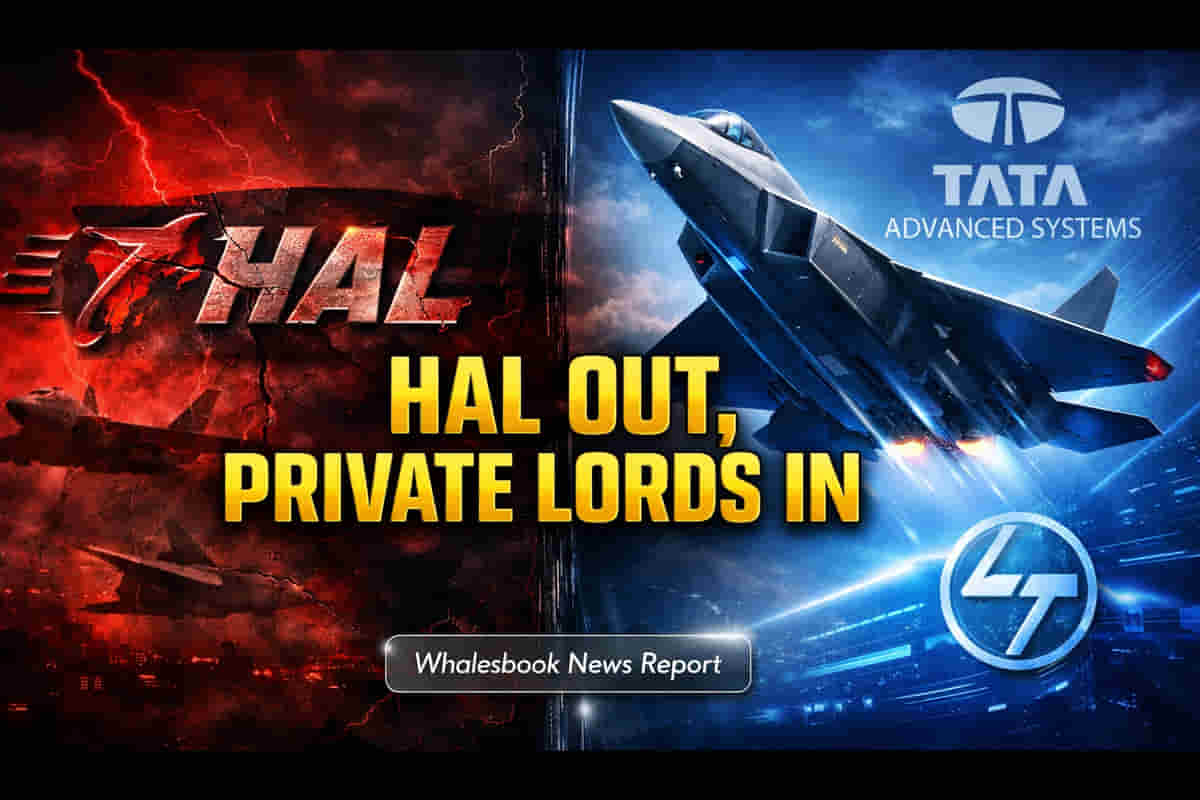
The exclusion of Hindustan Aeronautics Limited (HAL) from the flagship Advanced Multirole Combat Aircraft (AMCA) program marks a significant departure from decades of state-run dominance in India's defence manufacturing. This decision, as the Aeronautical Development Agency (ADA) moves to award contracts to private sector consortia, stems from HAL's prolonged struggles with delivery timelines and its existing substantial order book. The AMCA, envisioned as India's entry into the elite club of fifth-generation stealth fighter developers, now faces a new execution model designed to inject private sector agility and competitiveness.
Shifting Defence Paradigms
The Indian government's revised execution model for the AMCA project allows private and public sector entities to bid independently, form joint ventures, or collaborate in consortia. This move effectively ends the long-standing favouritism previously enjoyed by HAL. Analysts point to HAL's delays in delivering the Tejas aircraft, compounded by General Electric's challenges in supplying jet engines expeditiously, as primary catalysts for this change. With HAL out of contention for the initial prototype phase, the ADA will collaborate with one of three shortlisted private sector consortia to build five AMCA prototypes at a cost of ₹15,000 crore. A successful outcome could lead to a firm order for 114 aircraft worth ₹3.25 lakh crore.
Private Sector Takes the Helm
Leading the charge are consortia featuring prominent Indian corporations. Tata Advanced Systems Limited, Larsen & Toubro (L&T) partnered with Bharat Electronics Limited (BEL), and a group comprising Bharat Forge, BEML, and Data Patterns are among the key contenders. Other consortia, including those led by Adani Defence & Aerospace and ICOMM Tele, also vied for the project. This opening to the private sector, while unprecedented for a fighter-aircraft production line, aims to leverage their adaptability, rapid adoption of technology, and proven ability to meet production deadlines and stringent quality controls. Concerns remain regarding the private sector's experience with full-scale fighter production, but their focus on cost control and efficiency could address areas where public sector undertakings have historically lagged.
HAL's Wake-Up Call
The disqualification serves as a stark reminder for HAL, once a darling of the Indian stock market with its market capitalization soaring over 1000 percent in five years. Despite a robust order book for Tejas variants, the company has faced public criticism, including a rebuke from the Indian Air Force chief for slow delivery paces. Capacity constraints, with production lines allocated for trainers and LCA Mk-1A fighters, alongside the concurrent development of the Tejas Mk2, likely played a critical role in the government's decision. HAL's chairman has indicated the company will bid for large-scale production in later phases, but the immediate challenge is to enhance automation, reduce manual labor dependence, and strengthen project management to compete effectively in a more open defence ecosystem. The company needs to adapt swiftly to a competitive contracting environment to reclaim its position in national aerospace projects. HAL confirmed readiness for delivery of the first batch of Tejas Mk1A aircraft, pending engine supplies from GE.