

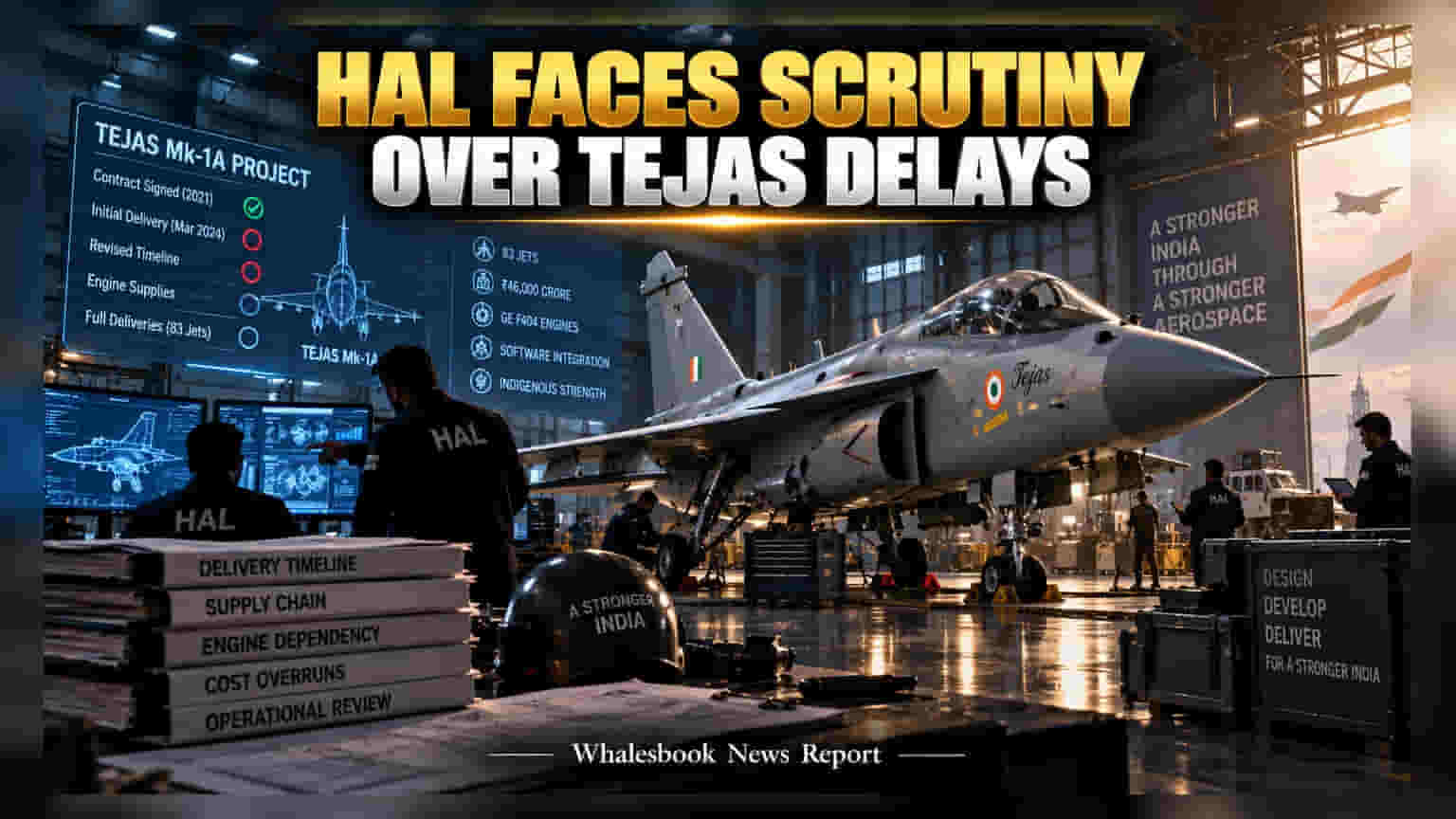
Defence Minister Rajnath Singh has publicly questioned Hindustan Aeronautics Limited over repeated delays in delivering Tejas LCA Mk-1A fighter jets. The ₹46,000 crore project is facing significant execution hurdles due to engine supply constraints, raising concerns among investors about the company's ability to meet critical output targets for the Indian Air Force.
Hindustan Aeronautics Limited (HAL) is under fresh government scrutiny following a public critique by Defence Minister Rajnath Singh regarding the delivery timeline for the Tejas Light Combat Aircraft (LCA) Mk-1A. During a recent event in Bengaluru, the Minister highlighted that the company has missed several delivery deadlines for this project, which was originally contracted in 2021.
The project involves the production of 83 jets with a contract value of approximately ₹46,000 crore. The initial delivery schedule was set for March 2024, a timeline that has since been missed. For shareholders and market observers, these delays represent more than just operational hurdles; they directly impact the company's ability to recognize revenue and maintain the pace of its order book execution. When production lags, it not only creates cost overruns but also prevents the company from demonstrating the high-speed output that is expected of a major aerospace manufacturer.
The primary bottleneck cited by the company and its partners is the supply of GE Aerospace F404 engines. While HAL has confirmed the receipt of ten engines and expects a further 12 by the end of this year, the persistent gap between the supply of these critical components and the final assembly of the aircraft has led to frustration within the Indian Air Force leadership. Beyond the supply chain issues, software integration challenges have further complicated the timeline for mission-ready jets.
For investors, the situation underscores the risk of execution in large-scale defense manufacturing. While HAL holds a substantial order book, its financial performance is highly sensitive to the successful and timely commissioning of these projects. Any prolonged delay not only risks potential penalties or loss of future order confidence but also stretches the company's working capital needs. The government’s recent demand for a shift toward a more output-driven model suggests that state-run manufacturers like HAL will face increased pressure to prove their efficiency, especially as the government pushes for indigenous defense innovation.
Moving forward, investors will be closely watching the actual delivery rate of the Tejas jets in the coming quarters. The key monitorable will be whether HAL can clear the backlog of engine integration and stabilize its production line to meet the revised targets. Any further slippage in delivery timelines, especially for high-value projects like the Tejas LCA, could keep the stock under pressure as the market weighs the company's growth potential against these operational risks.