

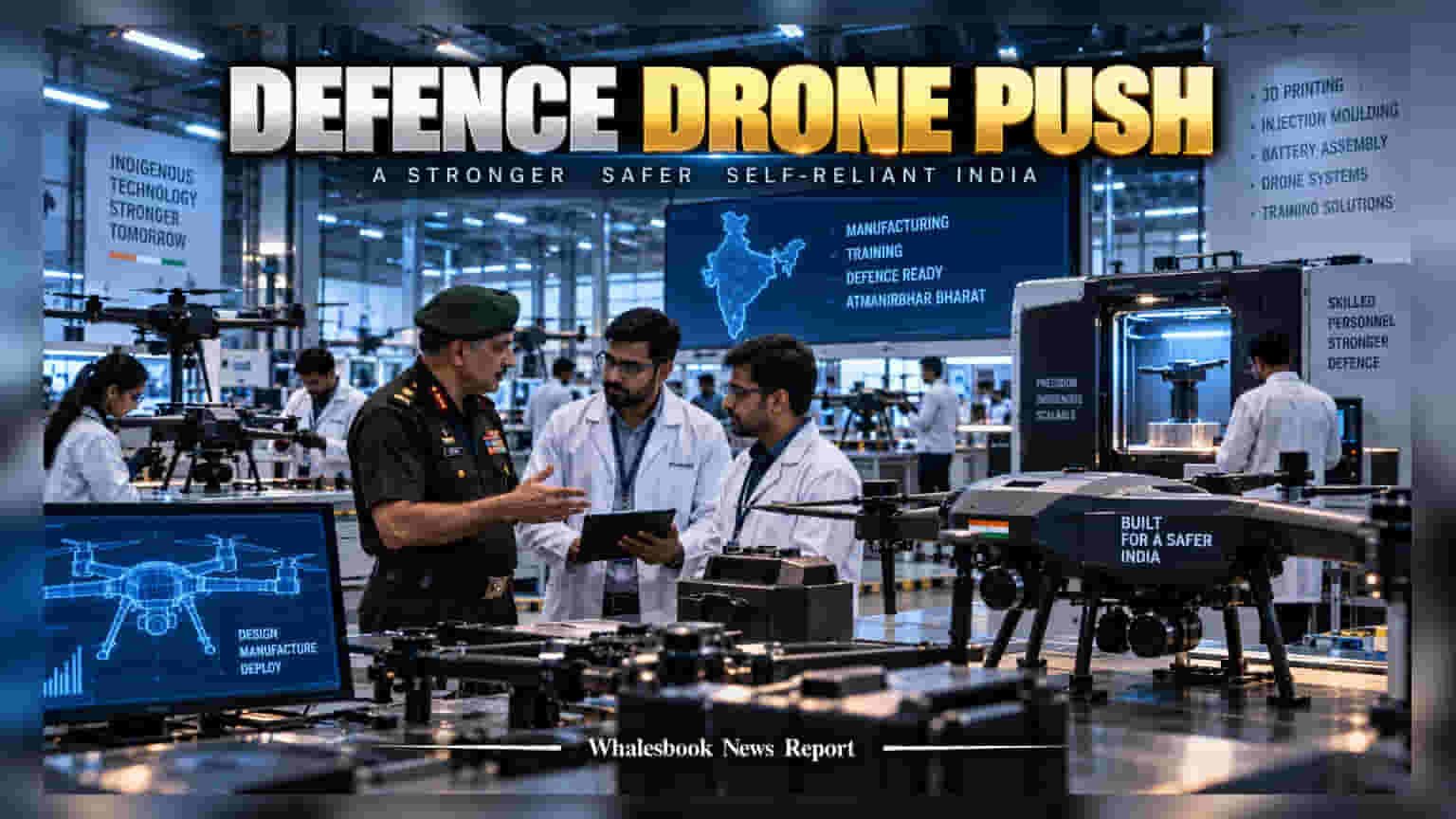
Garuda Aerospace, an IPO-bound drone manufacturer, hosted the Army Design Bureau to evaluate its indigenous production facility in Chennai. The company presented its defense project pipeline and a proposal to train 80,000 Agniveers. While the firm prepares for its stock market debut, potential investors should consider its heavy reliance on government contracts and current cash flow challenges.
Garuda Aerospace recently hosted Major General Gopal Kapoor, Additional Director General of the Army Design Bureau, at its manufacturing plant in Chennai. The visit was a formal audit of the company’s indigenous production capabilities, which include industrial-grade 3D printing, injection moulding, and battery assembly lines. This evaluation is part of a broader push to assess domestic drone technology providers for potential inclusion in future military procurement pipelines.
Beyond hardware manufacturing, Garuda Aerospace is seeking to expand its role in the defense ecosystem by offering specialized training. The company has formally proposed an initiative to the Chief of Defence Staff to train 80,000 Agniveers across the Tri-Services. If accepted, this could establish the firm as a key training partner for the Indian military, leveraging its network of Remote Pilot Training Organisations.
For investors monitoring the company, this visit is significant given Garuda Aerospace’s ongoing IPO preparations. The company, which is currently unlisted, received approval in August 2026 for its upcoming initial public offering after a confidential pre-filing route. While the firm has reported net profits, its financial health requires careful observation. Financial filings indicate that the company has struggled with negative operating cash flows in recent periods, partly due to a high volume of trade receivables. This suggests that while revenue may be booked, the actual cash conversion cycle is currently under pressure.
Another important aspect for potential investors is the company’s business model, which is heavily dependent on Business-to-Government (B2G) contracts. While the government’s focus on indigenization creates demand, this dependency means the company’s growth is closely tied to defense procurement policies, timelines, and budget allocations. Any shifts in government policy or delays in tender execution could impact the firm’s operational performance.
As Garuda Aerospace moves toward its public listing, the focus will remain on whether it can improve its cash collection and reduce its dependence on specific large-scale government orders. Investors should monitor updates regarding the proposed Agniveer training partnership, the actual launch timeline for the IPO, and the company's ability to maintain healthy margins while scaling its manufacturing capacity to meet defense standards.