

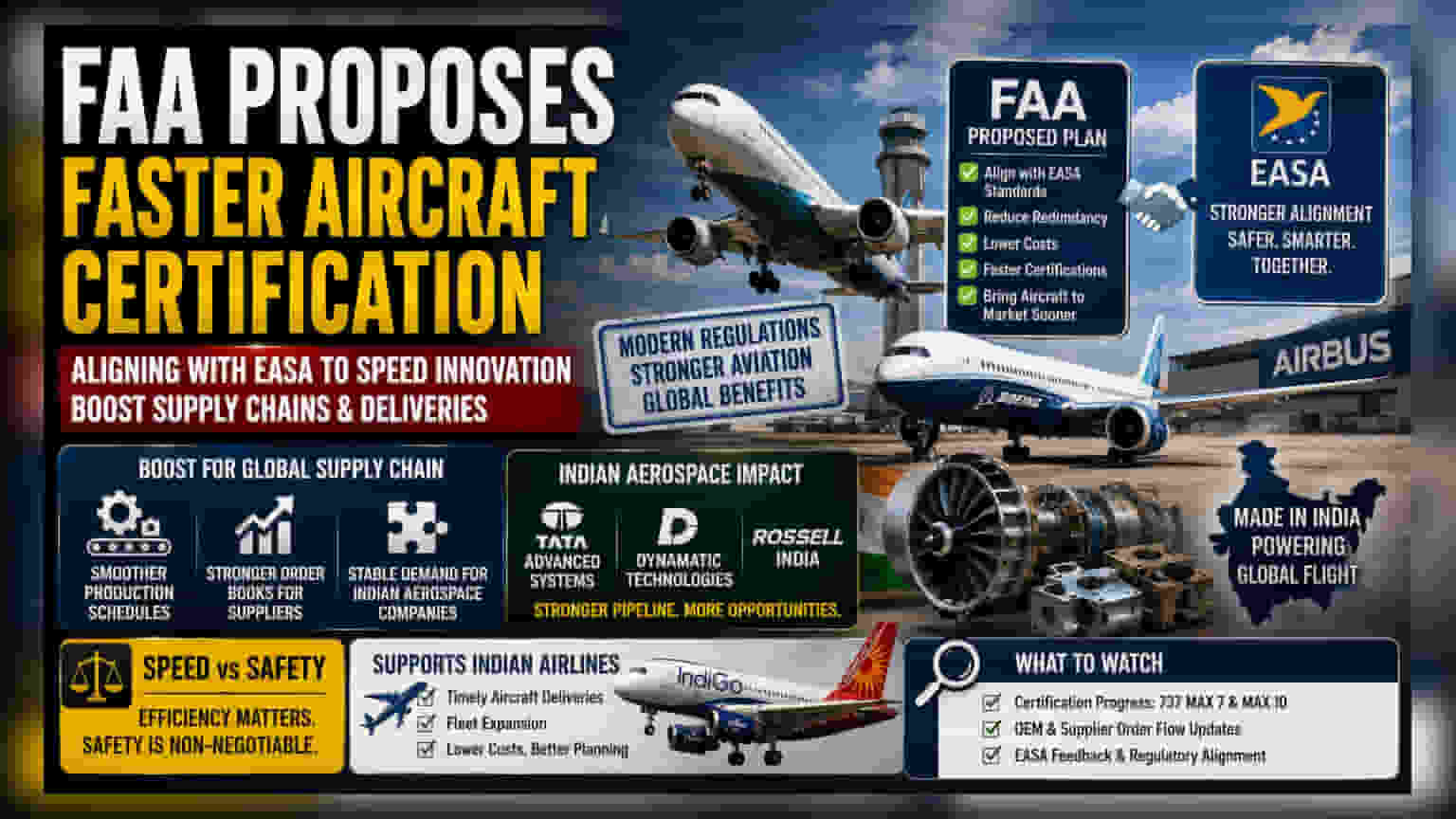
The Federal Aviation Administration (FAA) has proposed updating its aircraft certification process by aligning with the European Union Aviation Safety Agency (EASA). This initiative aims to reduce approval times and costs for new commercial planes. For Indian investors, the move could influence the global supply chain, potentially benefiting Indian aerospace suppliers that serve major manufacturers like Boeing and Airbus.
What Happened
The Federal Aviation Administration (FAA) has introduced a proposal to modernize how it certifies new commercial airplanes. The core of this initiative is to align U.S. airworthiness standards more closely with the European Union Aviation Safety Agency (EASA). By creating a more unified regulatory framework between the U.S. and Europe, the FAA aims to lower the administrative burden, reduce costs, and shorten the timeline for bringing new aircraft to market. This proposal follows a push from aviation leadership to embrace modern technologies and remove redundant safety checks that have historically slowed down aircraft approvals.
Impact on the Global Aviation Supply Chain
While Indian investors cannot directly buy shares of foreign original equipment manufacturers (OEMs) like Boeing or Airbus on domestic exchanges, this news is highly relevant for the Indian aerospace supply chain. Many Indian companies, including entities like Tata Advanced Systems, Dynamatic Technologies, and Rossell India, are integrated into the global supply chains of these major manufacturers.
If the certification process becomes faster and more efficient, it could lead to smoother production schedules for these global giants. Faster approvals generally mean more stable order books for suppliers. Consequently, any move that helps Boeing or Airbus deliver aircraft on time helps stabilize the demand for the specialized components manufactured in India.
The Trade-Off: Speed Versus Safety
For investors, it is important to balance the optimism regarding efficiency with the reality of aviation safety. The certification process for new aircraft is long precisely because it involves rigorous safety testing. The industry has a complicated history here, particularly with the Boeing 737 MAX series.
Following past incidents, the FAA faced intense scrutiny over its certification procedures. Any move to accelerate the process will likely be watched closely by regulators and the public to ensure that safety standards are not compromised in the pursuit of speed. If a new certification framework is perceived as rushed, it could lead to increased regulatory friction or even reputational damage, which can negatively impact the OEM’s business and, by extension, its global suppliers.
Indian Airline Context
This development is also meaningful for Indian airlines like IndiGo and Air India, which have massive order books for new aircraft. These airlines rely on timely deliveries to expand their capacity and manage their fleet. While a regulatory change in the U.S. does not guarantee immediate delivery, a more efficient certification system helps the broader industry reduce the backlog of aircraft waiting to enter service. When OEMs work faster, it helps airlines plan their growth and manage their fuel and maintenance costs more effectively.
What Investors Should Track Next
The key monitorable will be the actual implementation timeline of this alignment. Investors should watch for:
- Updates on the certification progress of existing models like the Boeing 737 MAX 7 and MAX 10, which act as a real-world test for these new processes.
- Management commentary from major aerospace suppliers regarding their order flow and production capacity.
- Any official feedback from the EASA on the compatibility of these new FAA standards, as full harmony between the two agencies is the ultimate goal for seamless operations.