 Whalesbook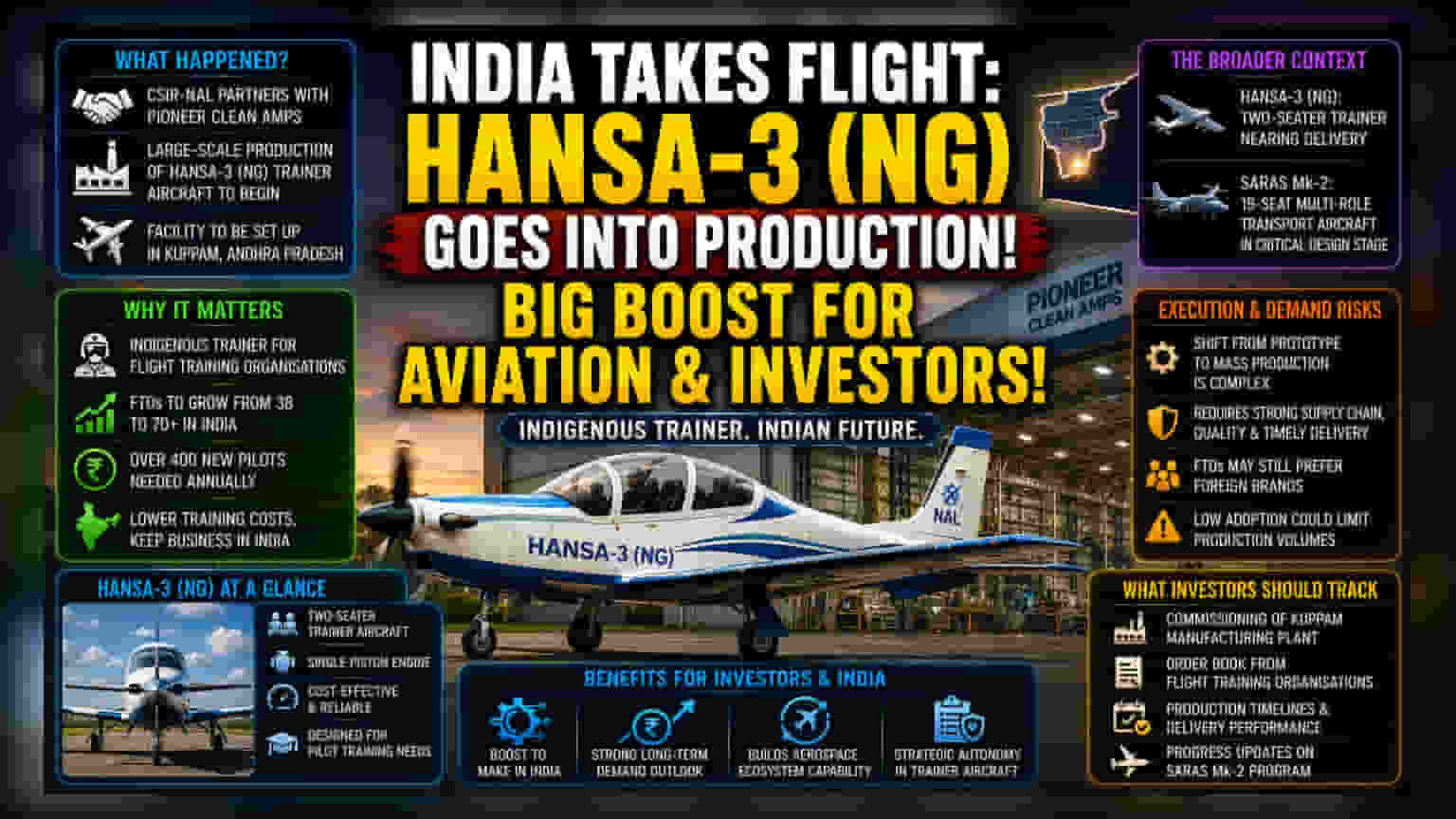


CSIR-NAL has selected Pioneer Clean Amps to manufacture the HANSA-3 (NG) trainer aircraft, shifting from prototype testing to mass production in Andhra Pradesh. This move addresses the rising demand for pilot training in India by reducing dependence on foreign schools. Investors may look at this as a step toward building a domestic aviation manufacturing ecosystem, though the success will depend on production scalability and actual orders from flight training schools.
What Happened
The Council of Scientific and Industrial Research-National Aerospace Laboratories (CSIR-NAL) has officially entered into a partnership with Pioneer Clean Amps to begin large-scale manufacturing of the HANSA-3 (NG) trainer aircraft. While CSIR-NAL has successfully developed the prototypes for this two-seater aircraft, it required a specialized partner to handle the industrial-scale production. The manufacturing facility for the aircraft is set to be established in Kuppam, Andhra Pradesh. This collaboration marks a transition for the government research body from design and prototype testing to commercial manufacturing, aiming to meet the domestic demand for pilot training.
The Move Toward Indigenous Manufacturing
For years, India has relied heavily on imported aircraft for pilot training. The HANSA-3 (NG) is specifically designed to provide an indigenous alternative for Flight Training Organisations (FTOs). The Ministry of Civil Aviation has been working to increase the number of FTOs in the country, aiming to expand from the current 38 to over 70. With over 400 new pilots requiring training annually, there is a clear demand gap that this initiative aims to fill. By producing these aircraft locally, the goal is to lower the cost of pilot training and keep that business within the Indian aviation ecosystem.
The Broader Aerospace Context
While the HANSA-3 is moving toward production, CSIR-NAL continues to work on other projects, including the 19-seat SARAS Mk-2 multi-role transport aircraft. The SARAS Mk-2 is currently in its critical design phase, with updates to its configuration being finalized. This distinction is important for investors: while the HANSA-3 is nearing the delivery stage, the SARAS Mk-2 remains in the development phase, highlighting that the organization is balancing multiple stages of aerospace technology simultaneously.
Execution and Demand Risks
The shift from a laboratory-based prototype to factory-based mass production involves significant execution challenges. Bringing a product to market requires not just the design, but a stable supply chain, strict quality control, and the ability to maintain production timelines. Investors should be aware that aerospace manufacturing is capital-intensive and requires high precision.
Another point to monitor is the actual demand. While the government aims to increase the number of FTOs, the ultimate success of the HANSA-3 depends on whether these private and public training schools choose to buy this indigenous model over established foreign competitors. If the aircraft proves reliable and cost-effective, it could see strong adoption, but if the training schools prefer legacy foreign brands, the production volume could be lower than planned.
What Investors Should Track
The most important factors to watch in the coming months are the commissioning of the new manufacturing plant in Kuppam and the actual order book from FTOs. A successful launch will depend on the production timeline and the ability of the partners to deliver aircraft that meet the operational requirements of pilot training schools. Investors may also look for updates on the SARAS Mk-2, as progress there could indicate the organization's overall capability to manage multiple aviation projects simultaneously.