 Whalesbook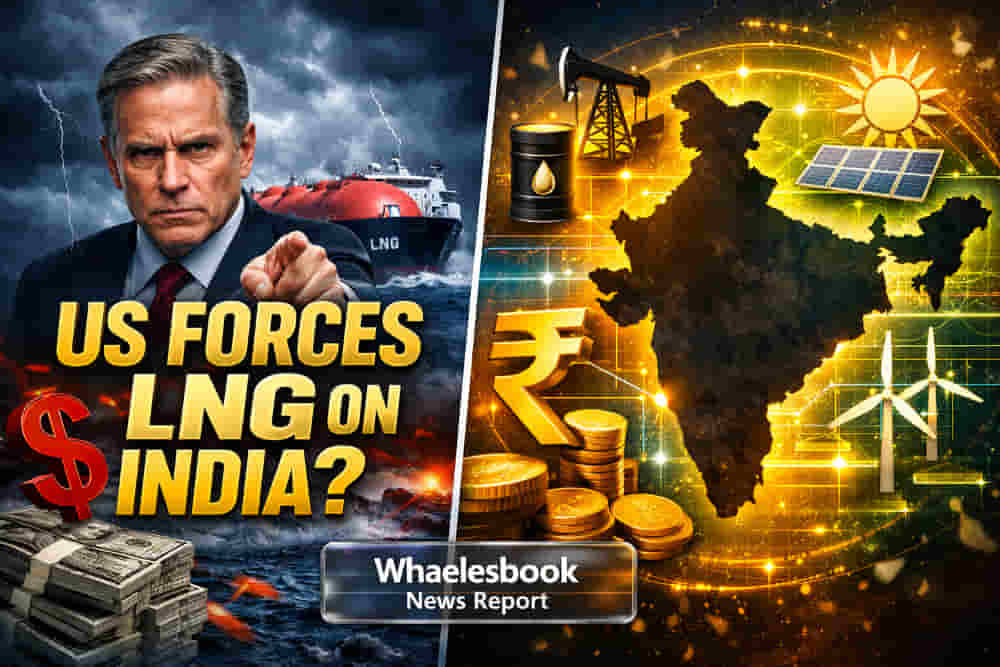
THE SEAMLESS LINK
This strategic tension highlights a critical juncture in global energy markets, where geopolitical objectives directly intersect with economic realities for importing nations. While Russia leverages discounted crude, the U.S. aims to expand its LNG market share, creating a complex environment for countries like India striving for energy security.
The Core Catalyst
Russian Foreign Minister Sergei Lavrov publicly decried U.S. foreign policy, alleging deliberate efforts to monopolize energy markets through sanctions and trade restrictions. Lavrov asserted that Washington is actively obstructing India and other partners from accessing cost-effective Russian energy resources, contrasting this with Europe's already established restrictions. He framed these actions as a strategic pursuit of U.S. economic dominance, incompatible with fair competition. This diplomatic broadside coincides with current market conditions where Brent crude futures are trading near $68.86 per barrel and WTI futures are hovering around $64.19, reflecting ongoing global supply uncertainties and the impact of geopolitical tensions. The U.S. has implemented sanctions targeting major Russian oil entities, aiming to cut revenue streams crucial for Moscow's economy.
The Analytical Deep Dive
Lavrov's accusations point to a broader U.S. strategy to leverage its growing LNG export capacity as a foreign policy tool, positioning itself as a key energy supplier and reducing global reliance on producers like Russia. U.S. LNG exports are projected to double by 2029, with capacity expansions targeting global markets, particularly in Europe where U.S. LNG has become a dominant source, increasing its share to over 57% by early 2026. This contrasts sharply with the economics of Russian pipeline gas, which remains significantly cheaper than U.S. LNG. Estimates for 2025 suggest Russian pipeline gas could cost $6–8/MMBTU, while U.S. LNG imports to Europe are priced between $10–15/MMBTU.
India, a nation importing over 85% of its crude oil, views energy security—defined by affordability, reliability, and diversification—as paramount. Following Western sanctions on Russia in 2022, India significantly increased its intake of discounted Russian crude, making Russia its largest supplier, peaking at over 2 million barrels per day in mid-2025. Indian officials have reiterated that procurement decisions are guided by national interest and market conditions, not external political pressure. While Russia accounted for approximately 38% of India's crude oil imports in August 2025, India's strategy involves gradual diversification rather than an outright cessation of Russian supplies. Analysts generally view India's stance as consistent with its long-standing policy of strategic autonomy in foreign affairs. The U.S. sanctions on Russian oil giants, while impacting global markets, have seen China and India emerge as principal destinations for discounted Russian crude.
The Forensic Bear Case
The geopolitical friction poses considerable risks. For India, an over-reliance on discounted Russian crude, even with diversification efforts, leaves it vulnerable to secondary U.S. sanctions and price volatility. While U.S. LNG offers a growing alternative, its higher cost could exacerbate inflationary pressures for India's developing economy. Russia, despite its strategic pivot to Asian markets, faces the challenge of sustaining its export revenues amidst sanctions and the potential for price caps to reduce its revenue per barrel, even with increased volumes via a 'shadow fleet'. The U.S. strategy, while strengthening its own energy export market and geopolitical influence, risks alienating key allies if high LNG prices strain their economies or if diplomatic pressure becomes overly burdensome. The competitive landscape sees Russia's pipeline gas offering a significant cost advantage where available, but its geopolitical limitations are pushing buyers toward the more expensive but accessible U.S. LNG, thereby creating a market for U.S. energy dominance at a higher cost for many consumers.
The Future Outlook
Analysts anticipate continued volatility in global energy markets, driven by geopolitical tensions, the effectiveness of sanctions enforcement, and the competing price points of Russian pipeline gas versus U.S. LNG. India's energy security will remain a primary driver of its procurement policies, suggesting a continued, albeit potentially reduced, intake of Russian crude alongside efforts to broaden supplier bases. The U.S. is expected to continue advocating for its LNG exports as a means to bolster global energy security and advance foreign policy objectives, while managing the impact of high export volumes on domestic energy costs and international market stability. The trajectory of Russian oil exports to Asia, particularly India, will be closely monitored as a key indicator of market resilience against Western sanctions.