 Whalesbook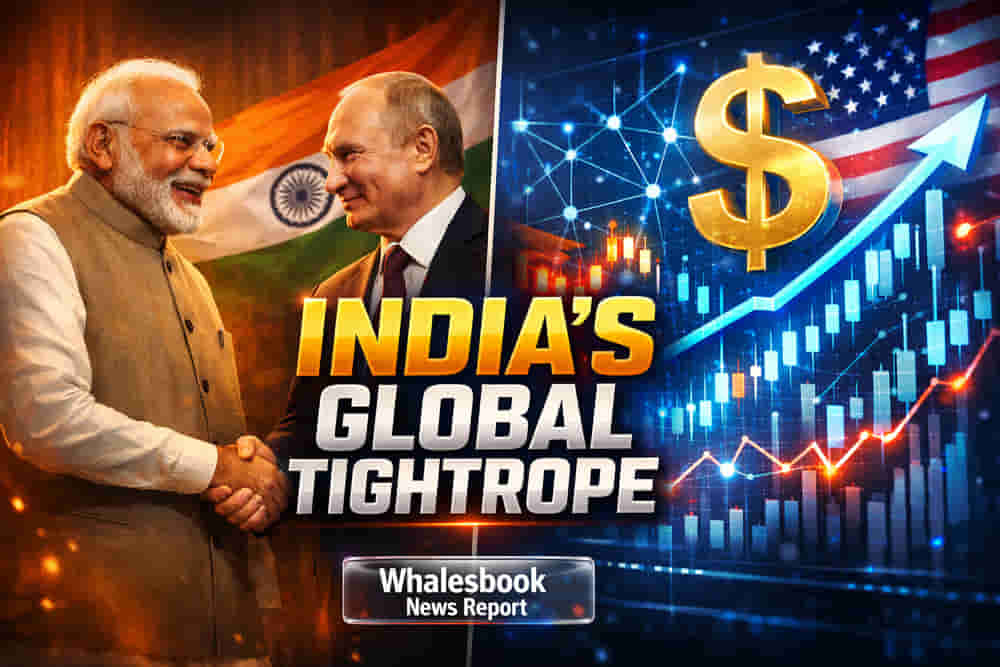
India-Russia Summit: A Strategic Balancing Act
Prime Minister Narendra Modi's personal welcome for Russian President Vladimir Putin in Delhi aimed to project a strong, time-tested partnership. While the summit was a diplomatic success for Moscow, showcasing Russia's continued alliances in Asia, its tangible outcomes for India were described as modest rather than transformational.
Modest Outcomes and Rebranded Defence Ties
The India-Russia Annual Summit resulted in a revised trade target of $100 billion by 2030 and an economic roadmap dubbed 'Programme 2030'. Pledges were made for long-term crude oil supplies and co-production of spares for Russian-origin defence platforms. Mobility and migration agreements, alongside discussions on tourism and Arctic cooperation, were also part of the agenda. Notably, no major new defence contracts were announced, with the narrative shifting towards 'co-development' largely focused on maintaining existing military hardware.
India's Core Strategic Challenges
The visit occurred against a backdrop of significant foreign policy constraints for India. These include an openly adversarial China with a militarised border, an economy grappling with job creation and manufacturing depth despite headline growth, and a global landscape where access to capital, high technology, and critical supply chains is increasingly dictated by the United States and its allies.
The partnership with Russia, under heavy sanctions post-Ukraine, offers limited solutions. Russia's structural dependence on China means it cannot meaningfully support India in a conflict with Beijing. Economically, a sanctions-hit Russia with a shrinking economy is not a credible partner for India's much-needed growth transformation. While discounted energy is a tactical advantage, it is not a development strategy.
Technology Gap and US Relations
Experts highlight a stark gap in technology, with India requiring advanced semiconductors and AI capabilities from Western and East Asian ecosystems that are simultaneously working to constrain Russia. Investing political capital in Russia's legacy technological base is seen as 'strategic neglect' when global technology networks are consolidating elsewhere.
The summit also carried implications for India's relationship with the United States. The strong optics of the Modi-Putin meeting served as a signal to Washington that India will not be dictated to, particularly regarding energy imports. However, this could subtly erode Western willingness to provide India with specific carve-outs, technology waivers, and sensitive co-development projects.
Impact Rating
Impact Rating: 6/10
This summit's impact on the Indian stock market is indirect, influencing investor sentiment and long-term strategic positioning. While not triggering immediate stock price movements, it highlights India's complex geopolitical balancing act, which could affect future access to technology and capital, crucial for economic growth and market development. Investors should monitor how these strategic alignments impact sectors reliant on advanced technology and global supply chains.
Difficult Terms Explained
- Diplomatic protocol: The customary code of polite behaviour in international relations.
- Pariah: An outcast nation or person shunned by others.
- Co-production: Joint manufacturing or production of goods.
- Platforms (defence): Military systems, such as aircraft, ships, or vehicles.
- Grand strategy: A nation's overall plan for achieving its long-term goals.
- Adversarial: Involving conflict or opposition.
- Sanctions: Penalties imposed by one country on another, typically for political reasons.
- Supply chains: The network of organisations, people, activities, information, and resources involved in moving a product or service from supplier to customer.
- Arbitrage: The simultaneous purchase and sale of an asset in different markets to profit from the price difference.
- Integration into global value chains: Becoming part of the international process of producing goods and services.
- Frontier capabilities: Advanced technologies at the cutting edge of development.
- Ecosystems (tech): Networks of companies, suppliers, and customers involved in a particular technology field.
- Strategic autonomy: A nation's ability to pursue its own interests independently.
- Strategic neglect: Ignoring or overlooking important strategic opportunities or areas.
- Spectacle: A visually striking performance or display.
- Carve-outs: Exemptions from rules or regulations.
- Technology waivers: Permissions to use or develop technology that might otherwise be restricted.
- Prudential limits: Cautious restrictions based on risk assessment.
- Leveraging contradictions: Using differences or conflicts between other parties to one's advantage.
- Tactical hedge: A protective measure taken for a specific, short-term situation.
- Strategic blind spot: An area where a nation's strategy is unaware of or neglects crucial factors.
- Deterrent weight: The capacity to discourage an opponent from taking action through the threat of retaliation.
- Leverage: The exertion of force or influence.
- Line of Actual Control: The de facto border between India and China.
- Optics vs Outcomes: Focusing on appearance and perception (optics) rather than actual results (outcomes).