 Whalesbook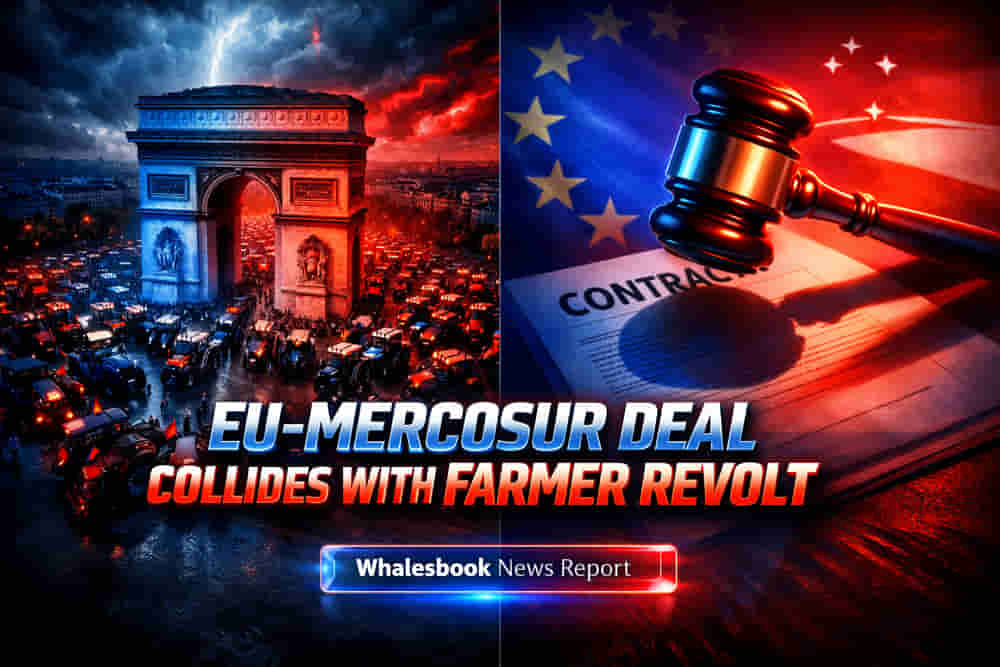
Geopolitical Ambition Meets Agricultural Reality
The recently signed EU-Mercosur trade agreement, intended to forge one of the world's largest free trade zones, is already confronting significant opposition. While proponents highlight its role in diversifying supply chains for critical raw materials essential for the EU's green and digital transitions, domestic agricultural interests are voicing strong objections. Farmers across Europe, particularly in France, are protesting perceived unfair competition from South American agricultural products, fearing a devaluation of their own produce and a threat to their livelihoods. This discontent has translated into widespread demonstrations, blocking key infrastructure and demanding policy reconsiderations.
The European Parliament's swift decision on January 21 to refer the agreement to the European Court of Justice (ECJ) for a judicial review has injected considerable uncertainty. This move, driven by concerns over potential violations of EU law and environmental standards, could push implementation back by up to two years, effectively freezing the legislative process while the court deliberates. The EU currently relies heavily on China for crucial minerals such as rare earth elements, with imports meeting up to 98% of demand, making diversification a strategic imperative. However, this long-term geopolitical and economic strategy is now directly colliding with the immediate, politically charged concerns of the European agricultural sector.
Safeguards vs. Sovereignty Concerns
The EU-Mercosur pact aims to eliminate tariffs on over 90% of goods traded between the blocs, with projections indicating substantial boosts to EU exports by 2040. A key aspect of the agreement includes "sensitive commodities" like beef and poultry, which are subject to limited tariff-free quotas. For beef, this quota allows an additional 99,000 tonnes annually, representing approximately 1.5% of total EU production, with safeguards designed to limit imports if they surge sharply or prices drop significantly (triggering at an 8% change compared to a three-year average). While these provisions are intended to protect EU farmers, many find them insufficient. Historically, farmer protests have been a recurring challenge for the EU, often forcing policy concessions and signaling political vulnerabilities. The current situation echoes past trade deal controversies where agricultural interests have pitted themselves against broader economic and geopolitical objectives.
The Strategic Imperative and Political Friction
The EU's push for this agreement is partly driven by a desire to reduce dependence on China for critical raw materials like lithium and rare earth elements, vital for renewable energy technologies and electric vehicle batteries. Mercosur countries, particularly Brazil and Argentina, are rich in these resources, offering a strategic alternative to current supply chains concentrated in Asia. However, the backlash from European farmers highlights a fundamental dilemma: the EU's global strategic ambitions are being tempered by domestic political pressures. The agricultural sector, while contributing a modest 1.2% to EU GDP, wields significant political influence, as evidenced by the scale of recent protests. Some analyses suggest that the overall impact on EU farm income could be a decline of 1.6%, with specific regions heavily reliant on meat production facing greater challenges.
Outlook: Uncertainty Prevails
The immediate future of the EU-Mercosur deal hinges on the ECJ's ruling and the subsequent ratification process by all member states and Mercosur parliaments. While provisional application is a theoretical possibility, it carries substantial political risk given the widespread opposition. The current scenario illustrates the inherent tension within the EU between pursuing expansive trade policies to secure long-term strategic interests and managing the immediate, often localized, economic and political consequences for its member states' key industries. The prolonged debate underscores that agricultural interests remain a formidable force in shaping the EU's external trade agenda.