 Whalesbook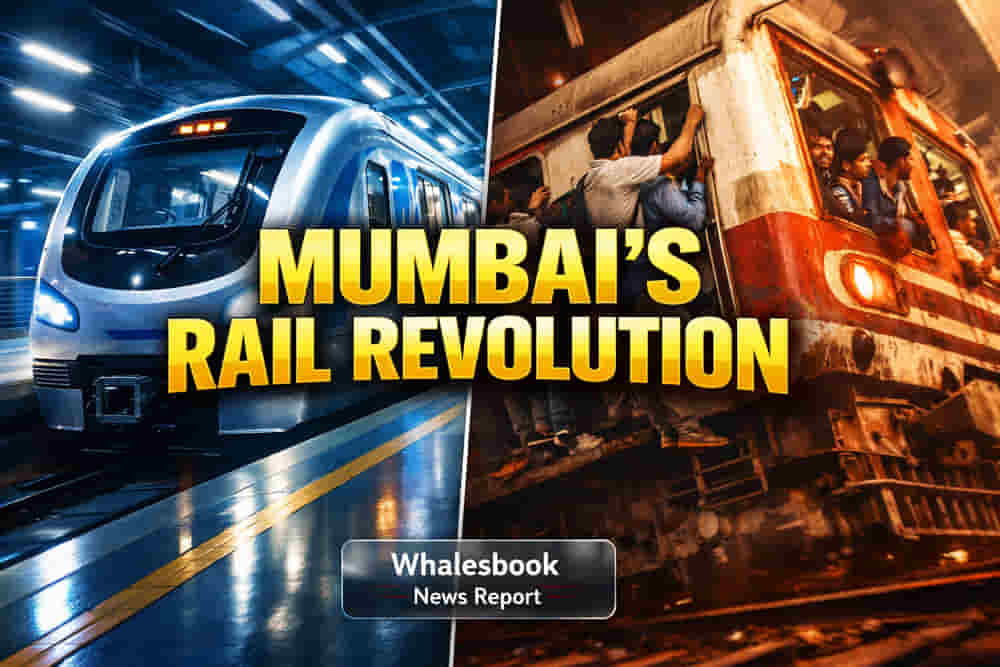
1. THE SEAMLESS LINK (Flow Rule):
This enhanced capacity and integrated approach aim to address the chronic issues plaguing Mumbai's vital suburban rail network. The daily movement of 70 to 80 lakh commuters strains existing infrastructure, leading to safety concerns and operational challenges. Gupta's statements provide insight into the strategic vision for reconciling the growth of the Metro with the enduring importance of the suburban system, positioning them as collaborators in a larger urban mobility framework.
2. THE STRUCTURE (The 'Smart Investor' Analysis):
Rail-Metro Integration Vision
Vivek Kumar Gupta, a senior official within the Indian Railway Board, has articulated a clear vision for Mumbai's public transportation. He emphasized that the expanding Metro network is not a rival to the established suburban railway but rather a crucial partner. Historically, the suburban rail replaced less capable tram systems, evolving into Mumbai's primary artery. The Metro's role is seen as filling critical east-west travel corridors, complementing the north-south reach of the suburban lines. Discussions with the Mumbai Metropolitan Region Development Authority (MMRDA) are in motion to ensure seamless intermodal transfers at integrated stations, a move designed to streamline passenger journeys. This synergy is expected to create a more efficient, city-wide mobility solution.
Capacity and Safety Overhaul
The Mumbai Suburban Railway, a critical artery serving an estimated 70-80 lakh passengers daily, faces persistent challenges related to overcrowding and safety. To mitigate these issues, extensive capacity augmentation is underway. A key strategy involves extending existing 12-car train sets to 15-car configurations, a change that can increase carrying capacity by approximately 30% per train. Western Railway aims to significantly increase its 15-car services, with operational plans suggesting over 200 such services. Central Railway is also undertaking substantial conversions, adding capacity with the expansion of its 12-car rakes to 15-car formations, a process involving significant workshop reconfigurations. Furthermore, two non-AC closed-door rakes are slated for a pilot introduction by April 2026, alongside ongoing plans for air-conditioned (AC) train services, with tenders for 238 AC rakes already floated. Safety improvements include identifying accident-prone locations, reinforcing boundary walls, constructing more foot overbridges (FOBs), and implementing continuous public awareness campaigns against track trespassing. Despite these efforts, fatalities on the suburban network, while declining slightly in 2025 to 2,287, still average around six per day, highlighting ongoing safety concerns.
Freight and Logistics Outlook
Gupta also touched upon the Railways' role in freight movement, viewing road transport as complementary rather than competitive. Indian Railways aims to substantially increase container traffic from western ports, targeting a doubling to 200 million tonnes in five years. The development of railway-based logistics parks connected to ports is a strategic initiative to enhance efficiency and reduce logistics costs nationwide [cite: Source A]. The national logistics sector is projected for continued growth, driven by government initiatives and increasing demand.
3. THE STYLE (Formatting & Safety):
This report is compiled based on statements made by Vivek Kumar Gupta, Member (Infrastructure), Railway Board. Information regarding capacity increases, safety measures, and integration plans has been incorporated. Financial data like P/E ratios and market capitalization are not directly applicable to government railway entities. However, the operational scale and investment plans reflect significant economic activity. Indian Railways is projected to receive substantial capital expenditure support, with figures anticipated to rise for FY27, building on the significant allocations for FY25-26. For instance, Maharashtra's railways received a record allocation of ₹23,778 crore for FY25-26, with ₹16,400 crore earmarked for Mumbai's rail system. Recent developments include the continued expansion of Mumbai Metro lines, with Metro 3 expected to be fully operational by the end of 2025, and significant ridership milestones being achieved across operational lines.