 Whalesbook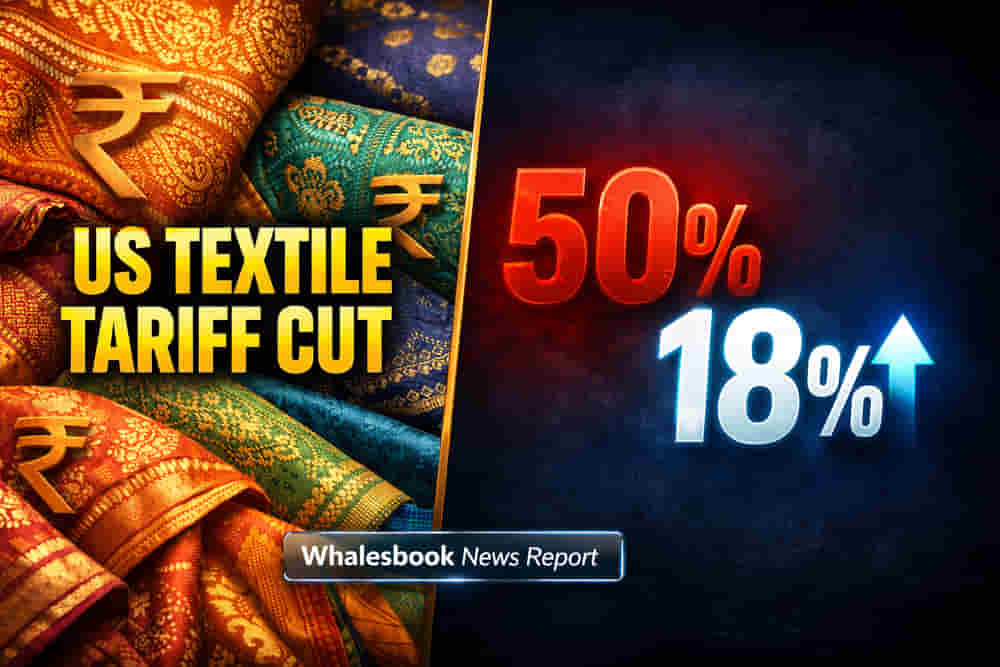
US Tariff Reduction Fuels Textile Sector Gains
Indian textile companies witnessed a substantial uplift in their stock values, with several counters surging up to 44% over two trading sessions. This market movement was directly catalyzed by the United States' decision to significantly lower import tariffs on Indian textile products from 50% to 18% [2, 10, 21]. The development is poised to reshape India's competitive standing in the global textile market, providing a crucial advantage over Asian counterparts facing higher levies [6, 10].
The Catalyst: Tariff Arbitrage and Market Share Expansion
The immediate impact of the US tariff reduction has been a surge in investor confidence and stock prices for key players in the Indian textile sector. Companies like Gokaldas Exports and Indo Count Industries, which have a substantial revenue exposure to the US market, saw their shares trade sharply higher [8, 10, 21]. Gokaldas Exports, for instance, experienced its stock price climb by 44% from ₹580.10 on January 2, 2026, reaching ₹835.30, while Indo Count Industries also saw a significant uptick [1, 21]. This competitive edge, with India's 18% tariff rate now being lower than that of China (around 30%), Bangladesh (20%), and Vietnam (20%), is expected to help India capture a larger share of the US textile import market, estimated at approximately $102 billion [1, 6]. Analysts believe this tariff reset, coupled with existing trade agreements with the UK and EU, creates a multi-year advantage for boosting earnings and cash flows [2, 3].
Analytical Deep Dive: Beyond Tariffs to Sustainable Growth
While the tariff reduction provides immediate relief and a competitive boost, a deeper analysis reveals that sustained long-term growth will depend on factors beyond tariff arbitrage. The Indian textile industry, valued at an estimated $194 billion domestically for 2025-26, relies heavily on exports, which stood at $37 billion in the same period [30]. The US market alone accounts for a significant portion of these exports [18]. However, the previous imposition of substantial tariffs, reportedly reaching up to 50% due to reciprocal and punitive duties, had pressured margins and driven buyers to alternative markets [10, 18, 25].
Competitive Benchmarking: India's new 18% tariff places it favorably against countries like Vietnam and Bangladesh, which previously faced 20% tariffs [10, 21]. This improved position could help regain market share lost during the period of higher tariffs. For example, Vietnam's textile and clothing sector faced additional tariffs, increasing their average rate to 15% by April 2025, with potential for higher rates [33, 41]. As of February 2026, the BSE Sensex has seen a marginal shift, trading near 83,679, while specific textile stocks have shown pronounced individual rallies [1].
Historical Context & Macro Trends: Looking back to January 2025, the textile sector faced headwinds, including potential tariff impacts and trade deal negotiations [5, 20]. The current rally echoes sentiments seen in earlier periods of trade policy shifts, but the current context includes stronger FTA progress with the EU and UK, alongside the US deal [9, 17]. Globally, the textile market is substantial, with India's technical textiles segment projected to reach $23.3 billion by 2027 [31]. However, slowing global demand and trade frictions were noted economic challenges in early 2026 [20].
Valuation and Analyst Sentiment: Despite the positive outlook, valuations are a key consideration. As of January 2026, Indo Count Industries had a P/E ratio of 26.80, while Gokaldas Exports' P/E was around 29.2 [4, 7]. Comparatively, the broader industry P/E for textiles is noted around 31.70 [15]. Analysts from ICICI Securities maintain 'BUY' ratings on Gokaldas Exports (₹929 target) and Indo Count Industries (₹370 target) [1]. Other brokerages indicate potential upside for Indo Count Industries (37%) and Gokaldas Exports (34%), though KPR Mills is considered the most valued stock in the pack with a P/E of 31.9x [8]. Despite recent gains, some analyses highlight that certain companies, like Gokaldas Exports, have seen profit drops due to margin pressures, underscoring the need for operational efficiency beyond tariff benefits [11, 19].
Future Outlook: Sustained Growth Hinges on Execution
The tariff reduction by the US is a significant tailwind, expected to restore competitiveness and revive order volumes for Indian textile and apparel exporters. Companies with strong US exposure, efficient operations, and a focus on value-added products are best positioned to benefit [21]. Prabhu Dhamodharan, convenor of the Indian Texpreneurs Federation, anticipates double-digit month-on-month growth in apparel and home textile exports from FY27, potentially lifting the monthly run rate to $1.5-$1.6 billion [25]. However, the full benefits may take several months to materialize as buyers renegotiate contracts [10, 12]. The sector's long-term trajectory will also be influenced by the government's strategic push through initiatives like Mega Textile Parks and support for man-made fibers, as outlined in Budget 2026 [19]. Investors will need to monitor execution timelines, capacity expansion plans, and product mix shifts towards higher-value segments to gauge the sustainability of current gains.