 Whalesbook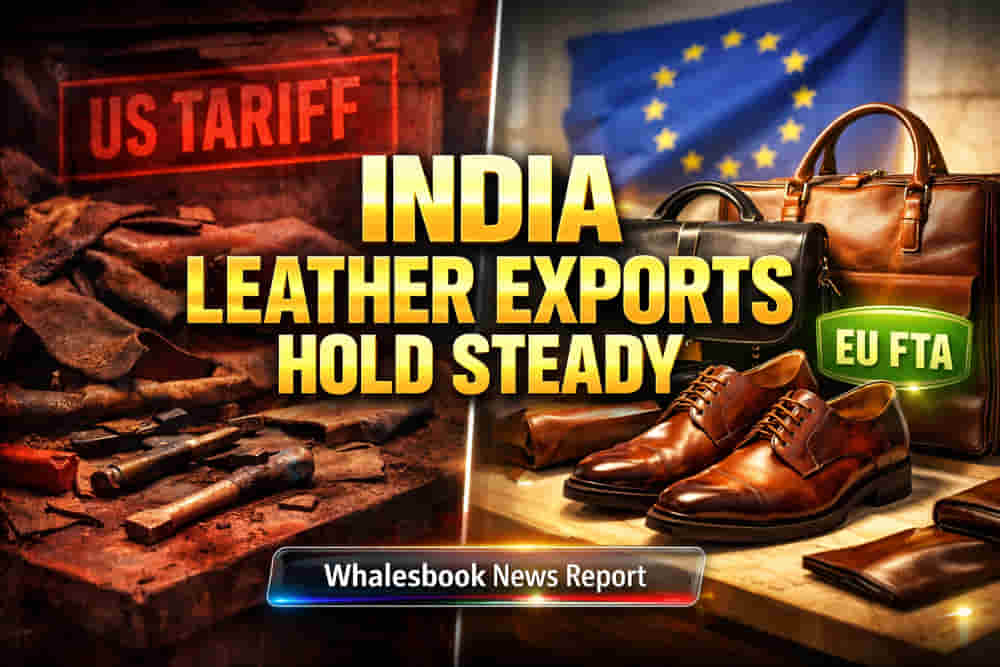
1. THE SEAMLESS LINK
This steady export outlook underscores a sector actively navigating global trade complexities, leveraging strategic agreements like the India-EU FTA to offset challenges posed by external market access disruptions. The industry's ability to absorb shocks, such as the U.S. tariffs, highlights its underlying strength and adaptive capacity.
EU Trade Deal: A Catalyst for Growth
The recent Free Trade Agreement (FTA) with the European Union is positioned as a significant enabler for India's leather and footwear sector. The EU represents the largest single market for Indian leather goods, contributing approximately 43% of the total export revenue. Under the terms of this agreement, substantial tariff reductions, including zero import duties on many leather and footwear products, are expected to enhance the competitiveness of Indian manufacturers. This development is crucial for achieving the ambitious export target of $14 billion by 2030, as stated by R Selvam, Executive Director of the Council for Leather Exports (CLE).
Resilience Against US Tariffs and Market Diversification
The Indian leather industry has recently faced considerable headwinds, notably from U.S. tariffs implemented in August 2023. These measures imposed significant pressure, yet the sector demonstrated remarkable resilience, maintaining a growth rate of 1% year-on-year through November. This stability was partly attributed to proactive government support that facilitated market diversification. Efforts focused on redirecting exports towards alternative destinations, including the United Kingdom, Russia, other European nations, and markets in the Far East, mitigating the direct impact of the U.S. trade actions.
Policy Imperatives for Ecosystem Development
To further bolster the industry's growth trajectory and manufacturing capabilities, CLE has urged the central government to implement the Focus Product Scheme. This initiative, if applied across the entire footwear and leather sector—encompassing all finished goods, critical inputs, and raw materials—is intended to foster a robust domestic production ecosystem. Such policy support is deemed essential for attracting both national and international investments, paving the way for CLE's goal of a $50 billion total turnover by 2030. This ambitious target comprises $36 billion in domestic sales and $14 billion in exports, a substantial increase from the $24.6 billion turnover recorded in 2024-25, which included $19 billion domestic and $5.6 billion in exports.
Regional Investment and Fair Outlook
Tamil Nadu, a key manufacturing hub for the leather industry, has seen substantial commitments, with approximately ₹12,000 crore in investments pledged for new units and expansions. These investments are projected to create employment for around 1.35 lakh individuals, underscoring the sector's regional economic significance. The upcoming India International Leather Fair in Chennai, scheduled from February 1 to 3, 2026, is expected to host over 425 domestic and 67 international exhibitors. The event serves as a vital platform for showcasing industry capabilities and exploring new business collaborations, potentially driving further investment and market access.