 Whalesbook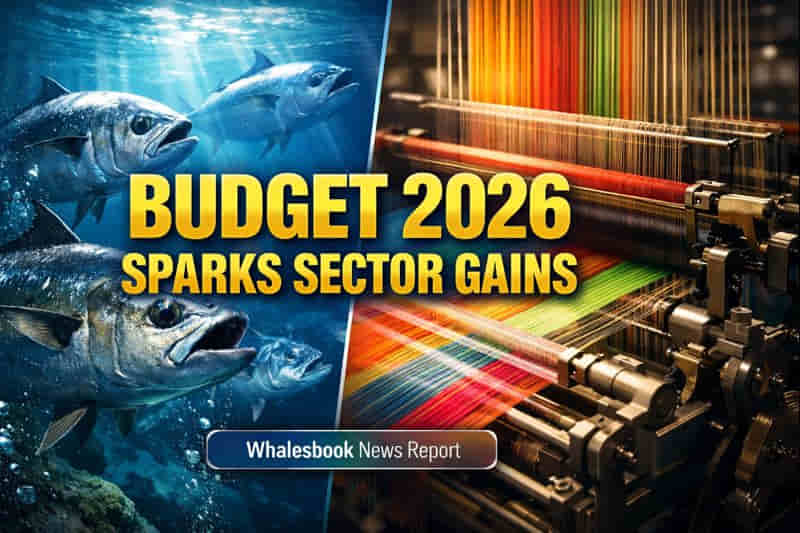
1. THE SEAMLESS LINK
The immediate market response to Union Budget 2026's sectoral initiatives highlights investor confidence in targeted government interventions. For the fisheries sector, Finance Minister Nirmala Sitharaman's plan to integrate development across 500 reservoirs and Amrut Sarovars, coupled with improved market linkages, directly influenced aquaculture and fisheries company valuations. This strategic push aims to expand production capacity and foster stronger connections from farm to consumer. Concurrently, the allocation of resources towards creating integrated textile manufacturing hubs, with a particular emphasis on technical textiles, signals a long-term commitment to modernizing the apparel and fabric industry. This policy direction is designed to enhance employment, sustainability, and global competitiveness.
2. THE STRUCTURE (The 'Smart Investor' Analysis)
Fisheries Sector Momentum
Equities in the fisheries and aquaculture segment registered immediate gains following the budget presentation. Apex Frozen Foods saw its stock climb by 5.83% to ₹308.55, while Avanti Feeds advanced 4.75% to ₹834.50. Coastal Corporation also reported a notable rise of 4.83%, reaching ₹46.49 and a new intraday high. These movements indicate that the market perceived the budget's focus on the fisheries value chain, including integrated development of water bodies and initiatives involving start-ups and women-led groups, as a catalyst for growth and improved operational efficiencies. The plan's emphasis on market linkages suggests a potential uplift in demand and distribution channels for these companies. While specific P/E ratios and market capitalizations vary, the sector's performance indicates a positive outlook from policy makers.
Textile Industry Policy Push
The announcement of a comprehensive, five-part program for the textile sector has injected renewed investor interest. Proposals include a National Fibre Scheme to boost self-reliance in natural and man-made fibers, alongside a Textile Expansion and Employment Scheme designed to modernize traditional clusters. This latter initiative, offering capital support for machinery and technology upgrades, directly addresses the need for smaller units to scale quality and production. Companies such as KPR Mill saw a 3.5% increase, and Vardhman Textiles gained 2.2%. Other players like Welspun Living, Page Industries, and Arvind also experienced gains ranging from 1% to 3%. The focus on mega textile parks and technical textiles positions the sector for enhanced global competitiveness and employment generation, a critical aspect for an economy prioritizing growth. Page Industries, a premium innerwear manufacturer, typically trades at a higher P/E multiple reflecting its market position, while Arvind, with its diversified textile operations, offers a different valuation profile. These policy measures are intended to support both segments.
Valuation and Outlook
Across both sectors, the budget's emphasis on value chain enhancement and manufacturing modernization suggests a deliberate effort to unlock latent potential. For fisheries, the integrated approach to reservoirs and market linkages could improve yield and reduce post-harvest losses. In textiles, the focus on technical textiles and cluster modernization aims to move India up the global value chain, potentially attracting further investment and boosting export capabilities. Historical reactions to similar budget allocations for these labor-intensive sectors have shown varied but generally positive short-term impacts, with longer-term performance contingent on effective policy implementation and market dynamics.
3. THE FUTURE OUTLOOK
Investor sentiment appears cautiously optimistic, contingent on the effective rollout of these ambitious budgetary plans. The success of these initiatives will hinge on execution, particularly in coordinating public and private sector efforts, and the capacity of the target beneficiaries – including fish farmer producer organizations and smaller textile units – to leverage the provided support. Analysts suggest that sustained focus on these sectors could translate into improved earnings visibility for companies positioned to benefit from the enhanced value chains and manufacturing ecosystems.