 Whalesbook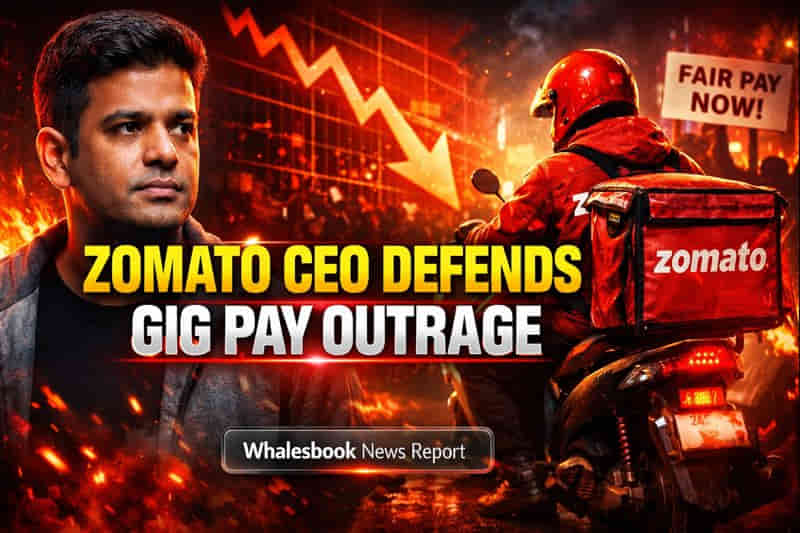
Zomato CEO Defends Gig Pay Amid Worker Backlash
Zomato CEO Deepinder Goyal is facing significant backlash after defending the company's gig pay model. He highlighted average hourly earnings and flexibility, but a workers' association sharply contested his claims, labelling the conditions as "not decent work." This debate intensifies scrutiny on the gig economy's labour practices in India's rapidly expanding food delivery and quick commerce sectors.
- This dispute highlights ongoing concerns about worker compensation and conditions in the gig economy.
- The conflict centers on differing interpretations of earnings and benefits for platform workers.
The Core Issue
In a recent social media post, Goyal stated that Zomato delivery partners earned an average of ₹102 per hour in 2025, a 10.9% increase from ₹92 in 2024. He clarified this metric includes waiting time between orders. Goyal emphasized the flexibility delivery partners have to choose working hours, retain 100% of customer tips, and asserted they are not pressured into unsafe driving. He also mentioned Zomato and Blinkit spent approximately ₹100 crore on insurance coverage for partners in 2025, alongside other support like rest periods for women partners and National Pension System (NPS) access.
- Average hourly earnings claimed: ₹102 (2025), ₹92 (2024).
- Total insurance spending: ₹100 crore (2025).
- Key benefits highlighted: Flexibility, 100% tips, no unsafe pressure, rest for women, NPS access.
Counter-Claim
The Telangana Gig and Platform Workers Association (TGPWA) strongly disputed Goyal's figures. The association argues that after deducting essential costs like fuel and vehicle maintenance, net earnings fall to around ₹81 per hour. This translates to approximately ₹21,000 per month for a partner working 10 hours daily for 26 days. TGPWA highlighted the absence of crucial benefits such as paid leave, accident insurance, and provident fund (PF) contributions. They also countered the claim about delivery pressure, stating that while official speed data might be moderate, the fear of low ratings, penalties, and order cancellations significantly influences delivery behaviour. Low tipping rates were also cited.
- Net earnings claimed: ₹81 per hour.
- Estimated monthly income: ₹21,000 (for 10 hrs/day, 26 days/month).
- Key concerns raised: No paid leave, PF, or accident insurance; indirect pressure via ratings; low tips.
Financial Implications
This public dispute raises questions about the long-term sustainability and profitability of Zomato's gig work model. Any potential regulatory changes or increased pressure to provide better benefits could significantly impact the company's operational costs and profit margins. Investor sentiment towards platform-based businesses relying on gig workers may also be affected.
- Potential impact on operational costs and profit margins.
- Influence on investor sentiment towards gig economy platforms.
Market Reaction
While the news has generated significant debate, a direct, immediate impact on Zomato's stock price is not evident in the provided text. However, sustained negative sentiment or regulatory intervention could influence future market performance.
- No immediate stock price impact mentioned.
- Potential for future impact based on sentiment and regulation.
Official Statements and Responses
Zomato CEO Deepinder Goyal made his defence via posts on the social media platform X. The Telangana Gig and Platform Workers Association issued counter-claims and statements refuting the company's assertions.
- Statements made via X (formerly Twitter).
- Worker association provided counter-arguments.
Future Outlook
The ongoing debate could pave the way for increased regulatory scrutiny of gig work in India's tech and delivery sectors. It might also galvanize further calls for formalization of gig worker rights, potentially leading to new industry standards. Companies like Zomato may face pressure to enhance welfare measures.
- Possibility of increased regulatory oversight.
- Potential push for formalization of gig worker rights.
Impact
The core issue revolves around fair compensation and working conditions for a large segment of the workforce in India's growing digital economy. If worker demands gain traction or regulations change, it could affect Zomato and other similar platforms' cost structures, potentially leading to higher prices for consumers or a revised operational model.
- Potential effect on operational costs for delivery platforms.
- Possible impact on consumer prices.
Difficult Terms Explained
- Gig work: A labor market characterized by short-term contracts or freelance work, as opposed to permanent jobs. Delivery partners typically operate under this model.
- Quick commerce: A retail model focused on delivering goods, often groceries, within a very short timeframe, typically less than an hour.
- NPS (National Pension System): A voluntary pension system regulated by the PFRDA in India, designed to provide retirement income.
- PF (Provident Fund): A mandatory retirement savings scheme in India where employees and employers contribute a portion of the salary.