 Whalesbook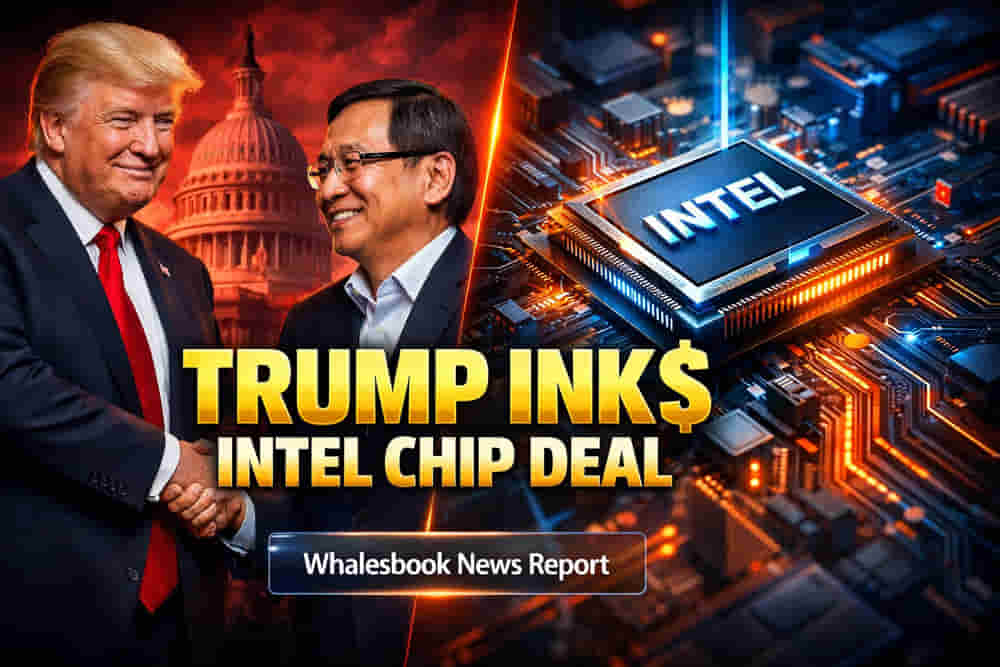
White House Summit on Semiconductor Sovereignty
President Donald Trump met Intel Corp. CEO Lip-Bu Tan at the White House Thursday, marking a significant discussion on bolstering domestic chip manufacturing. The summit focused on the U.S. government's growing investment in the Santa Clara, California-based chipmaker and its strategic push to reshore advanced semiconductor production.
Trump prominently featured the meeting on his social media, calling it a "great meeting" and a "GREAT Deal." He highlighted the federal government's acquisition of a 5.5% stake in Intel, part of a broader initiative to ensure leading-edge chip manufacturing returns to American soil. This stake is expected to grow further, with plans for the government to eventually own up to 10% of the company.
Corporate Strategy and Market Response
Since assuming leadership in March, CEO Lip-Bu Tan has embarked on an aggressive plan to revitalize Intel's business. The company has secured substantial capital injections, not only from the U.S. government but also from major investors like Nvidia Corp. and SoftBank Group Corp. These investments have coincided with a significant uptick in Intel's stock performance, which has surged more than 70% since the government's stake plans were revealed.
Manufacturing Advancement and Hurdles
Intel is racing to recapture its technological edge. Tan confirmed this week that the company is on track to ship its first sub-2-nanometer 18A products by the end of 2025. However, the path forward is complex; Intel continues to rely on Taiwan Semiconductor Manufacturing Co. for a portion of its chip fabrication, underscoring the intricate global supply chain dynamics at play.
Financial Gains Under Scrutiny
President Trump asserted that the U.S. government had secured "Tens of Billions of Dollars for the American People." While the total value of the government's holdings is substantial, the actual realized gains are still evolving. The initial stake purchased in August was valued at $5.7 billion. Under a complex arrangement, the stake could eventually be worth $27.7 billion if all available shares are acquired, though its current public market valuation stands at just over $11 billion.
Despite the positive momentum and significant investments, Intel's core challenge remains regaining lost market share. Investors and analysts are keenly awaiting proof that its new product lines will win back customers and solidify its competitive position in the global semiconductor arena.