 Whalesbook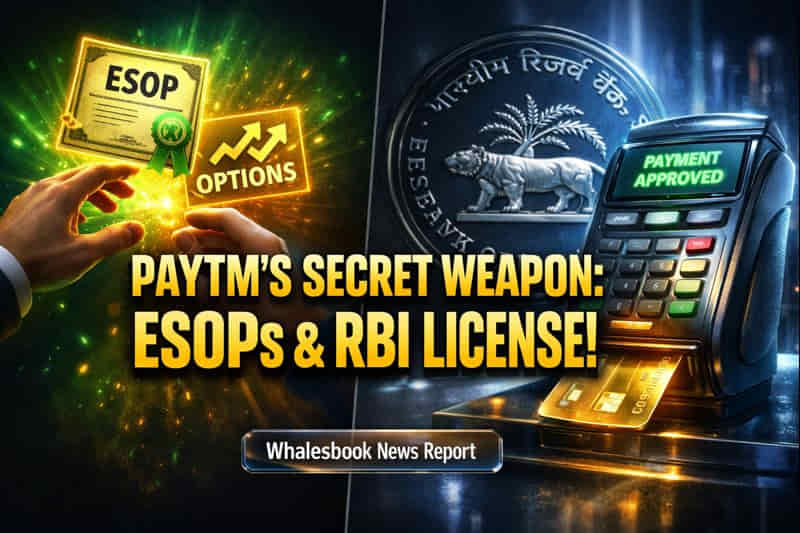
Paytm Boosts Workforce and Expands Payment Services Amidst Profit Dip
One 97 Communications Limited, the parent entity of the widely recognized digital payments platform Paytm, has announced a strategic move to bolster its workforce through a significant grant of employee stock options (ESOPs). This award is valued at approximately ₹16.7 crore and is designed to align employee interests with the company's long-term vision. Adding to this corporate development, a crucial subsidiary has achieved a key regulatory milestone, securing authorization from the Reserve Bank of India (RBI) to expand its payment services. These positive steps occur against the backdrop of a challenging financial performance for the quarter, marked by a substantial decline in net profit.
ESOP Grant Reinforces Employee Commitment
The company's Nomination and Remuneration Committee formally approved the grant of 1,23,908 stock options to eligible employees. This is executed under the established One 97 Employees Stock Option Scheme 2019. The decision, made on January 3, 2026, through circulation, allows these options to be converted into fully paid-up equity shares of face value ₹1 each. Each stock option carries an exercise price of ₹9. Considering Paytm's closing share price on Friday of roughly ₹1,340.4, the collective notional value of these newly granted ESOPs reaches an estimated ₹16.7 crore. This move is intended to foster a sense of ownership and reward employees for their contributions. The company also disclosed that 4,25,702 previously granted stock options had lapsed during the reporting period, with no other vesting, exercise, or cancellation activities noted.
RBI Authorization Expands Payment Gateway Capabilities
In a significant regulatory development, Paytm Payments Services Limited, a wholly owned subsidiary of One 97 Communications, has obtained authorization from the Reserve Bank of India. This license permits the subsidiary to operate as a payment aggregator, specifically catering to physical or offline payment environments and facilitating cross-border transactions. With this comprehensive authorization, Paytm Payments Services Limited is now equipped to offer its payment aggregation services across a much wider array of merchant use cases, encompassing online, offline, and international payment needs. This strategic expansion positions the subsidiary to capture a larger share of the burgeoning digital and physical payment markets.
Financial Performance Shows Mixed Signals
On the financial front, One 97 Communications reported its second-quarter fiscal year 2026 results, showcasing resilience in its top-line performance. Revenue from operations increased to ₹2,061 crore, a notable rise from ₹1,659 crore recorded during the corresponding period in the previous fiscal year. However, the company's profitability faced a significant downturn. Net profit for the quarter plummeted to ₹21 crore, a sharp contrast to the ₹930 crore profit reported in Q2 FY25. This substantial decrease in net profit is primarily attributed to two key factors: the absence of a significant one-time gain that had bolstered the prior year's results, and an impairment loss that was recognized in the latest financial period.
Strategic Implications and Market Outlook
The combination of ESOP grants and expanded regulatory approval presents a forward-looking strategy for One 97 Communications. The ESOPs aim to boost employee morale, retention, and alignment with company objectives. Meanwhile, the RBI's payment aggregator license for offline and cross-border transactions is a critical step towards diversifying and strengthening the company's revenue streams in the payments sector. Investors will be carefully evaluating these strategic initiatives against the backdrop of declining net profitability. The market's response will likely depend on the company's ability to effectively leverage its enhanced payment capabilities to drive sustained revenue growth and improve its bottom line in the coming quarters, managing operational costs effectively.
Impact
This news carries moderate weight for Indian stock market investors. The ESOP grant is a positive signal for employee morale and long-term commitment, potentially contributing to future performance. The RBI authorization for Paytm Payments Services Limited to operate as a payment aggregator for offline and cross-border transactions is a significant regulatory win, expanding its addressable market and future revenue potential. However, the sharp decline in net profit, attributed to one-time factors and impairment losses, introduces a note of caution. Investors will be looking for clear strategies to improve profitability while capitalizing on the expanded payment services. The overall impact is a blend of strategic expansion and near-term financial headwinds.
Impact Rating: 6/10
Difficult Terms Explained
- ESOPs (Employee Stock Options): A form of employee compensation that gives individuals the right to purchase a company's stock at a predetermined price, often below the market rate, within a specified timeframe. They are designed to incentivize employees by linking their rewards to the company's stock performance.
- Notional Value: The theoretical value assigned to an asset or financial instrument, calculated using prevailing market prices or specific formulas. It represents a potential value rather than an actual cash amount until the asset is realized.
- Exercise Price: The fixed price at which the holder of a stock option can purchase the underlying shares from the company.
- Payment Aggregator: A specialized entity that facilitates the collection and transfer of payments between merchants and their customers. They handle various payment methods and ensure secure transaction processing.
- Cross-border Transactions: Any financial exchange that involves parties located in different countries, requiring currency conversion and adherence to international financial regulations.
- Impairment Loss: An accounting charge recorded when the carrying amount of an asset exceeds its recoverable amount, indicating a permanent decrease in the asset's value.