 Whalesbook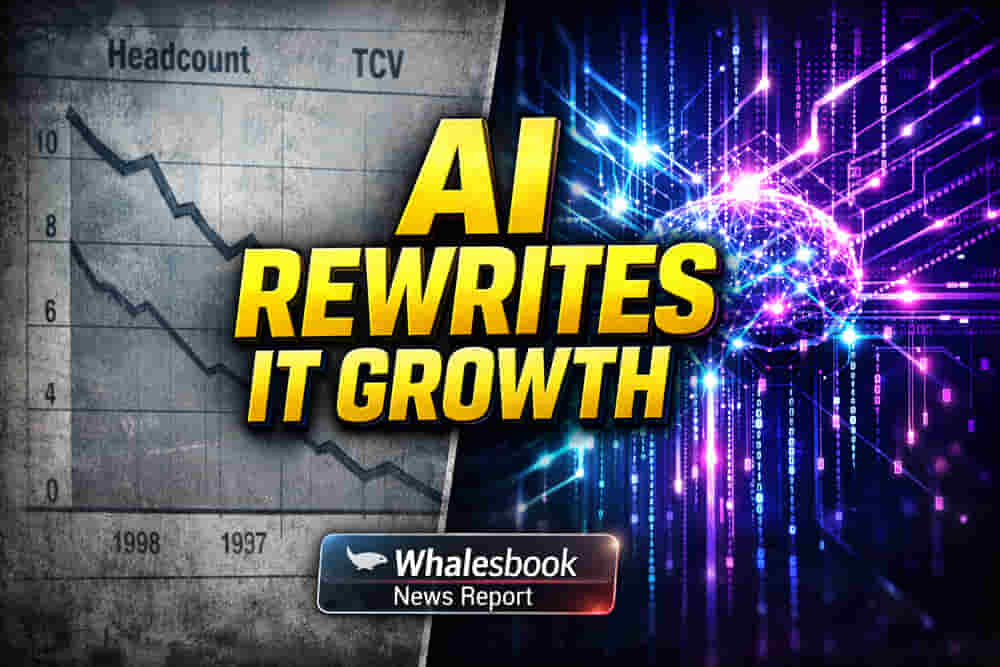
### The AI-Driven Valuation Reckoning
The Indian IT sector, comprising giants like Tata Consultancy Services (TCS), Infosys, and Wipro, is at a critical inflection point. The very definition of growth is being reshaped by widespread AI adoption, directly impacting how these companies are valued. For years, market sentiment and valuation multiples were tethered to metrics like expanding workforces and the sheer size of order books, such as Total Contract Value (TCV). However, advancements in AI and automation are fundamentally altering this paradigm.
AI is now directly contributing to operating margins, with 75% of manufacturers expecting it to be a top three margin driver by 2026. This shift means that traditional indicators, which implicitly correlated headcount with billable hours and revenue, are becoming outdated. For instance, Wipro, with a P/E ratio around 19.14, and Infosys, trading at approximately 23.3x earnings, are seeing their valuations scrutinized against this new reality. TCS, the largest player, trades at a P/E of roughly 22.8. The market is actively seeking quantifiable evidence of AI-driven efficiency gains and new service revenue streams, moving beyond historical growth levers. This recalibration is creating a degree of valuation uncertainty as investors grapple with how to price companies whose core operational efficiencies are being transformed by technology.
### Benchmarking Against AI Leaders and Sector Trends
The Nifty IT index has shown resilience, gaining approximately 12% in the past six months, outpacing the broader market. This performance reflects the sector's adaptation to global technology trends, including AI and cloud computing, which are projected to drive the IT services market to $2.64 trillion by 2034. Companies like Accenture are already integrating AI-native security solutions, highlighting the competitive pressures. In India, AI adoption is rapidly advancing, with 47% of enterprises already deploying multiple Generative AI use cases in production and another 23% in pilot stages. This indicates a significant shift from experimentation to performance. Despite this momentum, a substantial readiness gap persists, with only 21% of manufacturers stating they are fully AI-ready due to challenges in data, integration, and system modernization.
Infosys, despite recent underperformance relative to the Sensex over the past year, has seen a Mojo Score upgrade to 70.0 with a 'Buy' grade. Its large-cap status and market capitalization of approximately ₹6.7 trillion, coupled with a P/E ratio below the industry average, present a potentially attractive valuation. Wipro, however, has seen its Mojo Grade downgraded to 'Hold', reflecting a more cautious outlook amidst its P/E ratio hovering around 19.14. TCS, with its market capitalization exceeding ₹11.6 trillion and P/E around 22.8, remains a dominant force. The current market environment is influenced by a favorable India-US trade deal and supportive Budget 2026 provisions, including tax holidays for data centers, which are expected to boost AI infrastructure development.
### The Analyst Consensus and Future Trajectory
Analysts are closely monitoring the sector's ability to translate AI investments into tangible value. While AI is expected to be a significant margin enhancer, the speed of deployment and integration remains a key challenge. A McKinsey report highlights that while AI adoption is broadening across business functions, achieving transformative value requires precision in identifying key areas for AI impact and sustained leadership commitment.
The Indian government's focus on AI, underscored by the upcoming AI Impact Summit in New Delhi, signals a strategic imperative to leverage AI for economic growth, aiming to add $1.7 trillion to the economy by 2035. This national drive, combined with significant private sector investments in data centers and cloud infrastructure by companies like Google, Reliance, and AWS, is creating a fertile ground for AI innovation. The sector must navigate challenges such as data infrastructure complexity and security pressures, which are increasing for Indian enterprises. The future trajectory for Wipro, Infosys, and TCS will depend on their agility in adapting to these AI-driven changes, demonstrating quantifiable value creation beyond traditional metrics, and effectively upskilling their talent to meet the demands of an AI-first era.