 Whalesbook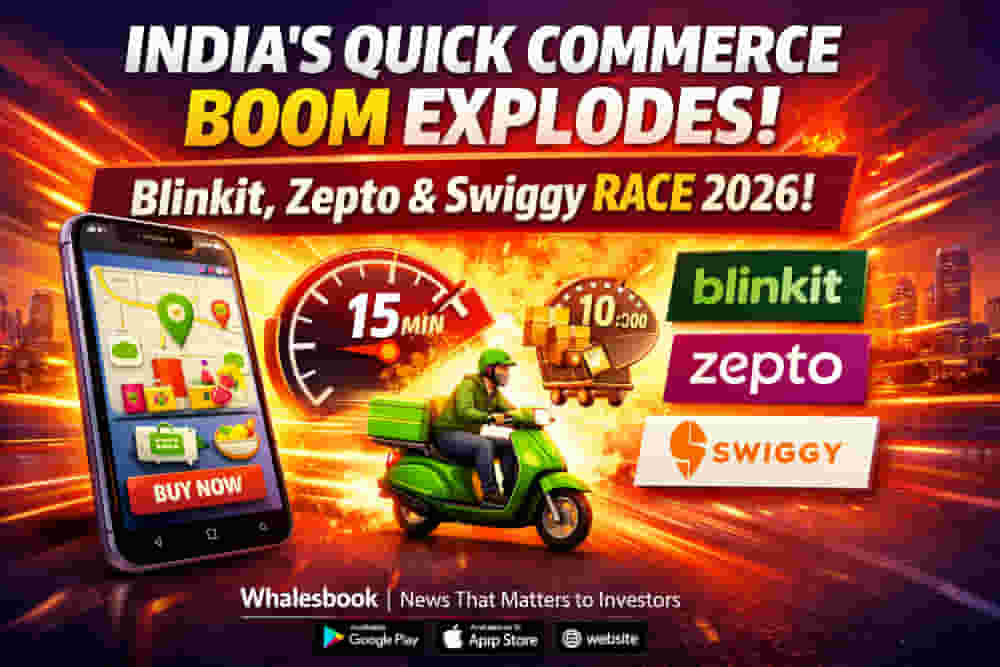
India's Quick Commerce Sector Poised for Explosive 2026 Growth
Quick commerce in India has moved beyond a nascent trend to become a dominant force, with consumers fully embracing the convenience of rapid delivery. Over the past year, platforms like Blinkit, Zepto, and Swiggy's Instamart have aggressively pursued user acquisition and expanded into diverse categories, including pharmaceuticals, capitalizing on strong festive demand.
The sector has also seen the rise of vertical quick commerce players, catering to niche segments from fashion to premium groceries, while horizontal giants secured substantial capital. Zepto raised $400 million in a round led by the California Public Employees’ Retirement System, and Swiggy bolstered its quick commerce network with approximately ₹10,000 crore ($1.2 billion) through a Qualified Institutional Placement.
Intensifying Competition and Market Dynamics
Competition in the quick commerce space is escalating, with smaller players like Flipkart Minutes, Amazon Fresh, and BB Now ramping up operations. Experts predict this rivalry will intensify significantly into 2026.
Neil Shah, co-founder and VP of research at Counterpoint Research, noted that competition will remain aggressive as players expand into new cities, add more dark stores, and push into fresh categories. He highlighted the current lack of consumer loyalty, with users frequently switching apps based on availability and discounts, keeping competitive pressure high.
The 2026 Outlook: Hyper Growth and Strategic Shifts
Analysts forecast that Blinkit, Instamart, Zepto, and others will add approximately 2,000-2,500 new dark stores across top metros and high-income micro-markets in 2026. Lloyd Mathias, an angel investor and brand strategist, emphasized that 2026 represents a crucial window to build defensible scale, warning that delays in capital expenditure will hinder future catch-up.
The focus will be on deeper penetration within the top eight Indian cities, where 10-20 minute delivery is behaviorally aligned with consumer demand. However, growth will not solely depend on random expansion; quick commerce players will target profitable areas with high incomes, strong order demand, available warehouse space, and easy delivery routes, particularly premium neighborhoods and IT hubs.
Battle for Second Place and Non-Grocery Dominance
With Blinkit established as the market leader, the real competition in 2026 will be for the second position between Swiggy's Instamart and Zepto. Instamart benefits from Swiggy's existing customer base and subscription model, while Zepto relies on its dense dark-store network and premium urban appeal. Amazon's renewed push into rapid delivery, backed by Prime loyalty, could also significantly shift momentum.
The growth engine is shifting towards non-grocery categories, which are expected to become the main drivers of Gross Merchandise Value (GMV). Personal care, toys, stationery, gifting, and small appliances are seeing strong adoption due to higher margins and impulse-led demand. These categories are crucial for increasing average selling prices and turning platforms into a weekly habit.
Private labels are estimated to contribute 5-10% of GMV, with platforms experimenting in categories like home cleaning and ready-to-eat meals where brand loyalty is lower. Vertical quick commerce players specializing in niche segments face consolidation, with many likely to merge or exit.
Future Trajectory
As quick commerce heads into 2026, the emphasis is shifting from simply proving demand to building durable, efficient businesses. Scale, execution, and category depth will be paramount in navigating intense competition and margin pressures.
Impact
This news is highly relevant for the Indian stock market, indicating significant growth and investment potential within the quick commerce and broader e-commerce sectors. It signals evolving consumer behavior and intense competition, which can impact listed players and attract further venture capital. Rating: 8/10.
Difficult Terms Explained
- Quick commerce: A business model focused on delivering goods, typically groceries and everyday essentials, within minutes (often 10-30).
- Dark stores: Small, centralized warehouses used exclusively for fulfilling online orders, not open to the public.
- Qualified Institutional Placement (QIP): A method for listed companies to raise capital by issuing shares to institutional investors.
- Gross Merchandise Value (GMV): The total value of goods sold through an e-commerce platform over a given period.
- Total Addressable Market (TAM): The total market demand for a product or service.
- Unit economics: The revenue and costs associated with producing and selling a single unit of a product or service.
- Private labels: Brands owned and sold by the retailer or platform itself, rather than by a third-party manufacturer.
- Vertical Q-commerce: Quick commerce services that focus on a single niche category, such as fashion or gourmet food.