 Whalesbook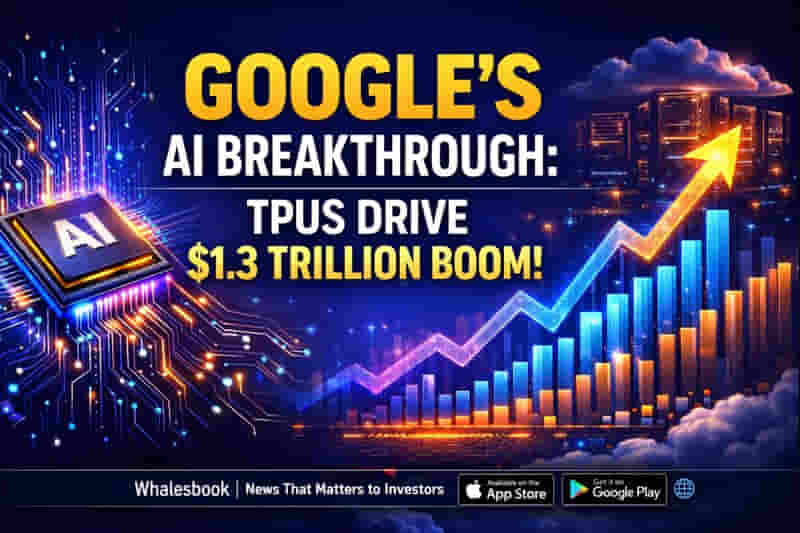


Alphabet's Triumphant AI Turnaround
The narrative surrounding Alphabet, the parent company of Google, has dramatically shifted. After initial fears in 2022 that AI chatbots like ChatGPT would decimate Google Search, the company's stock has rallied an impressive 60%, adding a staggering $1.3 trillion in market value. Alphabet is now approaching a $4 trillion valuation, attracting significant attention, including a substantial $4 billion investment from Berkshire Hathaway.
The Hidden Monopoly: Tensor Processing Units
The core of this revival lies in a technology most observers overlooked: Alphabet's proprietary Tensor Processing Units (TPUs). While the market focused heavily on versatile Graphics Processing Units (GPUs) from competitors like Nvidia, Google quietly perfected its custom-built TPUs. These are not general-purpose chips; they are highly specialized, designed specifically to accelerate deep learning tasks, offering a distinct advantage in efficiency and cost for AI workloads.
Record Financial Performance
Alphabet's third quarter of fiscal year 2025 marked a historic milestone, delivering its first-ever $100 billion quarter. Revenue reached $102.3 billion, representing a 16% increase year-over-year. Earnings per share hit a record $2.33, achieved despite significant investments in artificial intelligence infrastructure. The star performer was Google Cloud, which saw its revenue climb 34% to $15.2 billion.
The company also announced a substantial $155 billion backlog of future commitments from clients eager to secure its services. This surge in demand is partly driven by major technology firms like Apple, which used TPUs for its new AI features, and significant potential deals with Anthropic and Meta.
Strategic Vertical Integration
Google's control over its TPU development and deployment offers profound strategic benefits. By managing the entire stack, from hardware design to cloud services, Alphabet can achieve better profit margins and offer competitive pricing that undercuts rivals. This vertical integration enables Google to provide a comprehensive AI infrastructure solution, rather than just individual components.
A Complementary AI Landscape
It's important to note that TPUs are not replacing GPUs entirely. The burgeoning AI infrastructure market, projected to reach $7 trillion by 2030, has room for multiple players. Companies like Microsoft and Amazon Web Services continue to invest heavily in Nvidia's GPUs, highlighting a complementary relationship where specialized hardware like TPUs work alongside more versatile GPUs to meet diverse AI needs.
'Moonshot' Investments Yielding Returns
Beyond its core cloud and search operations, Alphabet's long-term 'moonshot' ventures are now proving highly lucrative. Its estimated 10% stake in SpaceX, which recently achieved an $800 billion valuation, accounts for an estimated $40-60 billion in paper gains for Alphabet. Autonomous driving leader Waymo, valued at $45 billion, provides critical real-world data that enhances Google's AI models. Meanwhile, subscription services like YouTube Premium and Google One generated $12.9 billion in Q3, operating at a $50 billion annual run rate, serving as a robust cash flow generator.
Gemini's Leap Forward and AI Integration
Google's AI capabilities have advanced significantly, moving past earlier challenges with its chatbot. Gemini 3, launched in November, demonstrates enhanced reasoning abilities, capable of thoughtful deliberation before responding to complex queries, positioning it as a leading model. This advanced AI is now deeply integrated across Google's ecosystem, improving Search, driving revenue growth in YouTube Shorts, and boosting ad conversion rates.
Aggressive Capital Expenditure
Alphabet is undertaking a massive capital expenditure program, with projections for 2025 between $91 billion and $93 billion, primarily allocated to TPUs and data centers. CEO Sundar Pichai characterizes this as "front-loading the next decade of computing," viewing under-investment in AI as a greater risk than over-investment. Crucially, this aggressive spending is financed by the company's considerable cash reserves, supporting operating margins that have reached a decade-high of 32.2%.
Navigating Regulatory Waters
While regulatory scrutiny remains a factor, recent developments have offered some reprieve. A September 2025 ruling allowed Google to continue its default search engine agreements, such as payments to Apple previously reported at $25 billion annually. Paradoxically, the growth of AI competition has also served as a regulatory shield, leading regulators to believe that market forces could naturally challenge Google's dominance.
Valuation and Future Execution
Following its significant rally, Alphabet trades at approximately 30.5 times earnings, a premium compared to the S&P 500's multiple. A sum-of-the-parts valuation suggests potential worth around $600 billion for Google Cloud, over $100 billion for its moonshot portfolio, and approximately $3 trillion for its core Search and YouTube businesses. Future stock gains will likely depend on continued execution rather than a mere expansion of its valuation multiple.
The Bottom Line
Alphabet appears well-positioned to sustain its growth trajectory. The company leads in the rapidly expanding AI infrastructure market with its integrated hardware and software solutions. Its diverse revenue streams, from cloud services and subscriptions to valuable stakes in pioneering ventures, provide a strong foundation. While risks related to regulatory challenges, substantial capital expenditure, and potential shifts in advertising remain, Google has decisively proven its resilience and adaptability. Its strategic focus on critical AI infrastructure suggests a sustained financial machine, even if the rapid stock appreciation seen this year may moderate.
Impact
This news demonstrates Alphabet's successful strategic pivot and execution in the AI sector, bolstering confidence in its future growth. It validates the importance of specialized AI hardware and integrated cloud solutions, potentially influencing investment decisions and competitive strategies across the global technology landscape. The significant capital expenditure also highlights the immense investment required to lead in AI infrastructure.
Impact Rating: 9/10
Difficult Terms Explained
- Tensor Processing Units (TPUs): Custom-designed hardware chips developed by Google specifically for accelerating machine learning and artificial intelligence tasks.
- Graphics Processing Units (GPUs): Versatile chips, originally for graphics, now widely used for training AI models due to their parallel processing capabilities.
- Vertical Integration: A business strategy where a company controls multiple stages of its production or supply chain, from raw materials to final product delivery.
- Capital Expenditure (CapEx): Funds used by a company to acquire, upgrade, and maintain physical assets such as property, industrial buildings, or equipment.
- Operating Margins: A profitability ratio that measures how much profit a company makes from its core business operations for every dollar of sales.
- Network Effects: A phenomenon where a product or service becomes more valuable as more people use it.