 Whalesbook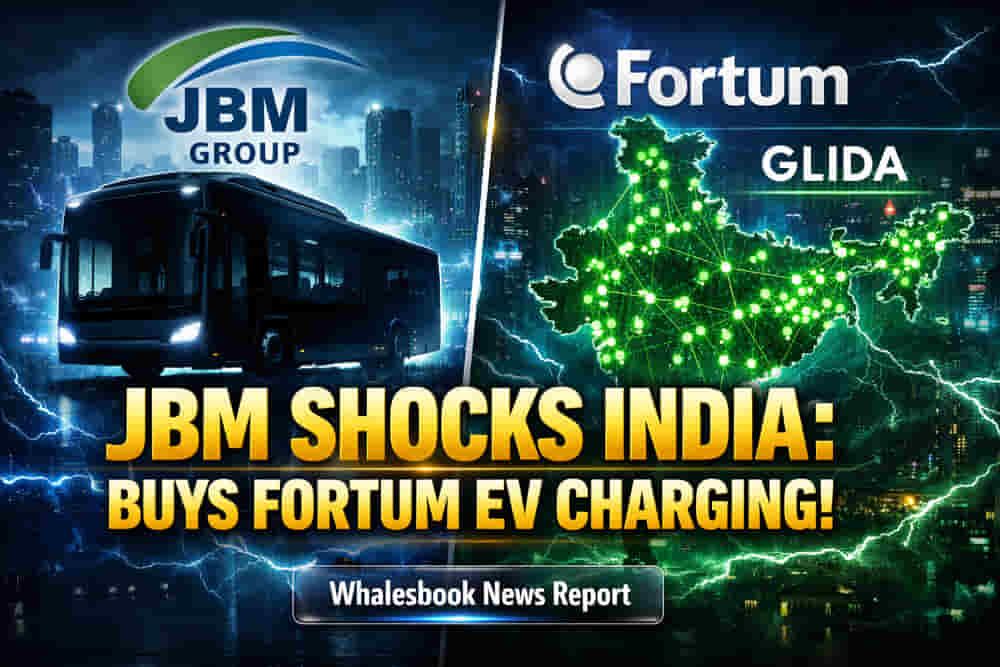
JBM Group, a prominent Indian conglomerate, has taken a significant step towards expanding its footprint in the electric vehicle (EV) sector by signing an exclusivity agreement to acquire a majority stake in GLIDA, the Indian EV charging network of Finnish energy company Fortum Oyj. This move, if finalized, would mark the complete exit of Fortum from the Indian market after more than a decade.
Strategic Expansion into EV Charging
The exclusivity pact allows JBM Group to conduct due diligence on GLIDA, formerly known as Fortum Charge & Drive India. The acquisition would grant JBM access to GLIDA's existing network of 850 charging points spread across 29 cities and 25 highways in 17 Indian states. This strategic acquisition aligns with India's aggressive push towards green mobility and the critical need for robust EV charging infrastructure.
JBM Group, through its flagship company JBM Auto Ltd, is already a major player in the EV ecosystem, being one of India's largest manufacturers of electric buses. The group also operates 1,500 EV charging sites. Furthermore, JBM Group is participating in the government's significant tender for 10,900 electric buses under the PM E-Drive scheme, highlighting its commitment to public transport electrification.
Fortum's Exit and Market Dynamics
Fortum's decision to exit the Indian EV charging market comes amid broader global challenges. The company has faced substantial financial strains stemming from the Russia-Ukraine war, including significant losses for its majority-owned Uniper subsidiary and the confiscation of its Russian assets. In line with this, Fortum has been divesting various Indian assets, including its renewable energy platform and stakes in joint ventures.
The Indian EV market presents a substantial opportunity, with projections indicating electric vehicles could constitute 30% of total vehicle sales by 2030. To support this growth, charging infrastructure development is paramount. Industry reports suggest Charging Point Operators aim to establish over 100,000 EV charging stations by fiscal year 2027.
Government Support and Future Prospects
The Indian government is actively promoting EV adoption through policies like the PM E-Drive scheme, which allocates substantial funds for setting up tens of thousands of charging stations across various vehicle segments. The New EV Charging Policy aims for ambitious infrastructure density, including at least one charging station per square kilometre and fast-charging stations every 100 kilometres on major highways. Policies ensuring electricity costs for charging stations remain competitive until March 2028 further incentivize growth.
Despite these efforts, challenges such as range anxiety, high upfront costs for EVs, and the complexities of setting up charging infrastructure, which involves multiple government agencies and stakeholders, persist. However, a combination of improving economics, government focus, rapid infrastructure expansion, and technological advancements is expected to accelerate India's EV growth momentum. This acquisition by JBM Group could play a pivotal role in consolidating and expanding the charging network, further driving EV adoption.
Impact
This development is highly relevant for the Indian stock market as it signals consolidation and strategic investment in the critical EV charging infrastructure segment. It could boost investor confidence in JBM Group's expansion strategy and the overall EV ecosystem in India.
Impact rating: 7/10
Difficult Terms Explained
- EV (Electric Vehicle): A vehicle powered entirely by electricity stored in batteries.
- Exclusivity Agreement: A contract granting one party the sole right to negotiate a deal for a specific period.
- Due Diligence: The process of thorough investigation and audit before a business transaction, like an acquisition.
- Charging Point Operators (CPOs): Companies that own and operate public EV charging stations.
- Range Anxiety: The fear that an electric vehicle has insufficient range to reach its destination.
- ACoS (Average Cost of Supply): The average cost incurred by electricity distribution companies to supply electricity.