 Whalesbook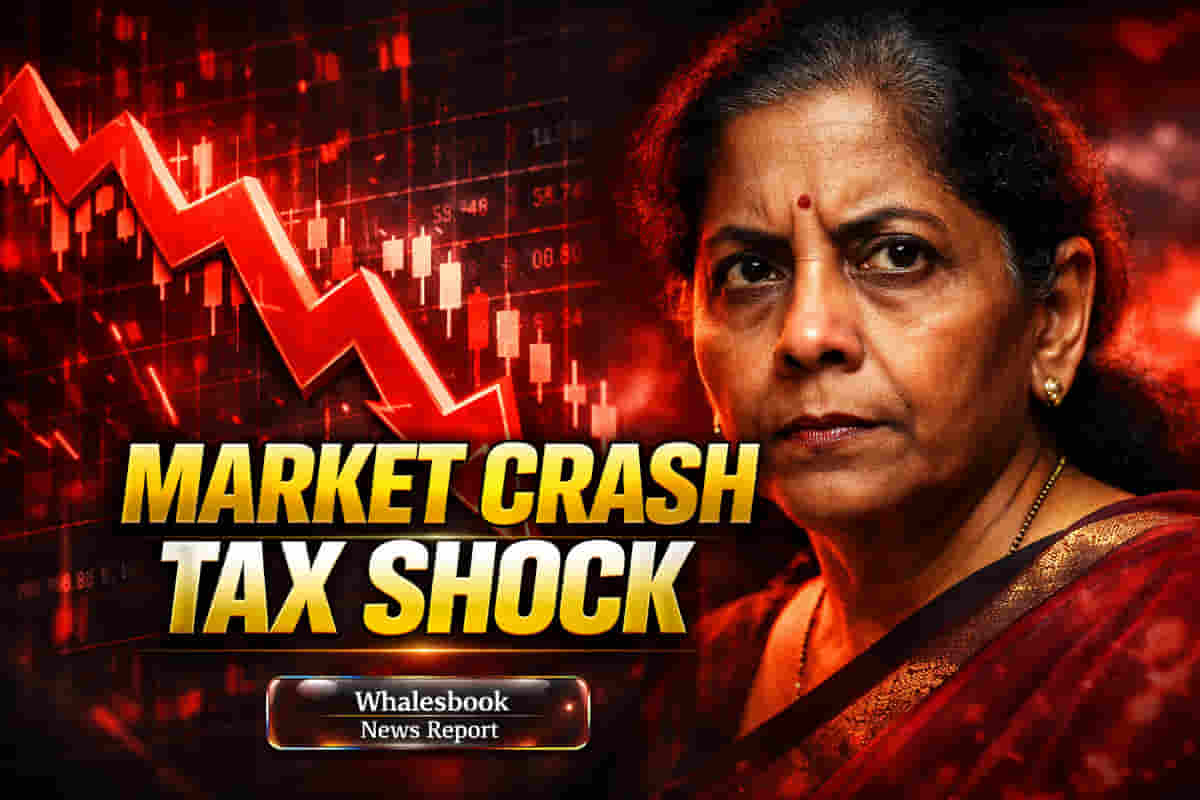
### The Budget Blowback: STT Hikes and Buyback Tax Shake Markets
Markets reacted swiftly and negatively to Union Finance Minister Nirmala Sitharaman's Budget 2026 proposals on Sunday, February 1, 2026. The benchmark Sensex plunged over 1,200 points, while the Nifty also hit multi-year lows, reflecting investor unease over revised taxation policies aimed at curbing derivatives trading and altering corporate payout structures. The announcement directly impacted trading costs for active participants and introduced a new tax regime for share buybacks, leading to immediate selling pressure across capital market-linked entities.
### STT Increases Drive F&O Costs Higher
The most immediate market trigger was the proposed hike in Securities Transaction Tax (STT). The tax on futures contracts will increase from 0.02% to 0.05%, and on options, it will rise to 0.15% from the current rates. This move is seen as a deliberate measure by the government to temper speculative trading in India's high-volume Futures & Options (F&O) segment. India's F&O market is the world's largest by volume, with significant participation from retail investors, many of whom incur substantial losses annually. Analysts suggest this increase in transaction costs, while potentially moderating excessive speculative activity, could also impact overall trading volumes and liquidity. The government's intent appears to be volume moderation rather than revenue maximization, as potential revenue gains might be offset by reduced derivative activity.
### Buyback Taxation Shifts to Capital Gains
Adding to the market's recalibration, the government announced that proceeds from share buybacks will be taxed as capital gains for all shareholder categories from FY27 onwards. Previously, buybacks were often treated as dividend income, taxed differently depending on the shareholder's bracket. This change aims to address misuse of the buyback route by promoters while protecting minority shareholders, though promoters will face an additional tax, resulting in effective rates of 22% to 30%. This alteration in tax treatment will affect corporate treasury strategies and the net returns for investors participating in buyback programs.
### Capital Market Firms Face Immediate Sell-off
The broader market decline translated into sharp losses for companies directly involved in the capital markets ecosystem. Multi Commodity Exchange of India (MCX) saw its shares plummet by over 17%. Angel One, a leading retail brokerage, dropped 12.22%. Nuvama Wealth Management declined by more than 9%, while the Indian Energy Exchange (IEX) fell 3.3%. The Bombay Stock Exchange (BSE) experienced a significant dip, falling over 11% to ₹2,485.50. These drops reflect investor sentiment that higher transaction costs and potential shifts in trading volumes directly impact the revenue and profitability of these intermediaries.
### Sectoral Valuation and Outlook
Valuation metrics for these capital market firms show varied P/E ratios. BSE Ltd trades with a TTM P/E of approximately 63.08x, MCX at around 68.69x, Angel One at 29.99x, and IEX around 23.53x. Nuvama Wealth Management's specific P/E was not immediately available in the provided search results, but the company's decline indicates sector-wide pressure. The market's reaction suggests a repricing of these stocks based on the anticipated impact of increased STT on trading volumes and potential changes in retail participation dynamics. Historically, unexpected tax measures on Budget Day have often led to sharp, albeit sometimes short-lived, market reactions. Analysts suggest that while immediate disappointment may persist, active traders are likely to adapt, and the long-term impact will depend on the actual moderation of trading volumes and market liquidity.
### Internal Audit Log
- Verified STT rate increase for futures (0.02% to 0.05%) and options (0.1% to 0.15% on premium, 0.125% to 0.15% on exercise).
- Confirmed buyback taxation shift to capital gains for all shareholders from FY27.
- Verified reported stock price drops for MCX (-17%), Angel One (-12.22%), Nuvama Wealth (-9%), IEX (-3.3%), and BSE (-11% to ₹2,485.50).
- Gathered Market Cap and P/E ratios for BSE (Market Cap ₹1,05,556 Cr, P/E ~63.08x), MCX (Market Cap ₹64,384 Cr, P/E ~68.69x), Angel One (Market Cap ~₹23,075 Cr, P/E ~29.99x), and IEX (Market Cap ~₹11,307 Cr, P/E ~23.53x).
- Incorporated context on India's F&O market size, retail participation (approx. 41% of index options), and retail trader losses (91% in FY25).
- Noted SEBI's prior action to increase minimum contract value for index derivatives in Nov 2024.
- Referenced analyst sentiment regarding STT hike impact on trading costs and volumes.
- Included historical context of market reactions to Budget Day tax changes.
- Ensured narrative pivot by discussing market reaction and context before detailing the specific announcements.