 Whalesbook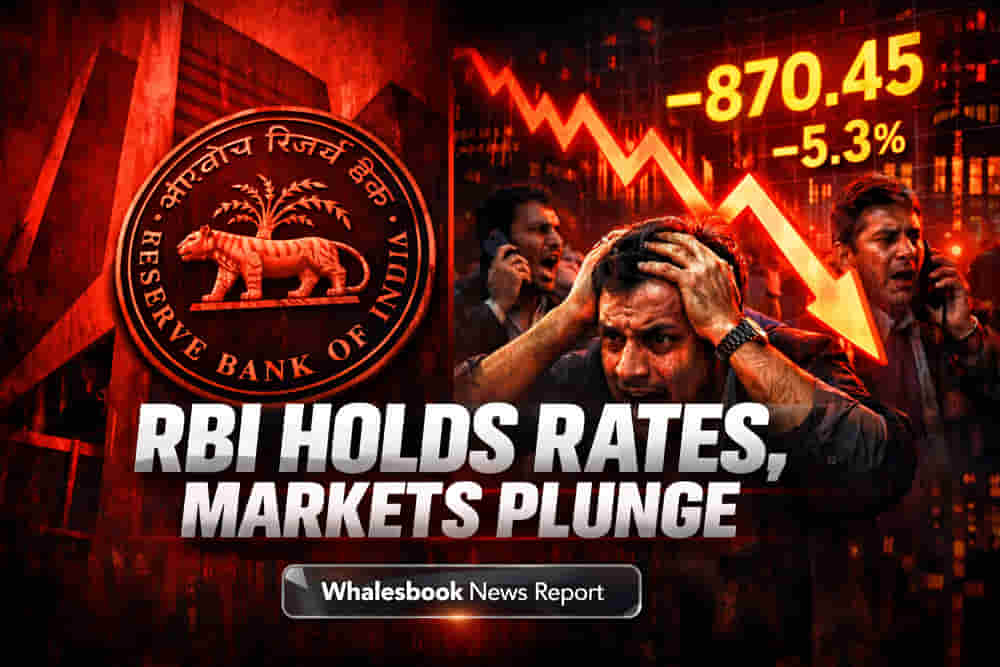
The Valuation Mismatch
The Reserve Bank of India's Monetary Policy Committee concluded its February 2026 meeting by keeping the repo rate unchanged at 5.25% and retaining a 'Neutral' policy stance. This decision, while aligning with market expectations for a hold, failed to buoy investor sentiment. Instead, the market reacted with a palpable sell-off, pushing the Sensex down by over 350 points and the Nifty50 below the 25,500 mark by mid-morning trading on February 6, 2026. The central bank's emphasis on a 'data-driven' approach was accompanied by a narrative of 'patience and vigilance,' signaling that it remains wary of global geopolitical tensions and commodity volatility, rather than signaling imminent monetary easing. This cautious tone clashed with investor aspirations for hints of future rate cuts, leading to a swift recalibration of risk appetite.
Despite robust domestic economic indicators, including a projected GDP growth of 7.4% for FY26 and contained inflation (CPI forecast at 2.1% for FY26), the market prioritized external risks. The RBI's revised CPI inflation projections for FY27, nudged up to 4.0% for Q1 and 4.2% for Q2, may have also contributed to the cautious outlook.
Global Headwinds and Sectoral Fallout
The prevailing 'risk-off' sentiment, amplified by declines in global markets, particularly the tech-heavy Nasdaq which is down 6% from its peak, significantly influenced domestic trading. Commodity prices also reflected this caution, with silver trading around $71, down from a recent high of $121. This global backdrop directly impacted Indian equities, leading to a broad-based decline. The Information Technology sector was a pronounced victim, with stocks like Tata Consultancy Services (TCS) plummeting 2.41% and Infosys falling 1.40%. This decline in IT was exacerbated by mounting concerns over the disruptive potential of artificial intelligence on traditional software services.
Other notable decliners included State Bank of India (SBI) down 1.60% and Adani Ports down 1.52%. Conversely, defensive sectors and certain value stocks showed resilience. ITC Ltd. emerged as a top gainer, rising 3.42%, supported by gains in Kotak Mahindra Bank Ltd. (+2.25%), Bharti Airtel Ltd. (+1.65%), and Bajaj Finance Ltd. (+0.90%). The Nifty FMCG sector also posted gains of 0.91%, alongside Nifty Private Bank (+0.29%) and Nifty Oil & Gas (+0.26%). Broader markets also felt the pressure, with the Nifty Midcap 100 declining by over 0.7% and the Nifty Smallcap 100 falling by nearly 1%.
Expert Outlook and Valuations
Analysts largely echoed the RBI's prudence, attributing the cautious stance to the volatile global environment. Divam Sharma, Co-founder and Fund Manager at Green Portfolio PMS, noted that while India's domestic economy remains strong, near-term market direction will depend on liquidity and inflation data. Anil Rego, Founder and Fund Manager at Right Horizons PMS, highlighted that the stable policy environment is supportive for sectors like banking and infrastructure. Dr. VK Vijayakumar, Chief Investment Strategist at Geojit Investments Limited, pointed to the global risk-off sentiment, including weakness in the Nasdaq and commodities, as key drivers.
Valuation metrics suggest the market may be finding current levels stretched, particularly in certain growth segments. The Sensex traded with a Price-to-Earnings (P/E) ratio of approximately 23.050, while TCS, a major IT stock, had a P/E of around 22.27. These valuations, coupled with concerns over AI disruption, contributed to the selling pressure in the IT sector.
Sectoral Performance Snapshot and Future Outlook
Most sectoral indices traded in the red, reflecting the broad-based selling. Nifty IT (-2.11%), Nifty Pharma (-1.12%), Nifty PSU Bank (-1.32%), and Nifty Healthcare Index (-1.19%) were among the significant laggards. The RBI projects India's GDP growth at 7.4% for FY26 and has marginally upgraded its outlook for the first half of FY27, signalling continued economic resilience. However, upcoming inflation data and global liquidity conditions will be critical determinants of market sentiment in the near term, as suggested by market observers. The central bank's commitment to maintaining vigilance suggests a patient approach to any future policy adjustments, leaving investors to navigate global uncertainties and domestic growth dynamics.