 Whalesbook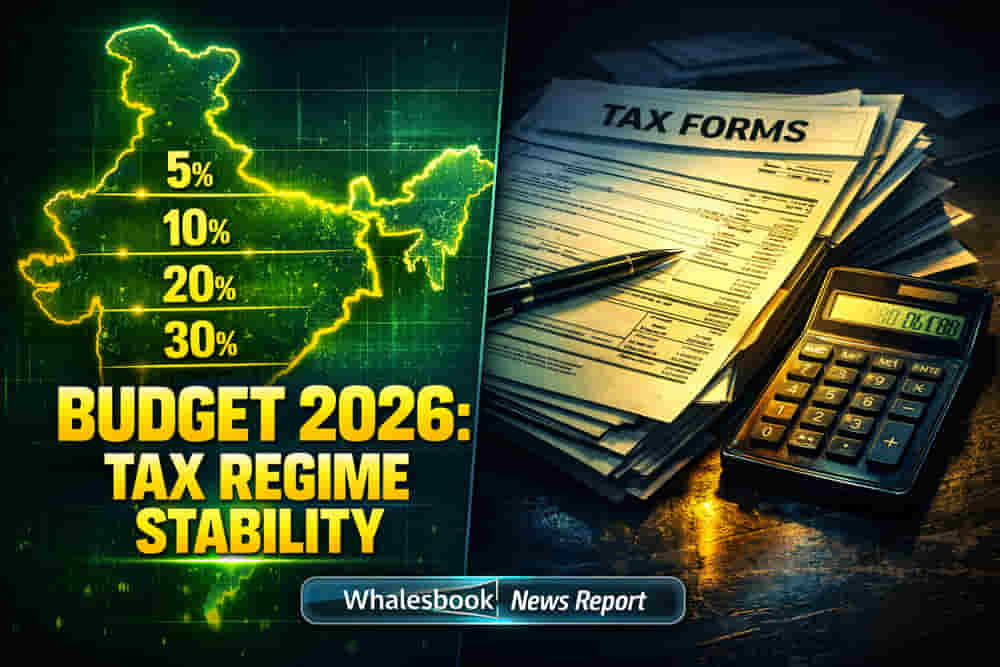
1. THE SEAMLESS LINK
This approach to tax policy leaves taxpayers with the familiar, yet increasingly complex, decision of selecting the most advantageous regime. The government's commitment to continuity suggests a strategy aimed at predictability in fiscal planning for both individuals and businesses, though it sidesteps immediate concerns for those seeking direct tax reductions.
The Unchanged Tax Regime Dilemma
Finance Minister Nirmala Sitharaman's Budget 2026 presented no alterations to the core income tax framework, leaving established slabs, rates, and exemption structures in place from the prior fiscal year. This decision offers a degree of certainty but bypasses the anticipation of fresh relief, such as adjustments to tax brackets or introduction of new deductions. The dual-regime system, comprising the traditional old tax system and the newer alternative introduced in 2020, persists, requiring taxpayers to weigh lower rates with fewer deductions against higher rates coupled with extensive exemptions. For FY 2026-27, the new regime continues to exempt income up to Rs 4 lakh, with subsequent slabs taxed progressively from 5% to 30% for income above Rs 24 lakh. A significant benefit remains the full tax rebate for resident individuals earning up to Rs 12 lakh, effectively creating a zero-tax liability. This is further enhanced for salaried individuals to Rs 12.75 lakh due to a Rs 75,000 standard deduction, making the new regime particularly attractive for middle-income earners who do not extensively utilize itemized deductions.
Old Regime's Enduring Appeal
The traditional old tax regime, while unchanged, continues to be a relevant option for taxpayers who can maximize various deductions and exemptions. This system offers an initial exemption up to Rs 2.5 lakh, followed by slab rates of 5%, 20%, and 30%. Popular deductions like those for House Rent Allowance (HRA), Leave Travel Allowance (LTA), Section 80C investments, medical insurance (Section 80D), National Pension System (NPS) contributions, and home loan interest remain accessible, providing substantial savings potential for individuals with significant eligible expenses. Tax experts suggest that for incomes up to Rs 12 lakh, the new regime's zero-tax outcome is often superior. However, for individuals earning above Rs 24 lakh, the choice hinges on whether their total deductions and exemptions surpass approximately Rs 8 lakh; if so, the old regime may still yield a lower tax burden. This highlights the critical need for detailed financial planning based on individual expenditure patterns.
Procedural Adjustments and Compliance Relief
While the fundamental tax structure remained static, the budget did introduce several procedural changes designed to ease taxpayer compliance. The deadline for filing revised income tax returns has been extended to March 31 from December 31, subject to a nominal fee. Filing timelines for certain income tax return (ITR) forms were also rationalized, with ITR-1 and ITR-2 due by July 31, and non-audit business cases and trusts having until August 31 to file. Further relief includes full tax exemption on interest received from motor accident claims tribunals. Additionally, tax collection at source (TCS) on overseas tour packages, education, and medical expenses under the Liberalised Remittance Scheme (LRS) has been reduced. The New Income Tax Act, 2025, is slated to take effect from April 1, 2026, with simplified return forms anticipated. Analysts note that these compliance-oriented measures aim to streamline processes rather than alter direct tax liabilities, reflecting a focus on administrative efficiency. The Indian economy, while showing resilience, continues to navigate global uncertainties, making tax stability a point of reference for economic predictability. Economic projections for India in 2026 suggest a continued growth trajectory, with stable tax policies potentially supporting consistent investment flows.
Expert Outlook and Future Considerations
Tax professionals anticipate that taxpayers will continue to rely on detailed financial planning to optimize their liabilities under the existing dual-regime framework. The lack of changes suggests a deliberate policy choice to allow the current system to stabilize and for taxpayers to fully adapt to the nuances of each regime. The government's strategy appears to lean towards fostering predictability in the tax environment, a move often favored by investors seeking stable operational conditions. While no specific brokerage targets were issued in relation to these budget announcements as they pertain to broad policy, the continuity in tax law is generally viewed as a neutral to positive factor for market sentiment by removing a layer of uncertainty. The effective date for the New Income Tax Act, 2025, is April 1, 2026, signifying a move towards a more consolidated tax framework in the near future.