 Whalesbook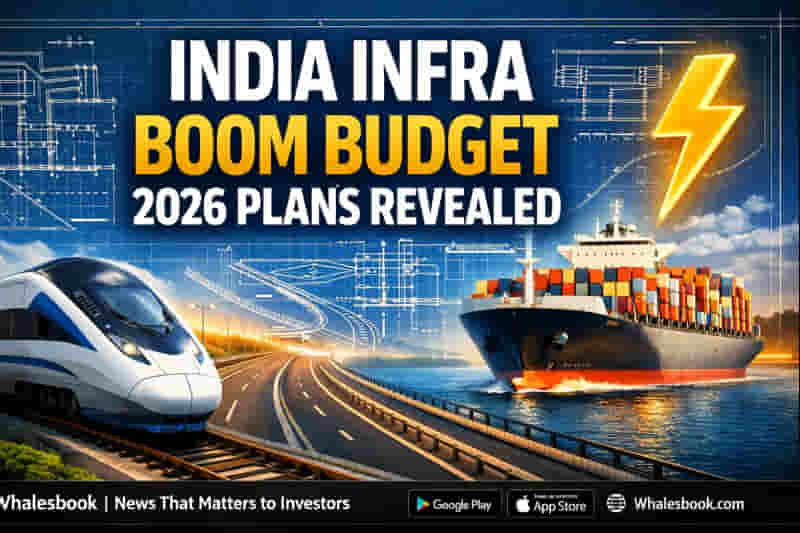
India's Infrastructure Sector at a Transformative Inflection Point
India's infrastructure sector is poised for significant evolution as it enters 2026, moving beyond a simple capital expenditure focus towards a more strategic, systems-driven approach. This transition is expected to accelerate growth, driven by reforms aimed at enhancing execution, attracting substantial private investment, and integrating green initiatives. Budget 2026 is anticipated to be a key determinant in shaping this dynamic phase, with a pronounced emphasis on fiscal efficiency and maximizing programme outcomes.
The Core Issue: A Strategic Pivot
The trajectory of India's infrastructure development is undergoing a fundamental shift. Central capital expenditure has seen a remarkable increase, more than tripling since FY21 to an estimated ₹11.1 trillion in FY25. While infrastructure has served as a crucial engine for long-term productivity and counter-cyclical growth, the focus for the upcoming Budget 2026 is likely to pivot towards the efficiency of capital deployment and the tangible results of projects, alongside a greater role for private participation rather than solely relying on government outlays.
Highways: Expressway Ambition Meets Monetization
Roads and highways have historically absorbed the largest share of infrastructure capital expenditure in India. Between FY20 and FY24, the National Highways Authority of India (NHAI) awarded projects exceeding 45,000 km, with annual construction surpassing 10,000 km. Budget 2026 is expected to sustain robust support but with a strategic emphasis on developing access-controlled expressways over traditional highways. The ambition includes a new expressway quadrilateral designed to enhance connectivity and economic benefits, mirroring the success of the original Golden Quadrilateral but with improved safety and speed standards.
Developing these high-capital-intensive expressways, costing between ₹30–40 crore per kilometre, necessitates securing significant private capital and effectively recycling assets. Policy reforms, including the finalization of a revised Model Concession Agreement (MCA) for Build-Operate-Transfer (BOT) projects, are critical to overcoming past deterrents that placed excessive risk on concessionaires. The NHAI has identified 53 projects spanning over 5,200 km, valued at ₹2.1 trillion, for awards starting this year, with another 100 road stretches worth over ₹3 trillion under evaluation. These projects are expected to operate under the enhanced investor protection framework.
Asset monetization remains a key focus, with NHAI having already raised over ₹60,000 crore through Infrastructure Investment Trusts (InvITs) and Toll-Operate-Transfer (TOT) bundles. Improved traffic predictability, bolstered by Fastag data, is enhancing valuation confidence and is expected to attract greater participation from global funds in future TOT rounds. The fiscal strategy for highways in 2026 will balance the construction of new assets with the recycling of operational ones.
Vaibhav Dange, an independent infrastructure expert, views 2026 as a year where India's infrastructure narrative will become more output-driven than policy-driven, indicating a maturing system focused on tangible economic productivity.
Railways: Freight Efficiency and Asset Monetization
Indian Railways continues to be a primary recipient of government capital expenditure, with recent budgets allocating over ₹2.5 trillion annually. While network expansion and safety remain key priorities for Budget 2026, there is a growing strategic shift towards asset monetization and enhancing freight efficiency. The successful commissioning of the Eastern and Western Dedicated Freight Corridors (DFCs), spanning over 3,300 km, has already demonstrated a significant increase in average freight train speeds compared to conventional routes.
Indian Railways is expanding its Gati Shakti Cargo Terminal (GCT) programme, allowing private entities to develop freight terminals on railway land. With over 100 GCTs operational or in development, Budget 2026 may provide policy support to accelerate this initiative, aiming to increase rail's share of freight movement from the current 27% to 40% over the medium term. The Amrit Bharat Station Scheme, involving the redevelopment of over 1,300 stations at an estimated cost of ₹25,000 crore, integrates passenger facilities with commercial real estate opportunities. Budget 2026 could formalize monetization frameworks for scaling this model.
Former ED, planning at Railways, V. Shanker, suggested that Railways' capital expenditure should be a mix of gross budgetary support (GBS) and market borrowings to mobilize larger funds and ensure efficient utilization.
Shipping and Ports: Sagarmala 2.0 and Maritime Policy
Historically receiving less fiscal attention than roads and railways, India’s shipping and ports sector is set to see increased focus, aligning with a revamped Sagarmala 2.0 initiative. This program prioritizes high-impact projects aimed at improving hinterland connectivity and reducing port turnaround times, areas where India trails global benchmarks. Sagarmala 2.0 will concentrate on targeted investments in mechanization, deeper drafts, port modernization, and port-linked logistics parks, with budgetary support likely directed towards enhancing rail and road connectivity to major ports for faster cargo evacuation.
A significant policy development is the inclusion of large ships under the Harmonized Master List (HML), granting access to long-term institutional finance for ship repair and shipbuilding projects. Given India's less than 1% share in the global shipbuilding market, Budget 2026 may introduce a broader maritime industrial policy. Continued support is also expected for inland waterways and coastal shipping, vital for lowering logistics costs.
Vivek Merchant, director at Swan Defence and Heavy Industries Ltd, described 2025 as an inflection point for the Indian maritime ecosystem, anticipating accelerated momentum in 2026, though cautioning about global uncertainties and geopolitical dynamics.
The Infrastructure Equation for Budget 2026
The overarching policy and fiscal theme uniting all infrastructure sub-sectors is the need to sustain momentum without disproportionately increasing the fiscal deficit. This objective drives the emphasis on asset monetization, corridor-based planning under PM Gati Shakti, and digital execution reforms. Shailesh K. Pathak, an infrastructure sector expert, anticipates continued high financial outlays and large projects in transport and logistics under Gati Shakti, with hope for increased traction on the National Monetization Pipeline in 2026. Anshuman Magazine, chairman & CEO of CBRE for India, South-East Asia, Middle East & Africa, highlighted transit-oriented developments (TODs) and multi-modal logistics parks (MMLPs) as key attractions for manufacturing investments. Vinayak Chatterjee, an infrastructure expert, advocates for a Unified Transport Authority for major metro cities and the development of a high-speed rail network as the next significant infrastructure leaps.
Energy and Urban Infrastructure
The energy sector's transition will be anchored by rapid solar and hybrid tenders, potentially reaching 40–50 GW auctions annually, alongside mainstreaming grid-scale storage through battery auctions and green hydrogen hub development. Expansion of interstate transmission lines and early moves on offshore wind clearances are also expected, potentially attracting global capital to green energy assets. Urban infrastructure development will continue, with expected progress in financing metro projects, 24x7 water supply, smart metering, affordable housing, and data centres as a distinct asset class, particularly focusing on Tier-2 cities.
A More Mature Infrastructure Phase
India's infrastructure strategy is entering a mature phase where success will be measured by system integration and asset efficiency. Budget 2026 will be a critical test of this transition. If policy reforms successfully revive private investment in highways, if rail freight reforms achieve a significant modal shift, and if ports evolve into true logistics hubs, the infrastructure sector is poised to deliver its next growth dividend. The challenge has clearly shifted from ambition to execution, and the upcoming budget will determine whether India's infrastructure cycle deepens or plateaus.
Impact
This strategic shift towards a more efficient, private-sector-driven infrastructure development model is expected to boost India's economic growth, improve logistics efficiency, and create significant investment opportunities. Companies involved in construction, engineering, materials, and related services could see enhanced prospects. Investor confidence in the infrastructure sector is likely to grow, supported by clear policy direction and funding mechanisms. The focus on green energy and urban renewal also aligns with global sustainability trends, potentially attracting foreign investment. This comprehensive push is critical for India's ambition to become a developed economy by 2047.
Impact Rating: 9/10
Difficult Terms Explained
- Model Concession Agreement (MCA): A standardized contract template used for public-private partnership projects, outlining terms, responsibilities, and risk allocation between the government and private concessionaires.
- Build-Operate-Transfer (BOT): A project delivery model where a private entity builds, operates, and maintains an infrastructure asset for a specified period before transferring it back to the government.
- Infrastructure Investment Trusts (InvITs): A collective investment scheme similar to a mutual fund, which owns and manages income-generating infrastructure assets and allows investors to hold units in these trusts.
- Toll-Operate-Transfer (TOT): A model where the government transfers toll collection rights of operational national highways to private players for a fixed concession period in return for an upfront payment.
- Dedicated Freight Corridors (DFCs): High-capacity, high-speed railway lines exclusively for freight movement, designed to decongest existing lines and improve logistics efficiency.
- Gati Shakti Cargo Terminal (GCT): Terminals developed on railway land by private players to enhance freight handling and logistics services, integrated into the PM Gati Shakti national master plan.
- Gross Budgetary Support (GBS): Direct financial allocation from the government's budget to public sector undertakings or projects.
- Transit-Oriented Development (TOD): Urban planning strategy that promotes mixed-use development around public transit stations to encourage transit ridership and reduce reliance on private vehicles.
- Multi-Modal Logistics Parks (MMLPs): Integrated logistics hubs designed to facilitate seamless transfer of goods between different modes of transport, reducing transit times and costs.