 Whalesbook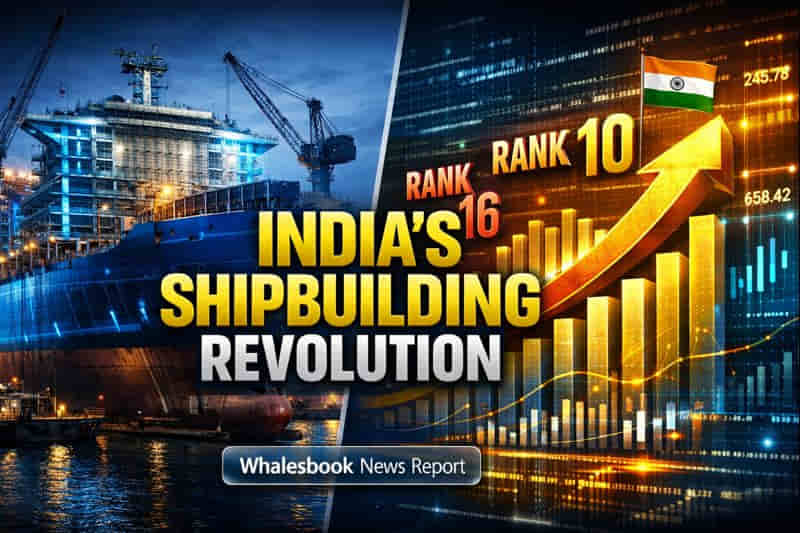
India Charts Ambitious Course for Global Shipbuilding Dominance
India is launching a comprehensive strategy to transform its shipbuilding capabilities, setting sights on the global top 10 by 2030 and a top-five position by 2047. The government has formalized two key programs: the Shipbuilding Financial Assistance Scheme (SBFAS) and the Shipbuilding Development Scheme (SbDS). These initiatives collectively represent an investment exceeding ₹44,700 crore.
Financial Muscle and Capacity Boost
Shipping Secretary Vijay Kumar stated that the schemes are designed to bolster domestic capacity and enhance international competitiveness. Support will extend to crucial areas like skilling, training, research, and development within the sector. India currently ranks 16th globally in shipbuilding, and these measures are intended to mitigate cost disadvantages and scale up production.
Subsidies are tied to local content requirements, necessitating a minimum of 30% for eligibility and climbing to 40% for full benefits. The government is also prioritizing capacity expansion for existing brownfield shipyards, offering approximately 25% assistance for such projects, alongside plans to establish new greenfield facilities. A maritime development fund is also on the cards to support equity investments in shipping operations, further boosting industry viability.
Regulatory Overhaul and Demand Assurance
Efforts are underway to simplify regulations, with the Draft Merchant Shipping Rules, 2026, aiming to integrate smaller operators. These schemes are projected to dramatically increase India’s annual shipbuilding output from under 1 lakh Gross Tonnage (GT) to 4.5 million GT, creating an estimated 30 lakh jobs. Prominent global shipping firms, including CMA CGM and Maersk, have reportedly begun placing orders with Indian shipyards. Significant demand visibility is assured, with ministries aggregating orders for over 400 vessels worth ₹2.2 lakh crore over the next decade.
Targeted incentives include a shipbreaking credit note of up to 40% to foster a circular economy and fleet renewal, an interest subvention of up to 3% to bridge cost gaps with international competitors, and enhanced subsidy rates for specialized vessels and green-fuel ships. Kumar emphasized that the entire ecosystem, from financing to technology and skilling, is being addressed to make Indian shipyards globally competitive.