 Whalesbook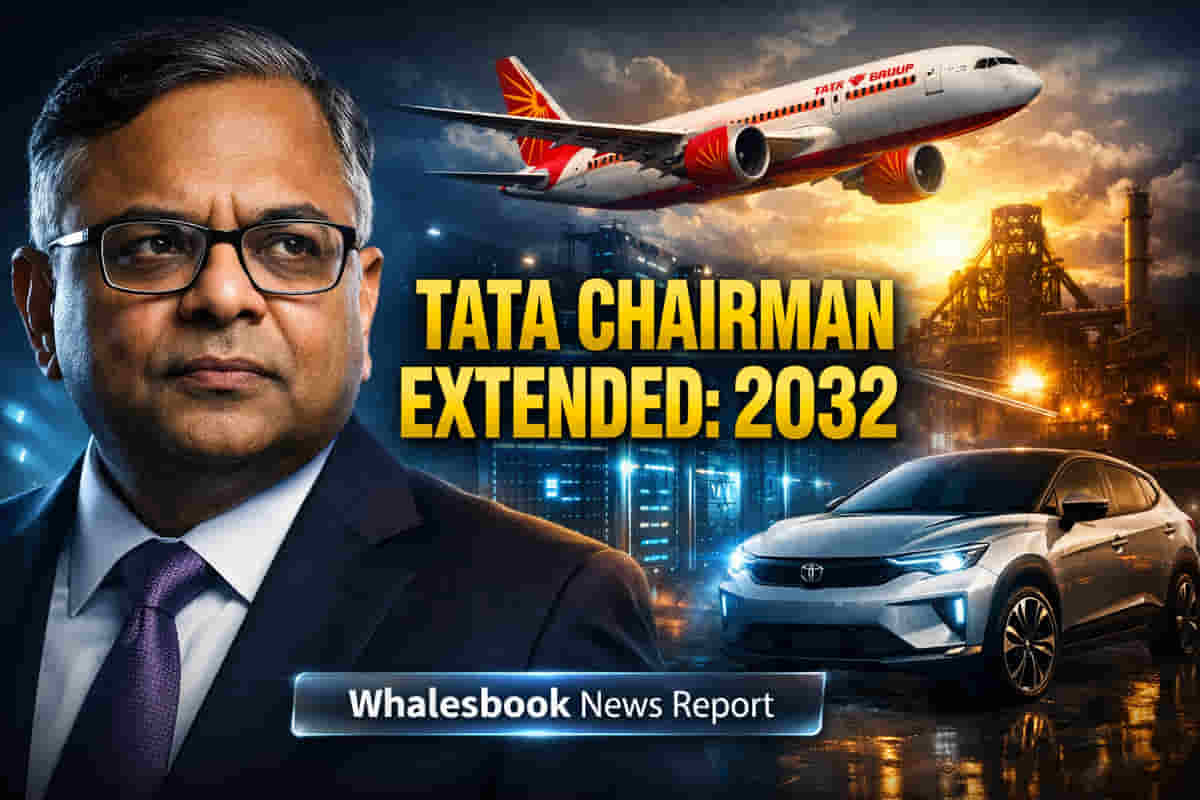
Leadership Extended Amidst Urgency
The Tata Trusts' decision to grant Natarajan Chandrasekaran a third term as chairman, extending his tenure to 2032, underscores a strategic preference for stability and consistent execution. Yet, this leadership continuity arrives at a precipitous moment. The conglomerate faces a deluge of complex, interconnected challenges that demand not just experience, but a rapid pivot towards innovation and decisive action, far exceeding mere consolidation of past achievements. The group's balance sheet, reputation, and strategic trajectory are under intensified scrutiny.
The AI Revolution and IT's Pivot
Tata Consultancy Services (TCS), once India's most valuable company, is directly confronting the disruptive force of artificial intelligence. Despite robust Q3 FY2026 revenues of ₹67,087 crore, the company has seen significant share price corrections, even as the broader market gained. Global excitement around AI breakthroughs and competitor moves have pressured TCS, which has reportedly initiated significant restructuring, including over 30,000 employee reductions by December 2025 [cite: Input 1]. While TCS reports an annualized AI services revenue of $1.8 billion and analysts maintain a consensus 'Buy' rating with price targets suggesting potential double-digit upside, the pace of AI adoption and its impact on margin expansion remain key investor watchpoints. TCS's P/E ratio hovers around 20.8-22.30, broadly in line with peers like Infosys and HCL Technologies, but the market is increasingly focused on future growth acceleration and AI-driven margin improvements.
Automotive Sector Dynamics and EV Race
Tata Motors is undergoing a structural split into commercial and passenger vehicle entities to sharpen focus [cite: Input 1]. While the company has successfully revitalized its domestic passenger vehicle business, particularly in EVs, it faces a rapidly intensifying competitive landscape. Mahindra's new launches, JSW-MG Motor's expansion, and the formidable presence of global players like Tesla and BYD threaten to erode its first-mover advantage in the electric vehicle segment [cite: Input 1]. Despite a significant market capitalization of over ₹1.68 lakh crore, Tata Motors' P/E ratio is notably high at approximately 71.15, significantly above its industry average, signaling high growth expectations that may be challenged by fierce competition.
Steel's Green Transition and European Headwinds
Tata Steel is investing £1.25 billion to convert its Port Talbot plant in the UK to electric arc furnace technology, aiming for reduced emissions and greater scrap utilization, supported by a £500 million UK government grant [cite: Input 1]. Operations are slated to begin by 2027. While Tata Steel was a standout performer in 2025, with gains of 30.4% and significant EBITDA growth of 31% YoY for the nine months ending December 2025, its European operations, particularly the UK, continue to present challenges, reporting an EBITDA loss of £170 million for the same period. Analysts have assigned a mixed outlook, with an average price target suggesting minimal downside, but the ongoing transition and volatile European market remain key risks. The company's current P/E ratio is around 34.5, higher than the industry average of 28.56.
New Ventures, Legacy Drag, and Financial Strains
Aggressive investments in future-facing sectors like semiconductors and battery technology are yielding substantial revenues but also significant losses. Tata Electronics recorded ₹66,000 crore in FY25 revenue but a ₹1,000 crore loss, while Tata Digital, housing platforms like Tata Neu, incurred ₹4,610 crore in losses on ₹32,188 crore revenue [cite: Input 1]. The ambitious Tata Neu super-app faces evolving consumer expectations and execution hurdles. Furthermore, several legacy businesses, including Tata Realty and Tejas Networks, continue to struggle with scale and order backlogs, necessitating clear growth strategies [cite: Input 1]. The Shapoorji Pallonji Group's stated intention to exit its 18.4% stake in Tata Sons, with a valuation demand of approximately ₹1.5 lakh crore, poses a significant financial and strategic hurdle that Chandrasekaran must navigate without destabilizing the holding company [cite: Input 1].
Navigating Geopolitical Shifts and Sectoral Scrutiny
Beyond internal transformations, the Tata Group must also adapt to a volatile global environment characterized by shifting supply chains and geopolitical realignments. The aviation sector, critical to India's connectivity, remains under intense scrutiny following recent accidents, amplifying the urgency for Air India's successful revival in fleet renewal and safety culture [cite: Input 1]. Balancing domestic growth priorities with renewed global ambition will be a defining aspect of Chandrasekaran's extended tenure.