 Whalesbook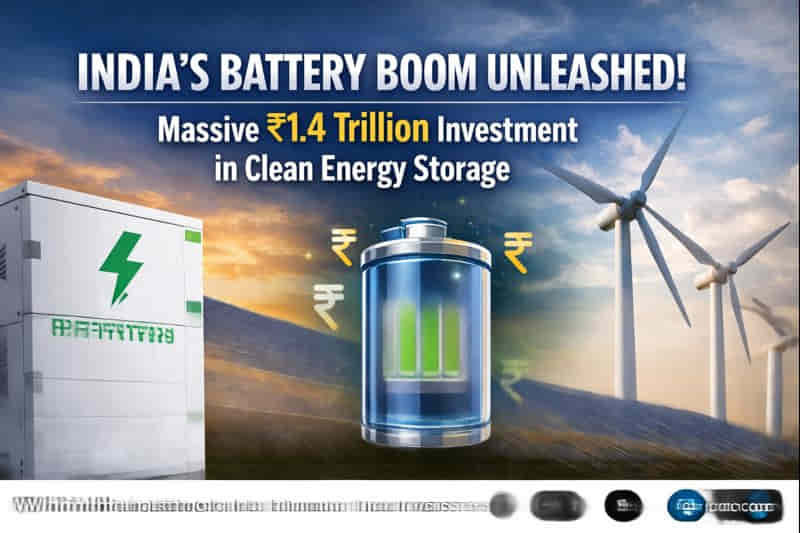
India's Clean Energy Leaps Forward with Massive Battery Storage Investment
Battery storage, once a minor component of India's clean energy strategy, is rapidly becoming a cornerstone. Falling costs and robust government policy are fueling a significant investment cycle in Battery Energy Storage Systems (BESS), promising up to ₹1.4 trillion by 2030. This surge is driven by energy companies, developers, and manufacturers recognizing BESS's vital role in stabilizing intermittent renewable power, ensuring grid reliability, and supporting India's ambitious expansion of solar and wind capacity.
The Core Issue
Renewable energy sources like solar and wind are inherently intermittent; they only generate power when the sun shines or the wind blows. This makes reliable energy storage systems crucial. Without them, India struggles to meet its clean energy targets, fulfill climate commitments, and reduce its reliance on coal-fired power plants. BESS infrastructure is essential to bridge this gap and ensure a consistent power supply.
Financial Implications
The driving force behind this investment boom is a sharp decline in battery prices. Costs have reportedly dropped below $100 per kilowatt-hour (kWh), a significant decrease from nearly $200 per kWh in 2019. Credit rating agency ICRA notes this cost reduction is accelerating grid-level battery adoption. Globally, BESS capacity saw substantial growth in 2025, though India's current cumulative BESS capacity remains modest at around 0.5 gigawatt-hours (GWh). ICRA projects total BESS investments could reach approximately ₹1.4 trillion by 2030, contingent on further price reductions improving project economics.
Policy Tailwinds
Government initiatives are providing a strong push. A ₹5,400-crore viability gap funding (VGF) scheme is designed to support 30 GWh of BESS capacity, aiming to attract private investment. Furthermore, an advisory mandates a minimum of two hours of co-located energy storage for future solar tenders, equating to 10% of installed solar capacity. This policy shift signals that battery storage is evolving from an auxiliary component to core grid infrastructure.
Big-Ticket Investors
Several major Indian conglomerates are leading the charge. Reliance Industries plans a significant 40 GWh battery cell plant by early 2026, scaling to 100 GWh, with initial output for its own renewable energy projects. Waaree Energies is investing over ₹10,000 crore to establish 20 GWh of integrated battery cell and pack manufacturing capacity, focusing on supplying other developers. The Adani Group is developing India's largest BESS project, aiming for 50 GWh by 2030. JSW Energy is establishing a 5 GWh battery assembly facility and targets 40 GWh of energy storage capacity by 2030, also utilizing pumped storage plants.
Why Storage Matters
As India expands its renewable energy portfolio, the need for storage is paramount. Projections indicate a requirement for 34.7 GWh of BESS capacity by the end of fiscal year 2027 and a staggering 236.2 GWh from BESS alone by fiscal year 2032. These figures may even be conservative, as they do not account for potential export hub status or integration with thermal power plants.
Impact
This strategic shift towards battery storage is poised to revolutionize India's energy landscape. It will drive significant capital deployment, foster technological advancements in manufacturing, create jobs, and significantly enhance the reliability and sustainability of the national grid. Achieving these ambitious storage targets is critical for India to meet its climate change obligations and secure its energy future.
Impact Rating: 9/10
Difficult Terms Explained
- Battery Energy Storage Systems (BESS): Large-scale systems using battery packs to store electricity generated from sources like solar and wind. They release this stored energy when needed, smoothing out supply fluctuations.
- Intermittency: The characteristic of renewable energy sources like solar and wind, which produce power inconsistently depending on weather conditions.
- Gigawatt-hour (GWh): A unit of energy measurement, representing one billion watt-hours. It is used to quantify large amounts of energy storage capacity.
- Viability Gap Funding (VGF): A scheme provided by the government to make financially unviable but strategically important projects economically feasible by bridging the gap between project costs and revenue.
- Pumped Storage Plants (PSP): A type of hydropower facility used for large-scale energy storage, typically involving pumping water uphill to a reservoir during periods of low electricity demand and releasing it downhill through turbines to generate electricity during peak demand.
- Co-located energy storage: Energy storage systems that are physically located at the same site as the renewable energy generation facility (e.g., a solar farm).
- Captive BESS projects: Energy storage projects built and primarily used by the company that owns the generation assets, rather than being sold to third parties.