 Whalesbook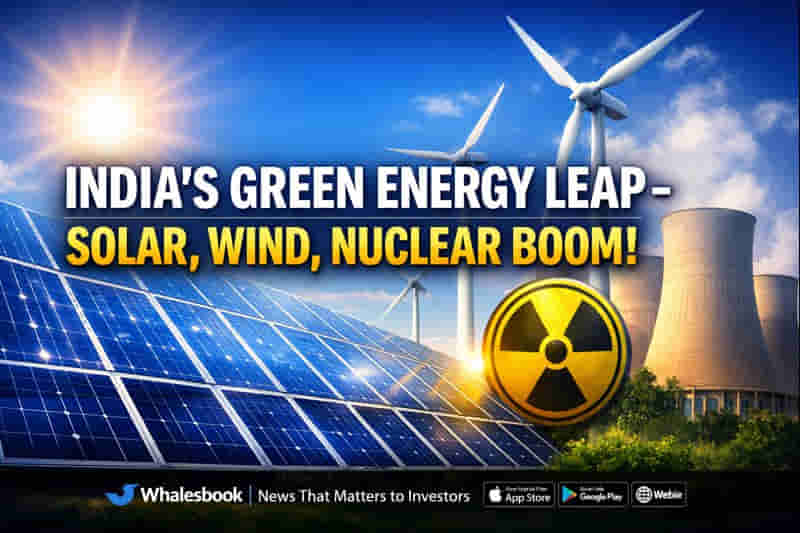
India Surges Ahead in Green Energy Revolution
India's commitment to clean energy has reached new heights in 2025, with significant milestones achieved across solar, wind, and even nuclear power sectors. The nation's installed solar power capacity has officially crossed the 100 gigawatt (GW) mark, a testament to rapid deployment and increasing manufacturing capabilities. Complementing this, solar module manufacturing capacity has also surged past 100 GW, now standing at 122 GW, while cell capacity has reached 27 GW.
Wind Power Gains Momentum
The wind energy sector has similarly seen impressive growth, surpassing the 50 GW installation milestone. In the first half of the current financial year alone, wind power capacity installations touched 3 GW, indicating a trajectory for a record-breaking year. Together, solar and wind power capacities reached 186 GW by the end of November 2025, positioning the country to easily cross the 200 GW threshold by the fiscal year 2025-26.
Expanding Non-Fossil Fuel Capacity
Overall, India's total non-fossil fuel capacity now exceeds 250 GW, representing more than 50 percent of the country's total electricity generation capacity. A critical factor enabling this expansion is the declining cost of battery storage, which facilitates the storage of intermittent renewable energy sources. This advancement allows for a more reliable, load-following supply of renewable energy, making green power a more consistent contributor to the grid.
Government Schemes Drive Adoption
Government initiatives are playing a pivotal role. The residential rooftop solar subsidy scheme, PM Surya Ghar: Muft Bijli Yojana, has seen substantial progress. As of mid-November, nearly 20 lakh rooftop solar systems were installed under this scheme, benefiting 24.5 lakh households. Importantly, over 7.71 lakh beneficiaries have reported zero electricity bills following their installations. The PM Kusum scheme, aimed at empowering farmers with solar power, is also progressing, with 10 lakh solar-powered agricultural pumps expected by year-end against a target of 14 lakh by 2027.
Strategic Policy Enhancements
On the policy front, significant decisions have been made to bolster renewable energy infrastructure. The waiver of Inter-State Transmission System (ISTS) charges has been extended to pumped hydro-storage projects and co-located Battery Energy Storage System (BESS) projects commencing construction before June 30, 2028. This provides a crucial impetus to energy storage solutions. Additionally, the Central Electricity Regulatory Commission's introduction of 'General Network Access' aims to optimize transmission capacity by segmenting the day into solar and non-solar hours, benefiting wind and hydro developers.
Nuclear Power Opens to Private Sector
A landmark development for 2025 is the opening of India's nuclear power business to private investment through the SHANTI Act. This new legislation replaces the Atomic Energy Act of 1962 and the Civil Liability for Nuclear Damage Act of 2010. While challenges related to government control over fuel supplies and tariff fixation may persist, the Act represents a historic step towards greater private participation in the nuclear energy domain.
Climate Action and Global Context
Globally, the focus on climate action saw a welcome emphasis on 'adaptation' at COP30 in Brazil. However, the year was also marked by a negative development: President Donald Trump's announcement of the US exit from the Paris Agreement. India is expected to announce its updated Nationally Determined Contributions (NDCs) soon, a significant step in its climate commitment.
Impact Rating: 8/10
Difficult Terms Explained
- Gigawatt (GW): A unit of power equal to one billion watts, used to measure large-scale electricity generation capacity.
- Intermittent Renewable Energy (RE): Energy sources like solar and wind that are not available constantly, depending on weather conditions.
- Load-following supply: The ability of a power source to adjust its output to match fluctuating electricity demand.
- Residential rooftop solar subsidy scheme: Government financial support to encourage homeowners to install solar panels on their roofs.
- PM Surya Ghar: Muft Bijli Yojana (PMSG–MBY): A specific Indian government scheme offering subsidies for rooftop solar installations for households.
- PM Kusum scheme: A government scheme designed to promote solar energy use among farmers, particularly for agricultural pumps.
- Inter-State Transmission System (ISTS) charges: Fees levied for transmitting electricity across different states in India.
- Pumped hydro-storage projects: Energy storage systems that use electricity to pump water to a higher reservoir and release it to generate power when needed.
- Co-located BESS projects: Battery Energy Storage Systems located at the same site as renewable energy generation facilities.
- Central Electricity Regulatory Commission (CERC): A statutory body that regulates electricity tariffs and other matters in the Indian power sector.
- General Network Access (GNA): A regulatory framework allowing renewable energy generators to access the national grid under defined conditions.
- Virtual Power Purchase Agreements (VPPAs): Financial contracts that allow parties to buy and sell electricity at a fixed price, helping to finance renewable energy projects without direct physical delivery.
- Merchant power capacities: Electricity generated by independent power producers sold directly to consumers or on the open market, rather than through long-term utility contracts.
- SHANTI Act: The proposed new law governing India's nuclear energy sector, aiming to facilitate private participation.
- Atomic Energy Act, 1962: The foundational Indian law governing the use of nuclear energy and atomic materials.
- Civil Liability for Nuclear Damage (CLND) Act of 2010: Indian law establishing the framework for liability in case of nuclear accidents.
- Nationally Determined Contributions (NDCs): Climate action targets submitted by countries under the Paris Agreement.