 Whalesbook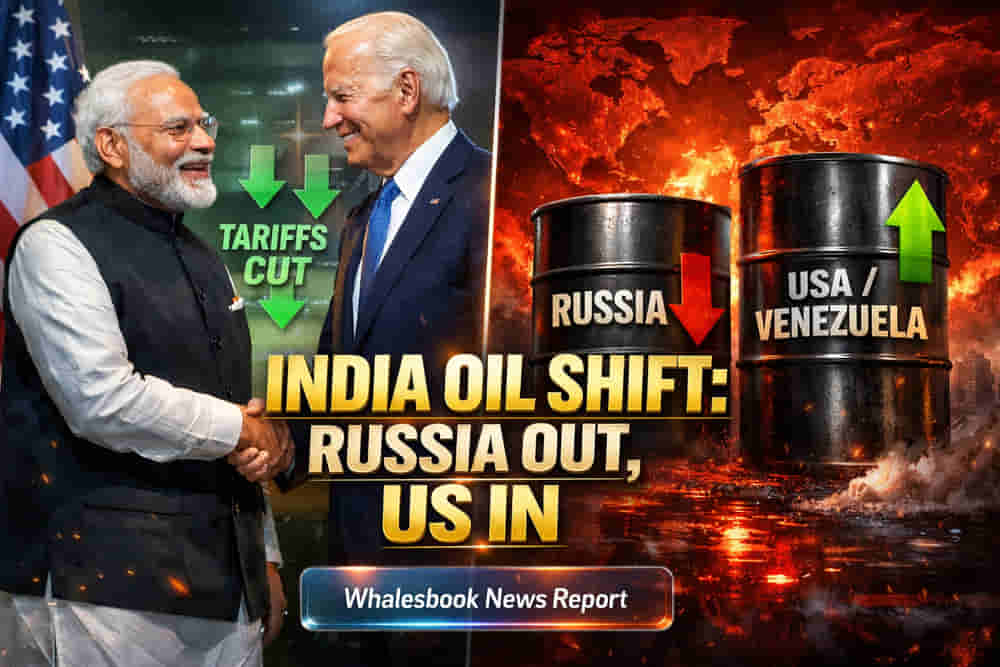
The Geopolitical Oil Pivot
The recently announced trade agreement between the United States and India, brokered by Presidents Donald Trump and Narendra Modi, mandates India's complete withdrawal from Russian oil imports. This accord aims to curb Russian revenue streams supporting its military activities, while simultaneously reshaping global energy trade dynamics. Under the pact, US tariffs on Indian goods are set to decrease from 50% to 18%, contingent on India adhering to reduced purchases of Russian crude and increasing its intake from US and potentially Venezuelan suppliers. This significant policy shift, effective by early 2026, requires a grace period for Indian refiners to manage existing February and March cargo commitments before a full transition. The United States sees this as a critical step to isolate Russia economically, while India navigates the complex challenge of maintaining its energy supply and operational stability. Recent market data shows a softening of crude oil prices, with WTI futures falling below $62 per barrel, influenced by easing geopolitical tensions and a stronger dollar, presenting a mixed backdrop for these supply chain realignments.
Refiner Realignment and Nayara's Challenge
The transition poses immediate operational hurdles for Indian refiners, particularly Nayara Energy. This company, operating India's second-largest single-site refinery with a 20 million metric tonnes per annum (MMTPA) capacity, currently exhibits a substantial dependence on Russian crude. Nayara's reliance intensified after suppliers like Iraq's SOMO and Saudi Aramco reduced their offtake amid payment complications following earlier European Union sanctions. While Nayara plans refinery maintenance in April that will temporarily reduce Russian imports, the long-term impact of this trade pact on its feedstock security is a considerable concern. India's overall refining capacity stands at approximately 5.2 million barrels per day, with major players like Indian Oil Corporation (P/E ratio around 9.02) and Reliance Industries (Market Cap ₹19.6 trillion) navigating a sector heavily reliant on imports, with over 87% of its crude oil needs met externally.
Diversifying Supply Chains Amidst Market Volatility
Indian refiners are actively seeking to diversify their crude sources. Recent data indicates a significant decline in Russian oil imports, with OPEC's share of Indian imports rising to an 11-month high of 65% in December 2025, reflecting a shift towards Middle Eastern, African, and South American suppliers. The potential resumption of Venezuelan oil purchases is being explored, although Venezuela's heavy crude requires specialized refining capabilities and its production is significantly below past peaks, with the US and China being its primary buyers in 2023. Indian refiners, including public sector entities, are reconstructing supplier relationships, while private firms like Reliance Industries have largely abstained from sanctioned Russian crude procurement. This strategic recalibration occurs against a backdrop of global oil price fluctuations influenced by geopolitical developments; for instance, recent easing of tensions between the US and Iran has contributed to price declines. India's historical vulnerability to oil price shocks underscores the strategic importance of this diversification, as adverse shocks have previously impacted its trade balance.
Future Outlook: Energy Security and Operational Resilience
India's role as a major global energy consumer is set to grow, projected to be the largest source of global oil demand growth by 2030. The current energy import strategy, which aims to reduce dependence and enhance security, is being fundamentally tested by this new trade dynamic. Refiners must develop sophisticated crude slate management systems to process a wider range of feedstocks effectively and cost-efficiently. The long-term success of this pivot will depend on securing reliable, economically viable alternative supplies and adapting refining infrastructure. This situation highlights the ongoing tension between geopolitical directives and the operational realities of a sector critical to India's economic stability and growth.