 Whalesbook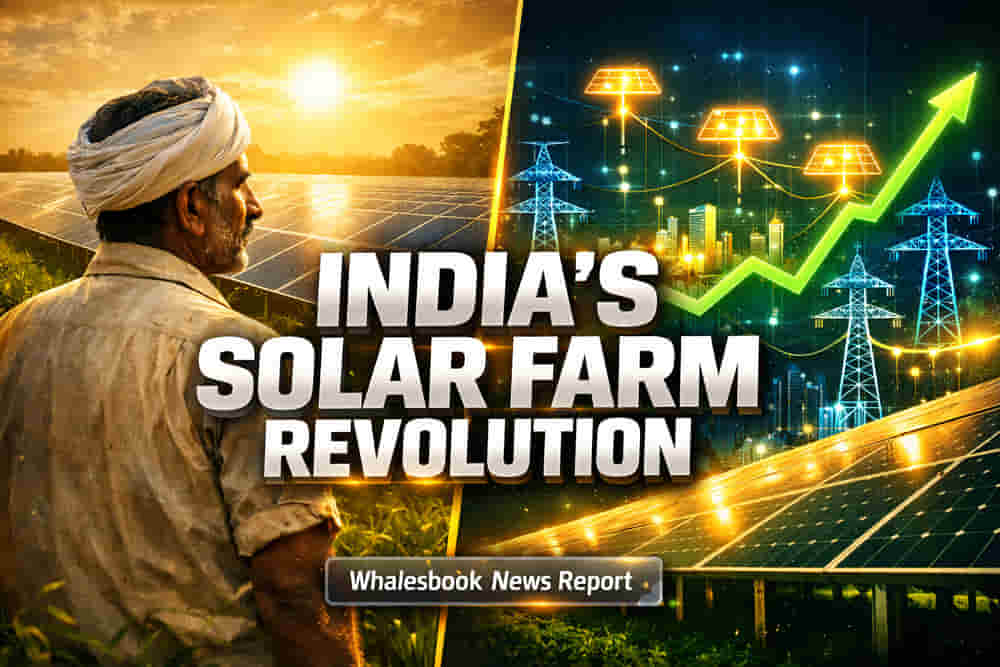
India Prepares for PM-KUSUM 2.0: A New Dawn for Agricultural Solarisation
The Union government is actively preparing for PM-KUSUM 2.0, the next phase of the Pradhan Mantri Kisan Urja Suraksha evam Utthaan Mahabhiyan. This initiative signifies a robust commitment to expanding decentralized solar power across India's agricultural landscape. While the current PM-KUSUM scheme continues to attract significant demand, the government is not formally extending it. Instead, it is charting a course for a successor program designed to address past challenges and enhance farmer-centric renewable energy solutions.
The Core Issue
The current PM-KUSUM scheme, with an outlay of Rs 34,422 crore, aimed to add approximately 34,800 megawatts of solar capacity by March 2026. This included grid-connected plants, standalone solar pumps, and the solarization of agricultural pumps, particularly at the feeder level. As of November, over 10,203 MW had been installed, demonstrating substantial interest. However, implementation has faced hurdles, including delays in payments from electricity distribution companies (discoms), uneven state-level execution, and challenges in accessing finance for farmers.
Financial Implications
PM-KUSUM 2.0 is expected to maintain a similar financial architecture to its predecessor. Central Financial Assistance typically covers around 30 per cent of benchmark costs, with higher support of 50 per cent for hilly and northeastern states. The remaining costs are shared by state governments and beneficiaries. For feeder-level solar plants, the Centre currently provides significant subsidies. Discussions for PM-KUSUM 2.0 suggest that capital expenditure could rise if innovative designs like agro-photovoltaic models or energy storage are incorporated, though specific figures are yet to be finalized.
Addressing Implementation Challenges
Officials indicate that PM-KUSUM 2.0 will incorporate updated components and design features to tackle existing implementation issues. Component A, which supports decentralized grid-connected solar plants, has faced challenges due to low discovered tariffs and financing bottlenecks, including high margin money requirements for farmers. To improve bankability, these projects are being brought under the Agri Infrastructure Fund to enhance access to concessional credit. Component C, focused on feeder-level solarization, is now viewed as the most critical element for large-scale solar adoption, aiming to provide reliable daytime power for agriculture and reduce discom subsidy burdens. Component B, promoting standalone solar pumps, has seen better uptake, especially in areas with unreliable grid supply, though concerns about upfront costs and groundwater over-extraction persist.
Future Outlook
The next phase is likely to place a greater emphasis on feeder-level solarization and encourage increased private participation in decentralized renewable projects. The integration of Component A projects, which can act as generation sources for Component C, is seen as a scalable template. Innovative concepts such as agro-photovoltaic models, allowing cultivation beneath elevated solar structures, are also under discussion to overcome land constraints. Industry stakeholders emphasize the need for payment security, faster approvals, and stronger state-level coordination for PM-KUSUM 2.0 to achieve its ambitious goals. The success of this new phase will be crucial for easing grid stress, reducing subsidy burdens, and ensuring reliable solar power for millions of Indian farmers.
Impact
This government initiative is poised to significantly impact India's renewable energy sector, particularly solar power generation in agriculture. It offers opportunities for renewable energy developers, solar pump manufacturers, and related service providers. For farmers, it promises reduced electricity costs and more reliable power, potentially boosting agricultural productivity. Discoms could benefit from reduced subsidy burdens and improved grid stability. The overall impact on the Indian stock market could be positive for companies involved in solar power generation, equipment manufacturing, and rural infrastructure development.
Impact Rating: 9/10
Difficult Terms Explained
- PM-KUSUM: Pradhan Mantri Kisan Urja Suraksha evam Utthaan Mahabhiyan. A government scheme to promote solar energy use in the agriculture sector.
- Decentralised solar: Solar power generation that is spread out across many small locations rather than being concentrated in large power plants.
- Feeder-level solarisation: Installing solar power systems specifically to meet the electricity demand of an agricultural feeder line, which supplies power to a group of farmers.
- Agro-photovoltaic (agro-PV) models: Systems that combine agriculture and solar power generation on the same land, often by placing solar panels on elevated structures.
- Discoms: Distribution companies responsible for supplying electricity to consumers.
- Benchmark costs: The standard or average cost used to calculate subsidies and financial assistance for projects.
- Agri Infrastructure Fund: A financial scheme launched by the government to support post-harvest management infrastructure and community farming assets.
- DCR norms: Domestic Content Requirement norms, which mandate the use of domestically manufactured solar modules and components.
- Standalone solar pumps: Solar-powered water pumps that operate independently of the main electricity grid.
- Component A, B, C: Refers to the different parts or categories of the PM-KUSUM scheme, each with a specific focus (A: Grid-connected solar plants, B: Standalone solar pumps, C: Solarisation of grid-connected agriculture pumps/feeders).