 Whalesbook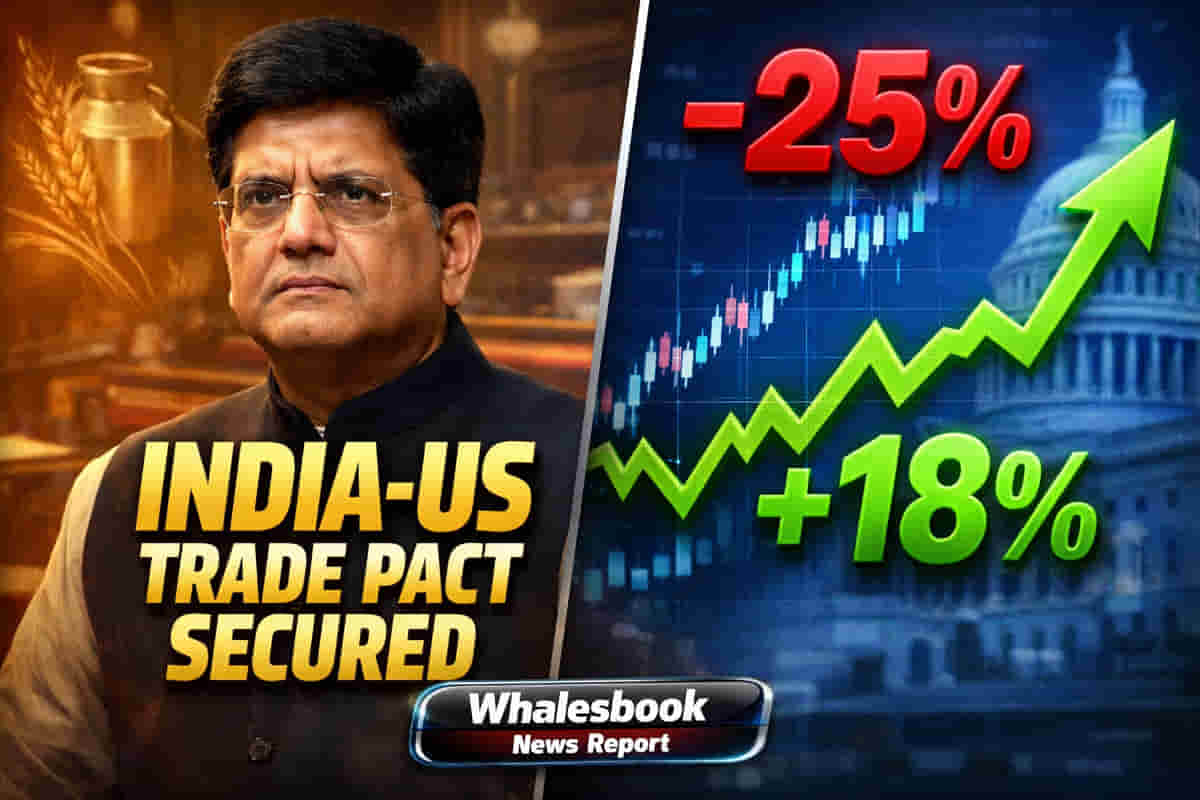
### The Tariff Tangle: Reduced Duties, Lingering Doubts
Washington and New Delhi have reached an initial agreement to de-escalate trade tensions, with the United States committing to reduce tariffs on Indian goods from a peak of 50% down to a new rate of 18%. This significant reduction, which effectively scraps an additional 25% punitive duty previously imposed due to India's continued purchases of Russian crude oil, offers immediate relief to Indian exporters previously burdened by some of the world's steepest import duties. The prior tariff regime had escalated through mid-2025, impacting sectors like textiles, steel, and manufactured goods, and contributing to a widening trade deficit for India, which reached $45.8 billion in 2024. Despite the stated reduction, market participants and analysts caution that the deal, announced via social media pronouncements rather than comprehensive documentation, remains shrouded in ambiguity. The lack of finalized legal texts and sector-specific schedules leaves room for interpretation and potential future disputes.
### Sectoral Realignments and Strategic Concessions
Official statements emphasize the protection afforded to India's sensitive agriculture and dairy sectors, a critical negotiating point that had previously stalled discussions. The agreement is also projected to invigorate labor-intensive industries and Micro, Small, and Medium Enterprises (MSMEs), potentially enhancing their competitiveness against rivals in Vietnam and Bangladesh, which face higher duties. Emerging sectors like artificial intelligence, semiconductors, and critical minerals are also cited as beneficiaries, aligning with India's 'Make in India' and 'Design in India' initiatives. However, concerns persist regarding the perceived imbalance in concessions. Analysts highlight that while US tariffs are reduced to 18%, India may be committing to near-zero tariffs and non-tariff barriers on US imports, a proposition deemed "disconcerting" by some economists. Furthermore, Indian officials have remained notably silent on explicit commitments regarding a halt or significant reduction in Russian oil imports, a key demand from the US President. This strategic alignment, or lack thereof, risks straining India's historical ties with Russia.
### Market Reaction and Future Outlook
The announcement spurred immediate positive market sentiment, with the Indian rupee strengthening by over 1% against the dollar on February 3, 2026, and stock market benchmarks like the Sensex and Nifty rallying significantly. Foreign Portfolio Investors (FPIs), who had withdrawn approximately $12 billion from Indian markets between August 2025 and January 2026, may reassess their positions, potentially boosting capital inflows. Moody's Ratings views the tariff reduction as credit positive for labor-intensive sectors. Despite these short-term gains, the long-term outlook is tempered by considerable uncertainty. The US has historically employed tariffs as leverage, and the transactional nature of this agreement, coupled with unconfirmed commitments such as the $500 billion purchase of US goods—a figure many analysts view as aspirational given US exports to India were $41.5 billion in 2024—suggests a potential for renewed friction. The broader economic context, including fragile global demand and India's ongoing efforts to diversify trade partnerships, particularly its recent FTAs with New Zealand and the EU, will shape how this 'deal' ultimately translates into sustained economic benefit beyond the initial diplomatic fanfare.