 Whalesbook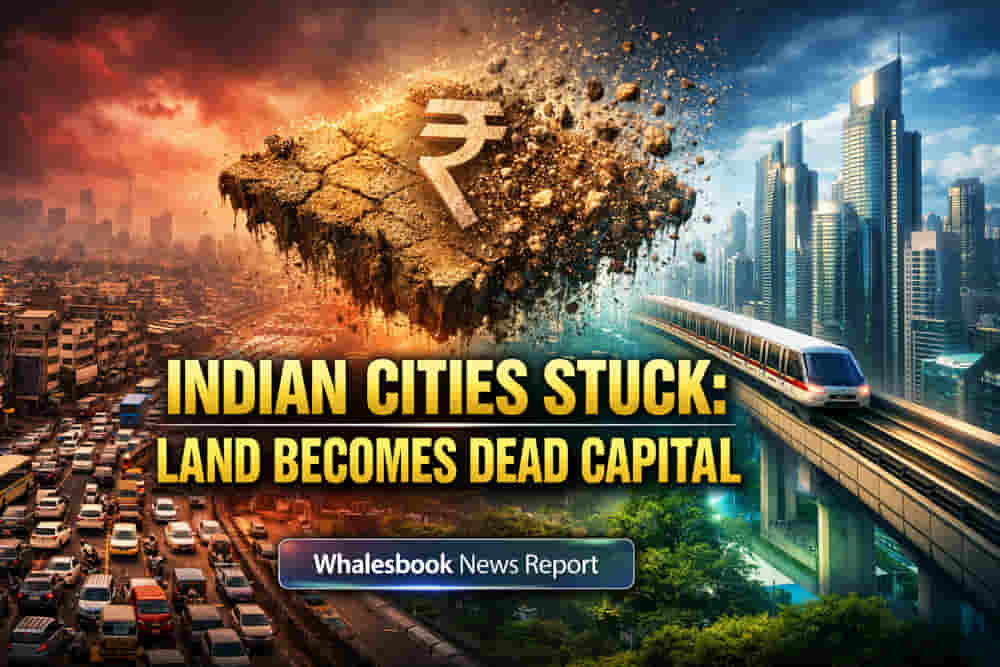
THE SEAMLESS LINK
The Indian real estate sector, despite projected growth and robust demand, faces a significant headwind: a large portion of urban land is locked in a state of 'dead capital'. This condition, as detailed in the Economic Survey 2025-26, implies that valuable urban land assets are not functioning productively due to systemic inefficiencies. The Nifty Realty Index, for instance, experienced a notable downturn in the days leading up to January 29, 2026, reflecting market sensitivity to fundamental economic constraints. The sector's estimated market size of USD 585.09 billion in 2026, with projected growth to USD 926.56 billion by 2031, highlights the immense potential undermined by these core issues.
The 'Dead Capital' Conundrum: Regulation and Title Inertia
The Economic Survey 2025-26 identifies restrictive land-use regulations, primarily in the form of low Floor Space Index (FSI) or Floor Area Ratio (FAR), as a principal culprit. These norms cap the permissible built-up area, forcing urban expansion outward rather than upward. This distortion inflates land values and creates artificial scarcity in prime urban locations, while simultaneously increasing per-unit infrastructure delivery costs. Compared to global hubs like Hong Kong (FSI 25) and New York (FSI 15), Indian cities like Mumbai (FSI 4) and Delhi (FSI 3) exhibit substantially lower ratios, limiting housing supply and driving up prices relative to incomes. Beyond regulatory caps, unclear land titles, market fragmentation, and opaque records further impede land's function as productive capital, preventing its use as collateral or efficient trading. The government's Digital India Land Records Modernisation Programme, including initiatives like ULPIN, aims to address title insecurity.
Sectoral Resilience Meets Urban Planning Challenges
Despite these structural impediments, the Indian real estate market demonstrates resilience. Projections indicate a 9.63% CAGR for the sector from 2026 to 2031, driven by strong corporate leasing, institutional investment, and demand for residential, commercial, and industrial spaces. Average home prices rose by 13-15% in FY25 and are expected to climb further. However, the 'dead capital' issue presents a paradox: while the sector aims for expansion, fundamental constraints on land utilization persist. The survey cautions that simply increasing FSI without augmenting supporting infrastructure could lead to unproductive outcomes such as increased congestion and strained services. Successful global cities pair density with robust public transportation, sanitation, and water supply systems. Regional initiatives, such as Chennai Metropolitan Development Authority's (CMDA) third master plan, are reportedly considering higher FSI and mixed-use development to encourage compact, vertical growth. The Ministry of Housing and Urban Affairs also promotes transit-oriented development (TOD) plans.
Outlook: Navigating Constraints with Policy Reforms
India's urban land remains significantly underutilized as productive capital, a finding echoed by the Economic Survey 2025-26. The challenges of restrictive density norms and title issues directly counteract the nation's rapid urbanization and economic growth. While policy interventions like the National Real Estate Policy 2025's single-window clearance system and the Union Budget 2025-26's allocation to the Urban Challenge Fund signal a move towards reform, a fundamental rethinking of land-use regulations and titling processes is necessary. The recent market performance, with the Nifty Realty Index showing volatility, underscores investor awareness of these systemic issues. The future trajectory of India's real estate market will depend on the effective translation of these policy discussions into actionable reforms that unlock the true potential of urban land.