 Whalesbook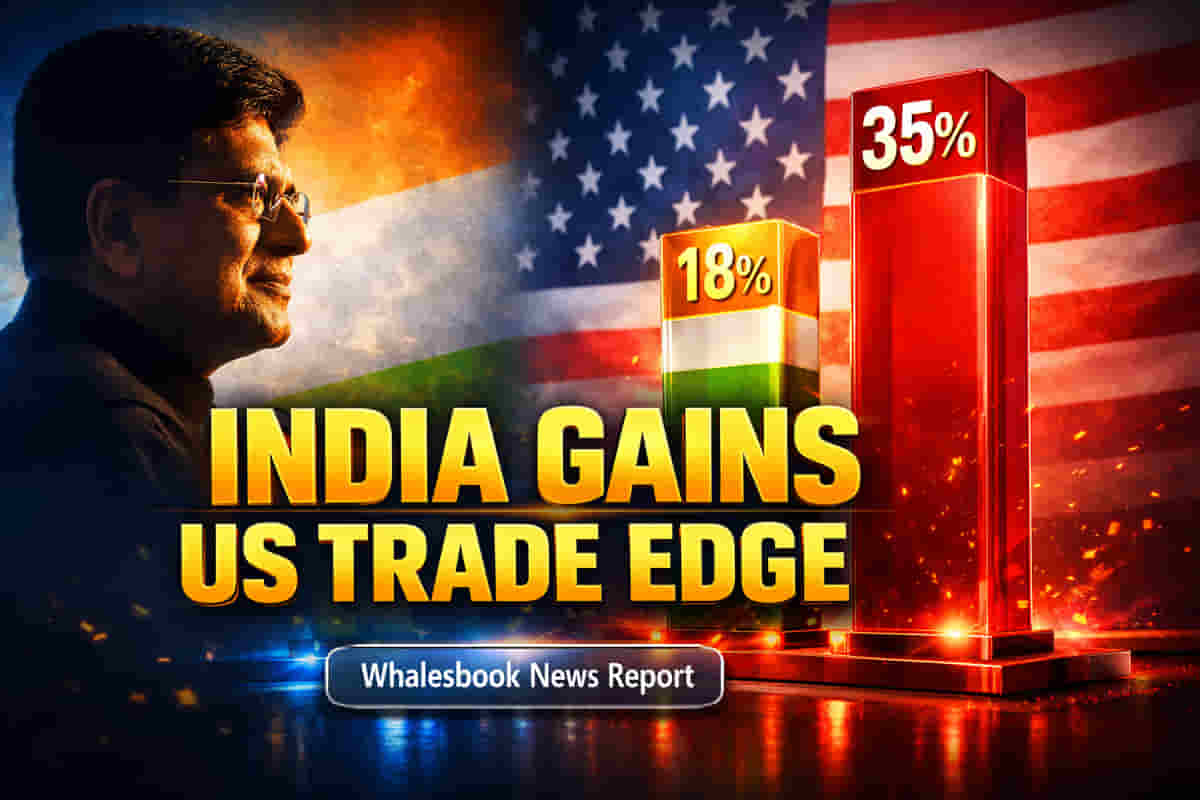
India Secures 18% US Tariff Rate Amidst Strategic Concessions
The recent interim trade framework between India and the United States marks a significant recalibration of bilateral trade relations, lowering the United States' tariff on most Indian imports to 18 percent from a peak of 50 percent. This rollback, effective February 2, 2026, aims to restore India's competitive standing in the US market, positioning it more favorably than China (35% tariff) and other nations facing duties of 19 percent or more. The previous 50 percent tariff was a culmination of a 25 percent reciprocal duty and an additional 25 percent punitive tariff, largely implemented in response to India's procurement of Russian oil.
Sectoral Divergence: Winners and Lingering Concerns
The reduction in tariffs is expected to be a boon for export-oriented industries. Textiles, a sector with an 8% share of US imports, is identified as a key beneficiary, with stocks surging as the 18% rate provides a distinct advantage over Asian competitors facing 20-30% duties. Similarly, the capital goods and engineering sectors, accounting for 8.1% of India's exports to the US, stand to benefit from reduced costs for machinery and equipment, potentially stimulating domestic steel consumption as well. The automotive sector also sees optimism, though specific components still face 25% duties, and India has strategically excluded electric vehicles (EVs) from tariff concessions to protect its nascent domestic industry.
Conversely, the information technology (IT) sector faces a starkly different outlook. Amidst fears that advancements in Artificial Intelligence could disrupt traditional outsourcing models, major Indian IT firms experienced significant stock declines, with the Nifty IT index dropping 5.87% on February 4, 2026. This highlights a growing divergence where trade policy benefits one segment while technological shifts challenge another.
Deeper Dive: The 'Alpha Angle' Analysis
### The Competitive Edge Re-examined
The proclaimed "competitive advantage" hinges on the 18% tariff rate, which is notably lower than China's 35% or 47.5% and other countries' 19-20% rates. This improved positioning directly benefits sectors like textiles, where India's share in US imports has grown while China's has contracted. Machinery and equipment exports, critical for capital goods, also see an immediate reduction in landed costs, enhancing their competitiveness. However, this advantage is tempered by India's commitment to eliminate or reduce tariffs on a wide range of US industrial, food, and agricultural products, potentially increasing import competition in certain domestic markets.
### Sectoral Benchmarking and Valuations
IT Sector Pressure: The Nifty IT index trades at a P/E of approximately 25.3, with key players like TCS and Infosys having P/Es around 20.82 and 21.18 respectively. This valuation appears high given the looming threat of AI-driven automation reducing demand for outsourcing services.
Textiles Sector Momentum: Companies like KPR Mill (P/E 40.98) and Trident (P/E 38.15) are set to capitalize on the tariff reduction. Their improved export competitiveness, coupled with recent trade deals with the UK and EU, expands their market access significantly.
Automotive Component Resilience: While the broader auto sector gains, auto components still face a 25% duty in the US. Companies like Bharat Forge, a key player in this segment, might see a more muted benefit compared to sectors with direct tariff relief.
Pharmaceuticals: India's pharmaceutical sector, a major global supplier of generic drugs, faces mild profit-taking. While the deal is expected to ease access, the sector's P/E ratios, such as Divi's Lab at 64.36 and Sun Pharma at 33.51, reflect existing market expectations, with the deal's primary impact likely being on export accessibility rather than immediate valuation shifts.
### The Forensic Bear Case
While the 18% tariff is a significant rollback from 50%, it represents a negotiation from a position of considerable prior disadvantage. India's concessions are substantial: agreeing to halt Russian oil purchases, shifting sourcing to the US, adopting 'Buy American' policies, and pledging to purchase over $500 billion in US goods over five years. This commitment to US imports, while potentially boosting trade, raises questions about the net benefit and whether it will displace domestic production or other trade partners. Furthermore, critical barriers persist for certain Indian industries. US Section 232 tariffs on steel and aluminum remain at 50%, impacting steel-intensive exporters, and auto components are still subject to 25% duties. The narrative of a clear 'competitive advantage' is complicated by the existential threat posed by AI to the IT sector, India's traditional export engine, which has led to significant market sell-offs. The deal's benefits appear unevenly distributed, creating potential for economic dislocation rather than a uniform uplift across all export segments. Questions also linger over the specifics of the bilateral trade agreement (BTA) negotiations, which are still ongoing, leaving the full scope of long-term implications uncertain.
Future Outlook
The framework agreement is a stepping stone towards a broader US-India Bilateral Trade Agreement (BTA), with negotiations continuing. India's economic growth is projected to continue around 7%, with ambitious targets to reach $30-35 trillion by 2047. The recent trade deal has injected optimism, driving a rally in benchmark indices like the Nifty 50, which closed near its high on February 7, 2026, defending key support levels. However, the market faces upcoming corporate earnings seasons, which may introduce volatility. Analysts maintain a positive stance on equities, with Nifty targets around 29,500, but emphasize the need for careful monitoring of sector-specific performance and the evolving geopolitical trade landscape.