 Whalesbook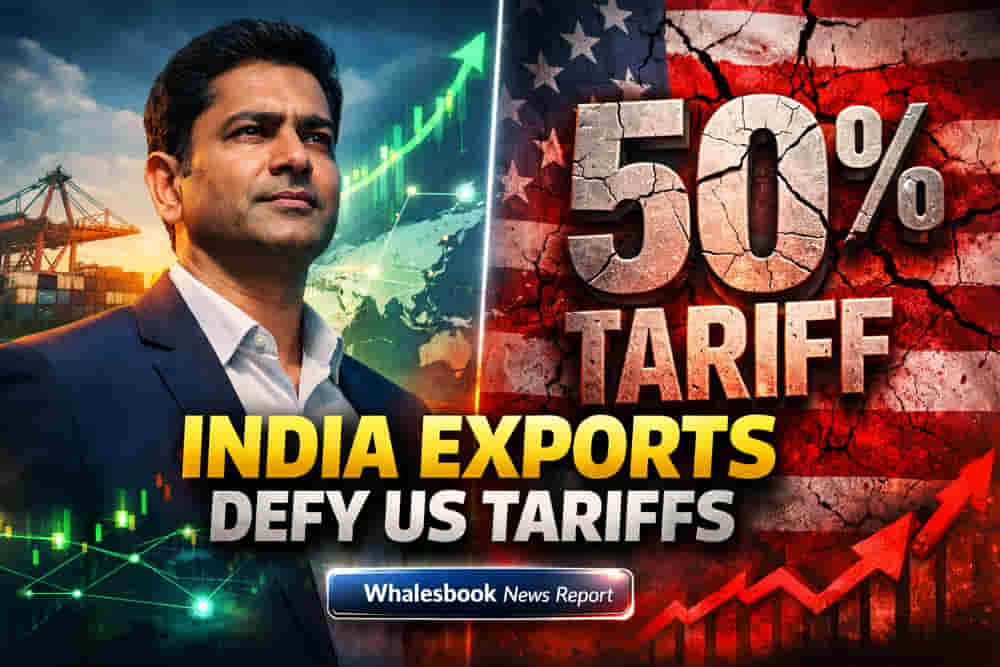
India's Export Resilience Shines Amidst Global Challenges
India's export sector is demonstrating extraordinary resilience, successfully navigating a challenging global landscape characterized by rising tariffs, geopolitical instability, and supply chain disruptions. Despite a significant 50% US tariff imposed in 2025, Indian exporters have pivoted, diversifying their markets and maintaining robust growth momentum. This agility suggests that the positive trajectory is likely to extend well into 2026, defying initial concerns about trade fragmentation.
The nation's ability to adapt has been likened to water finding its own course, a testament to the strategic adjustments made in response to numerous global shocks. From the Covid-19 pandemic to the Russia-Ukraine war, the Red Sea shipping crisis, and semiconductor shortages, Indian trade has consistently shown an ability to weather storms and find new avenues for growth.
Navigating Tariff Headwinds
The imposition of steep tariffs by the United States, India's largest trading partner, presented a significant hurdle. Shipments to the US experienced impacts in September and October 2025 due to these measures. However, a notable surge of 22.61% in November 2025, reaching $6.98 billion, indicates a degree of recovery and adaptation even in the face of this pressure. Exporters remain watchful, however, pinning hopes on potential bilateral trade agreements with the US and the European Union to further ease market access.
Resilience Amidst Global Uncertainty
The World Trade Organization (WTO) has projected a modest 2.4% growth for global trade in 2025, with a further downgrade to 0.5% for 2026, citing increased tariffs, trade policy uncertainty, and slowing GDP growth in developed economies. Despite this cautious global outlook, India's export figures paint a brighter picture. Merchandise exports reached $395.5 billion in 2021, $453.3 billion in 2022, dipped to $389.5 billion in 2023, but rebounded to $443 billion in 2024. For 2025 (January-November), exports stood at $407 billion, contributing to a historic high of $825.25 billion for goods and services in FY 2024-25, marking over 6% year-on-year growth.
Drivers of Future Growth
Commerce Secretary Rajesh Agrawal expressed optimism for continued solid growth in 2026, bolstered by upcoming free trade agreements (FTAs) with the United Kingdom, Oman, and New Zealand. These agreements are expected to unlock enhanced market access. Government initiatives, including an export promotion mission worth ₹25,060 crore and extending collateral-free credit facilities up to ₹20,000 crore, further support exporters. Measures like debt moratoriums and leveraging FTAs are also key components of the strategy to mitigate uncertainties.
Sectoral Strength and Diversification
Experts like Rudra Kumar Pandey highlight that India's export outlook for 2026 is driven by structural shifts rather than cyclical global recovery. Electronics exports saw a significant rise of nearly 39% in November 2025, fueled by foreign direct investment and integration into global value chains. Engineering goods, pharmaceuticals, and automotive exports continue to bolster this momentum. Geographic diversification is also a key feature, with exports spreading across Europe, East Asia, and South Asia, alongside continued strength in traditional markets like the US and UAE. Federation of Indian Export Organisations Director General Ajay Sahai points to expanding trade partnerships and India's improving ease of doing business as crucial factors.
Challenges Ahead
Despite the positive outlook, challenges persist. Geopolitical tensions, trade fragmentation, slower growth in developed markets, and rising protectionism including carbon-related measures and non-tariff barriers could increase compliance costs. Exchange-rate volatility, high freight and insurance costs, and tighter global financing conditions pose risks, particularly for Micro, Small, and Medium Enterprises (MSMEs). The Indian Rupee's depreciation of about 5% in 2025 adds another layer of complexity.
Impact
This resilience in exports is crucial for India's economic growth, contributing to foreign exchange reserves, employment generation, and overall GDP. A strong export sector can positively influence the Indian stock market by boosting corporate earnings, enhancing investor confidence, and strengthening the rupee. The diversification strategy reduces reliance on any single market, making the economy more robust against external shocks.
Impact Rating: 8/10
Difficult Terms Explained
- Tariffs: Taxes imposed by a government on imported or exported goods.
- Resilience: The ability of a system or entity to withstand or recover quickly from difficult conditions.
- Geopolitical Conflicts: Disputes between nations arising from political, economic, or strategic factors.
- Supply Chain Disruptions: Interruptions in the normal flow of goods and services from production to consumption.
- Merchandise Exports: Goods that are physically shipped out of a country.
- Free Trade Agreements (FTAs): Treaties between countries to reduce or eliminate barriers to trade, such as tariffs and quotas.
- Market Access: The ability for businesses to sell their products and services in a particular country or region.
- Global Headwinds: External factors that negatively affect economic growth or business performance.
- Foreign Direct Investment (FDI): An investment made by a company or individual in one country into business interests located in another country.
- Global Value Chains: The entire range of activities (design, production, marketing, distribution, after-sales service) required to bring a product from conception to the end consumer.
- Non-Tariff Barriers: Trade restrictions that are not customs duties, such as import quotas, sanctions, embargoes, and levies.
- MSMEs: Micro, Small, and Medium Enterprises, which are small-scale businesses crucial for employment and economic activity.