 Whalesbook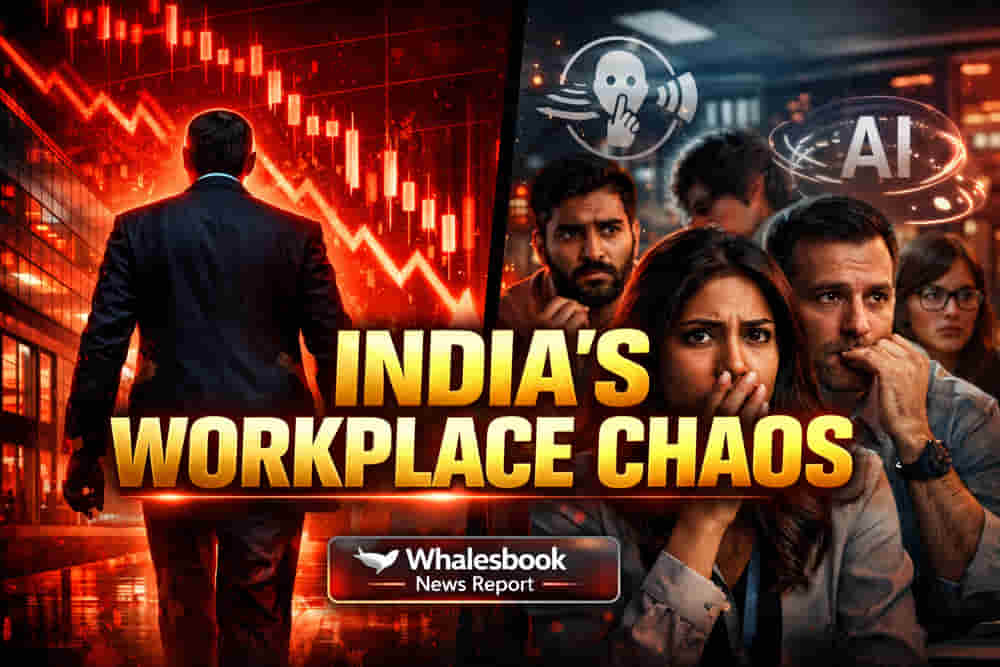
The Year of Corporate Upheaval in India
2025 has been a defining year for India's corporate landscape, marked by significant turbulence across leadership, workforce management, and ethical conduct. Investors have navigated a period of unprecedented disruption, with high-profile CEO exits, widespread layoffs, and major governance scandals reshaping the business environment. These events have not only impacted company valuations but also raised critical questions about the sustainability of India Inc's growth model and its treatment of employees.
Leadership Transitions and Governance Lapses
A stark trend observed in 2025 was the unusually high rate of CEO exits. Data from Spencer Stuart indicated that 16 CEOs stepped down from BSE 200 companies in the first half alone, a pace not seen since 2020. Broader figures showed 141 CEO and managing director resignations across NSE-listed companies in FY2024-25. This elevated churn suggests increased board pressure on leadership amidst mounting strategic challenges and a demand for quicker course corrections.
The financial sector bore witness to a significant governance scandal involving IndusInd Bank. In March 2025, the bank disclosed substantial accounting discrepancies related to forex derivative valuations. This revelation led to a sharp decline in its market value, wiping out nearly a quarter of its worth in a single trading session. The immediate fallout saw the resignation of the bank's CEO and other senior executives, who cited "moral responsibility." The Securities and Exchange Board of India (SEBI) intensified its scrutiny, barring former executives due to allegations of insider trading prior to the disclosure. This episode cast a shadow over governance standards and internal controls at a prominent private lender.
Workforce Adjustments and Employee Concerns
The IT services giant, Tata Consultancy Services (TCS), faced considerable backlash after announcing layoffs impacting approximately 12,000 employees. The company positioned the move as part of an AI-led restructuring. However, it triggered widespread debate regarding "forced exits" and the fairness of mid-career layoffs within India's largest private sector employer. Employee groups voiced concerns, alleging that many were subtly nudged towards resignation rather than formal termination. The controversy was amplified by public scrutiny over high senior executive compensation packages during these large-scale job cuts, reigniting discussions on the need for more transparent and empathetic layoff frameworks in India.
Startups, once a beacon of growth, also experienced significant job losses as funding conditions tightened. Companies in AI, fintech, gaming, and logistics collectively cut hundreds of roles. Over 6,700 startup job losses were recorded, including notable instances like conversational AI unicorn Gupshup laying off 500 employees and Ola Electric terminating 1,000 roles due to automation. Founders faced criticism for abrupt communication, unclear severance packages, and a disconnect between employer branding and actual practices.
The Debate on Work Hours and Culture
The discourse on work-life balance intensified with comments from L&T Chairman SN Subrahmanyan in early 2025. Following similar remarks by Infosys founder Narayan Murthy in 2024, Subrahmanyan suggested employees should be prepared to work up to 90 hours a week, even on Sundays. His statements, particularly the remark about being happier if employees worked Sundays and his rationale about activities at home, were widely condemned as dismissive of employee well-being. This sparked immediate backlash from employees and labor groups, highlighting what they described as toxic expectations prevalent across corporate India. Gen Z and millennial professionals leveraged the moment to emphasize the ongoing issues of long hours, late-night communications, and unrealistic demands across sectors.
The Rise of 'Silent Firing'
Adding to the workforce volatility was the disturbing trend of 'silent firing' or 'quiet firing'. Reports indicated an increasing number of companies subtly pushing employees towards resignation without formal termination notices. This was achieved by sidelining workers, reducing responsibilities, excluding them from communications, delaying appraisals, or denying growth opportunities. This tactic allowed companies to reduce headcount while avoiding severance obligations and the public scrutiny associated with overt layoffs. The tech sector, in particular, saw a rise in these opaque methods, with mid-career professionals being particularly vulnerable amidst AI-driven restructuring and cost-cutting efforts.
Market Reaction and Future Outlook
The cumulative effect of these controversies has amplified investor caution. Governance issues, mass layoffs, and cultural debates put pressure on corporate India to enhance transparency, accountability, and employee welfare. The record CEO churn signals a board-level imperative for strategic agility and performance. For investors, this period underscores the importance of diligent due diligence, focusing on companies with strong governance, sustainable business models, and a commitment to employee well-being. The growing voice of Gen Z and younger millennials demanding better work-life balance and ethical treatment is likely to force further introspection and change within India Inc. The events of 2025 may well prove to be a pivotal turning point in shaping the future of work and corporate culture in India.
Impact
This news has a significant impact on the Indian stock market and Indian businesses by highlighting potential risks associated with corporate governance, workforce stability, and ethical practices. Scandals and mass layoffs can lead to stock price volatility, reduced investor confidence, and increased regulatory scrutiny, affecting market returns. It also influences employee sentiment and employer branding, which are crucial for talent acquisition and retention in Indian businesses.
Impact Rating: 9/10
Difficult Terms Explained
- CEO exits: Chief Executive Officers leaving their positions.
- Governance lapses: Failures in a company's system of rules, practices, and processes by which it is directed and controlled.
- Toxic culture: A workplace environment that is unhealthy, abusive, or detrimental to employee well-being.
- Silent layoffs: A practice where companies aim to reduce headcount by subtly pressuring employees to resign, rather than formal termination.
- AI-led restructuring: Reorganizing business operations by integrating Artificial Intelligence, often impacting job roles.
- Forex derivatives: Financial contracts whose value is based on currency exchange rates.
- SEBI: Securities and Exchange Board of India, the market regulator.
- Insider activity: Trading based on non-public information, which is illegal.
- Mid-career layoffs: Job cuts affecting employees who are in the middle stages of their professional lives.
- Severance structures: The terms and conditions for compensation and benefits provided to employees upon leaving a company.
- Work-life balance: The equilibrium between professional and personal life.
- Gen Z employees: Individuals born roughly between the mid-1990s and early 2010s, known for distinct workplace expectations.
- BSE 200 companies: A stock market index representing the top 200 companies listed on the Bombay Stock Exchange.
- NSE-listed companies: Companies whose shares are traded on the National Stock Exchange of India.