 Whalesbook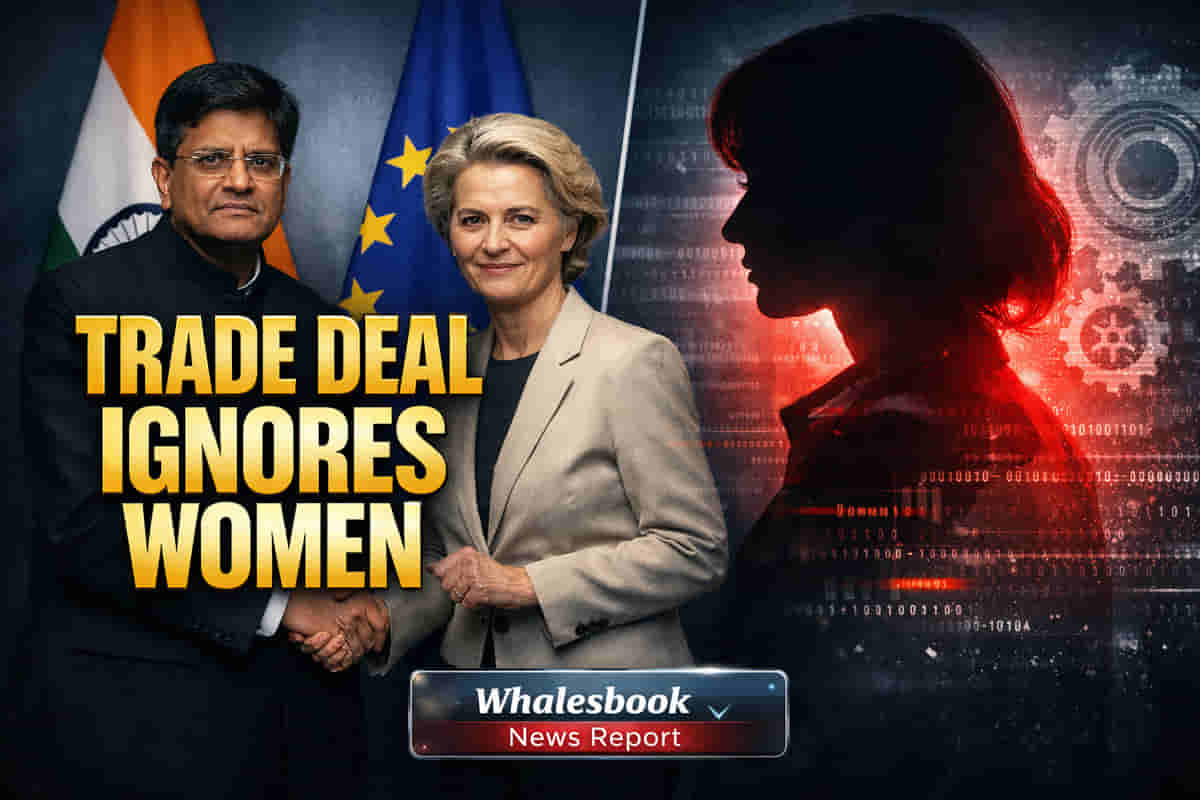
The 'Mother of All Deals' and Its Gendered Shadow
The conclusion of the India-European Union Free Trade Agreement (FTA) on January 27, 2026, has been widely celebrated as a landmark achievement, with Union Minister Piyush Goyal and European Commission President Ursula von der Leyen calling it the “Mother of all Deals.” This agreement promises significant tariff liberalizations and enhanced market access, particularly for labour-intensive sectors like textiles, apparel, leather, and food processing, which are crucial for women's employment in India [3, 12]. While the FTA includes provisions referencing relevant UN and ILO conventions on advancing women's economic empowerment and gender equality, and promotes cooperation in international forums [13], a deeper examination reveals a systemic oversight of gender dimensions that could undermine its inclusive potential.
Pre-existing Asymmetries and Trade's Unintended Consequences
The narrative of trade liberalization often assumes neutral economic agents, overlooking the deeply gendered structure of developing economies like India. Women consistently face systemic disadvantages in accessing land, credit, skills, and technology, concentrating them in informal employment and low-productivity activities [cite:original_news]. Historical analysis of India's trade liberalization in the 1990s indicates that output tariff reductions were associated with a reduced share of female workers in certain establishments, partly due to increased shifts per worker and legal constraints on women's working hours [8, 14, 16, 19]. This suggests that without explicit, proactive measures, trade policy benefits may not automatically translate into gains for women, and could even exacerbate existing inequalities [15, 28].
Sectoral Impacts and MSME Challenges
Key sectors targeted by the FTA, such as textiles and apparel, are significant employers of women, with estimates suggesting that women comprise a substantial portion of the workforce in garment manufacturing and artisanal clusters [3]. While the agreement aims to boost exports and employment in these sectors by removing tariffs, historical evidence indicates that trade liberalization can lead to wage cuts and precarious working conditions for vulnerable labour, including women [cite:original_news]. Similarly, in agriculture, while women are primary workers, they often lack formal recognition and access to resources like land titles, making them vulnerable to competition from capital-intensive systems [5].
Women-led Micro, Small, and Medium Enterprises (MSMEs) represent another critical area. While India has a robust MSME sector contributing significantly to exports, women entrepreneurs face substantial barriers in accessing finance, markets, and supportive infrastructure due to gender biases, lack of collateral, and societal norms [6, 21, 31]. Although the FTA reportedly includes provisions to support women entrepreneurs through simplified procedures and improved market access [10], their ability to leverage these opportunities will depend on addressing these deep-seated structural challenges.
Global Value Chains and the Path Forward
Global Value Chains (GVCs) offer both opportunities and risks. While GVC participation can lead to higher wages and better working conditions, women often remain confined to the lower tiers of these chains, with upgrading bypassing them [cite:original_news]. Research indicates that participation in GVCs has not significantly improved relative wages for female workers in India [20]. To ensure the FTA contributes to equitable growth, it is essential to move beyond general provisions and implement concrete, gender-responsive strategies. This includes collecting gender-disaggregated data, conducting thorough gender-impact assessments before and during trade agreement implementation, and fostering women's participation across all value chain segments [11, 13, 35]. The EU itself has a framework for mainstreaming gender into trade policy [4], and recent agreements, like the India-UK FTA, have incorporated standalone gender chapters, setting a potential precedent [11]. However, concerns persist that certain gender clauses could inadvertently create new trade barriers [2].
Integrating Gender for Sustainable Globalization
Ultimately, the success of the India-EU FTA in fostering inclusive growth hinges on its ability to address gender inequalities. A gender-responsive trade policy is not merely an add-on but a prerequisite for sustainable and legitimate globalization [cite:original_news]. Countries that fail to fully utilize female talent and ensure their equitable participation in trade incur significant productivity losses [cite:original_news]. For the India-EU FTA to truly live up to its "Mother of all Deals" moniker, it must translate into tangible improvements in women's economic empowerment, skills development, and access to secure, decent work, thereby enhancing overall competitiveness and resilience.