 Whalesbook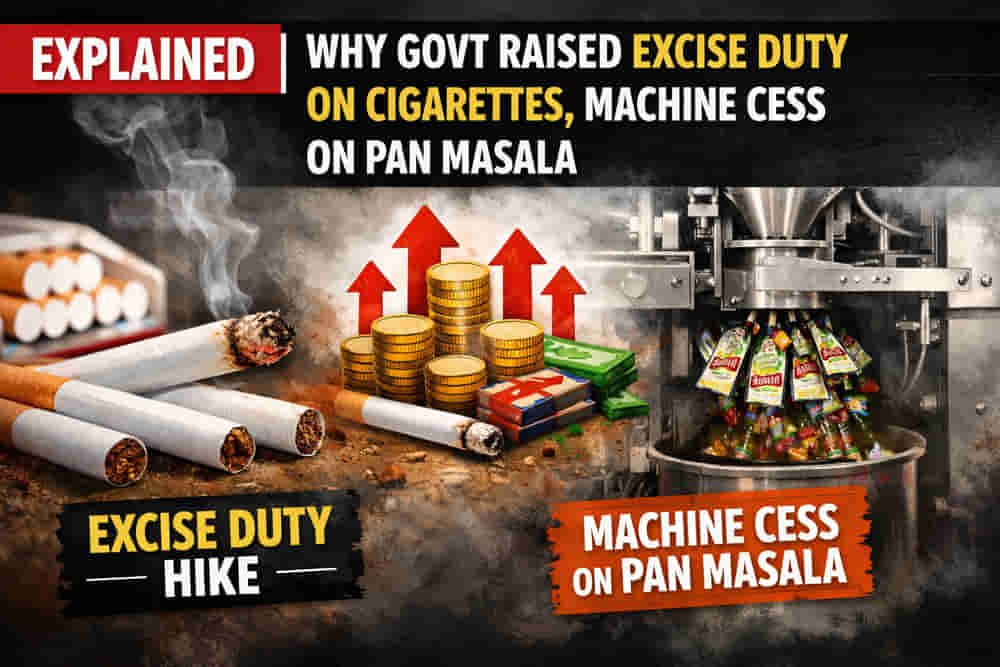
India Boosts 'Sin Taxes' on Cigarettes and Pan Masala
The Indian government has enacted substantial changes to its taxation of tobacco and pan masala products, representing a significant recalibration of its 'sin tax' framework. This includes a notable increase in excise duty on cigarettes and the introduction of a new machine-capacity-based cess on pan masala. Officials state these measures are crucial for preventing revenue leakage, safeguarding public health, and securing funding for national security initiatives. These policy adjustments come at a time when the Goods and Services Tax (GST) Compensation Cess is nearing its sunset date.
The government views these changes as long overdue, constitutionally sound, and essential to align fiscal policy with public health and national security goals. The move marks a departure from a seven-year period of minimal revision in cigarette taxes and addresses long-standing issues of tax evasion within the pan masala sector.
The Core Issue: Cigarette Taxation Freeze and Public Health
Since the implementation of GST in 2017, the basic excise duty on cigarettes had remained stagnant for most categories, dropping to as low as ₹5 per 1,000 sticks. This contrasts sharply with India's pre-GST regime, where duties were substantially higher, ranging from ₹1,585 to ₹4,170 per 100 sticks depending on length and filter type.
Despite rising incomes and inflation, neither GST nor the Compensation Cess on cigarettes was revised between 2017 and 2024. Global evidence from the World Health Organization (WHO) and World Bank indicates that cigarette affordability in India has stagnated or even increased during this period. This trend undermines the effectiveness of tobacco taxation as a public health tool, as cheaper cigarettes can lead to increased consumption.
With the GST Compensation Cess scheduled to end, the government argued that restoring excise duties was imperative. This aims to prevent cigarettes from becoming cheaper in real terms and to maintain revenue buoyancy. Many countries, including over 80 globally, revise tobacco taxes annually, often indexing them to inflation or income growth, making India's extended pause an anomaly.
Addressing Pan Masala Evasion
Pan masala and smokeless tobacco products have long been identified as highly prone to evasion within India's indirect tax system. Production typically occurs on high-speed form-fill-seal (FFS) machines capable of packing hundreds or even thousands of pouches per minute. The sheer speed of these machines makes manual counting of output practically impossible, facilitating under-reporting of production.
Historically, enforcement agencies have uncovered widespread issues such as the use of undeclared machines, misrepresentation of pouch weights, and diversion of untaxed stock. The government contends that a levy based on machine capacity is the most reliable proxy for actual production potential. This new system uses objective parameters like machine speed, number of tracks, motor RPM, and pouch weight to determine tax liability, with higher-capacity machines attracting higher levies.
Maintaining the Tax Burden
The government emphasizes that this policy shift does not reduce the overall tax burden on pan masala. With the GST Compensation Cess expiring, there was a significant risk that the total tax burden, currently around 88%, could fall to the GST ceiling of 40%. To prevent this, the GST rate on pan masala has been increased from 28% to 40%. The remaining tax burden is now shifted to a new Health Security and National Security Cess, calculated based on machine capacity.
The combined incidence of GST and the new cess is designed to remain broadly equivalent to the previous GST-plus-Compensation-Cess regime. This ensures that pan masala does not become more affordable, despite its severe health consequences.
Rationale for a New Cess
Introducing a new cess rather than further increasing the GST rate has specific strategic reasons. GST rates are legally capped at 40%, and all GST revenues are shared with states. Furthermore, the GST framework's seamless input tax credit mechanism can dilute the intended impact of higher rates on final consumption.
A cess, conversely, can be ring-fenced for specific purposes, operates outside the input tax credit chain, and does not alter the core GST structure. This new cess is specifically earmarked to fund public health expenditures, particularly for cancer and oral health care, and to support national security needs that require stable, long-term financing.
Constitutional Validity and Compliance
The government asserts that the new cess is constitutionally valid, resting on Parliament's power under Article 270 to levy cesses for specific purposes and Entry 97 of the Union List for residual taxing powers. For tobacco products, excise duty remains under Entry 84 of the Union List, a position affirmed by the Supreme Court. For pan masala, the cess is framed as a distinct levy on machine capacity, not on manufacture or sale. Judicial precedents, such as Mohit Minerals v Union of India, support Parliament's broad authority to design such purpose-specific levies.
Compliance monitoring will rely on upfront declarations and verification of machine parameters, often supported by Chartered Engineer certifications. Verified machines will be subject to CCTV monitoring and sealing during shutdowns. Enforcement will be risk-based, triggered by discrepancies or intelligence, rather than routine inspections. Future upgrades aim to further reduce discretion.
Impact on States and GST
The Centre contends that these changes will not dilute GST or harm states' revenues; in fact, the opposite is argued. Higher GST rates on cigarettes and pan masala mean states receive a larger share of GST revenue. While the pan masala cess is not shareable, its proceeds are allocated to public health and national security programs that benefit states. Crucially, the machine-based cess enhances GST enforcement by enabling triangulation between value-based GST data and physical production capacity, thereby making evasion more difficult.
Impact
These policy changes signal a renewed emphasis on 'sin taxes' in India, aiming to curb consumption of demerit goods and enhance revenue collection. The increased taxes are likely to lead to higher retail prices for cigarettes and pan masala, potentially impacting demand for these products. For companies in these sectors, profit margins may face pressure unless they can pass on the full tax burden to consumers. The government expects improved revenue collection and better public health outcomes in the long term.
Impact rating: 8/10
Difficult Terms Explained
- Excise Duty: A tax levied on the production of goods within a country.
- Sin Tax: An excise tax specifically levied on goods considered harmful or undesirable, such as tobacco, alcohol, and sugary drinks.
- Pan Masala: A mixture of ingredients like betel nut, tobacco, and sweeteners, consumed as a stimulant and often addictive.
- GST (Goods and Services Tax): An indirect tax levied on the supply of goods and services in India.
- GST Compensation Cess: A temporary tax levied under GST to compensate states for revenue losses incurred due to the transition to GST. It is set to expire.
- Machine-Capacity-Based Cess: A tax calculated based on the production capability of manufacturing machinery, rather than the volume of goods produced or sold.
- Revenue Leakage: Loss of potential government revenue due to tax evasion, avoidance, or inefficiencies in collection.
- WHO (World Health Organization): A specialized agency of the United Nations responsible for international public health.
- World Bank: An international financial institution that provides loans and grants to the governments of low- and middle-income countries for the purpose of pursuing capital projects.
- Affordability: The degree to which consumers can afford to purchase goods or services, often measured relative to income.
- Illicit Trade: The illegal trading or smuggling of goods, often to avoid taxes or regulations.
- Form-Fill-Seal (FFS) Machines: Automated machines used in packaging that form a container, fill it, and seal it in one continuous process.
- Input Tax Credit (ITC): A mechanism within GST where businesses can claim credit for taxes paid on inputs used in their production process, reducing cascading taxation.
- Divisible Pool: Refers to the share of taxes collected by the Union government that is divided and distributed among the states as per the recommendations of the Finance Commission.
- Finance Commission: A constitutional body that advises on the distribution of financial resources between the Union government and the state governments.