 Whalesbook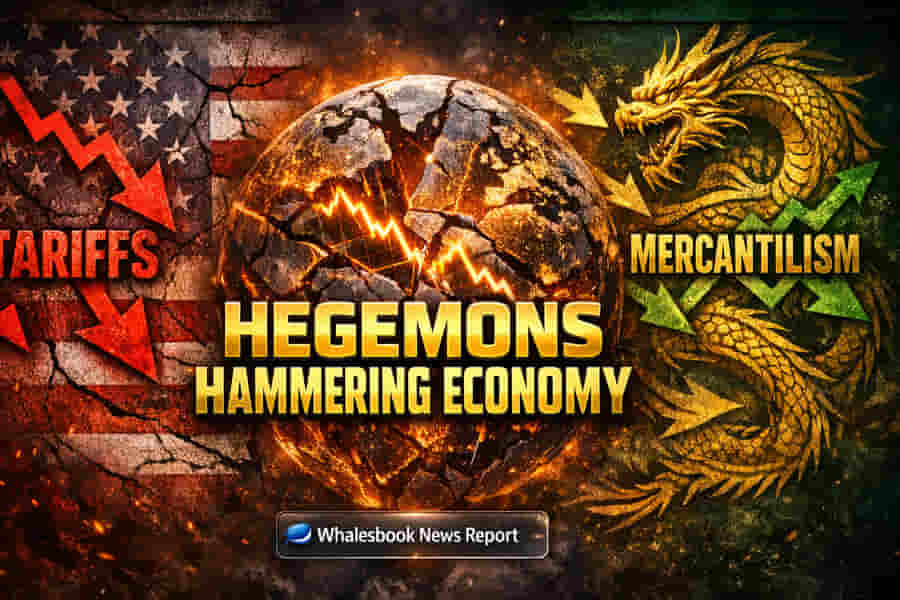
The World's Economic Stalemate: US and China Under Fire
The global economic landscape is facing unprecedented challenges, largely attributed to the actions of its two dominant powers, the United States and China. Instead of fostering global stability and growth, both nations are pursuing policies that inflict economic harm worldwide, creating a scenario described as "G-Negative-Two."
US Protectionism and Tariffs
Under President Donald Trump, the United States has adopted a strongly protectionist stance. Tariffs on goods entering the U.S. market have seen a dramatic increase, jumping from an average of just over 2 percent to 17 percent. This policy has not only restricted access to the U.S. market but has also introduced significant uncertainty, as tariffs are reportedly used for political reasons and private interests.
The U.S. Supreme Court has indicated it will defer to the executive branch's authority regarding national security justifications for these tariffs. This broad executive power has been invoked in cases targeting countries like Brazil and India, raising concerns about the arbitrary nature of these trade actions. Even if legal challenges occur, the unpredictability of U.S. trade policy is expected to persist.
China's Resurgent Mercantilism
China's economic model has long been characterized by mercantilism, a policy that prioritizes exports and restricts imports. This historical tendency has been exacerbated by current global conditions. Reports suggest China is increasingly unwilling to import goods, believing it can produce everything more efficiently.
This mercantilist approach, amplified by U.S. tariffs that limit access to American markets, has led China to aggressively pursue markets elsewhere, particularly in Southeast Asia. The result is a sharp rise in China's exports of low-value-added goods to developing countries, undermining their domestic industries and hindering their growth prospects. This export dependency is sustained, in part, by an undervalued renminbi, estimated to be 20 percent below its market value.
Impact on Developing Nations and Globalization
The combined actions of the U.S. and China are significantly impacting developing economies. These nations rely on exports of low-value-added manufacturing products, such as textiles and apparel, as a key engine for development and convergence towards Western living standards. With global trade becoming more restricted and uncertain, this engine is stalling.
Research indicates that the rapid convergence of developing countries toward higher living standards, which characterized the previous decade, has halted. The reversal of globalization, driven by the protectionist policies of the world's hegemons, means the poorest populations in the world's poorest regions are the most vulnerable. This trend suggests a bleak near-term future for global economic development.
Expert Analysis
The writer, a senior fellow at the Peterson Institute for International Economics, argues that both the U.S. and China are actively damaging the global economy. Their mutually reinforcing protectionist and mercantilist policies create a "G-Negative-Two" world, where global economic costs are inflicted rather than global public goods being provided. This situation hinders trading opportunities for all other nations and poses a significant threat to global economic progress.
Impact
This news has a significant indirect impact on the Indian stock market by contributing to global economic uncertainty and potentially slowing international trade, which affects Indian businesses involved in exports and imports. It highlights systemic risks in the global economy that investors must consider. The impact on the Indian market is moderate to high due to India's integration into global supply chains and its status as a developing economy. Impact Rating: 7/10
Difficult Terms Explained
- Hegemons: Dominant global powers or states that wield significant influence.
- Protectionism: Economic policy of restraining trade between countries through tariffs, quotas, and other government regulations.
- Mercantilism: An economic policy that is designed to maximize the exports and minimize the imports of a nation.
- G-Zero: A term referring to a world with no dominant global leader or superpower.
- G-Negative-Two: A concept suggesting a world where the two dominant powers (U.S. and China) actively create negative global economic externalities.
- Trade Surpluses: Occurs when a country's exports exceed its imports.
- Tariffs: Taxes imposed on imported goods, usually by governments.
- Renminbi: The official currency of the People's Republic of China.
- Supply Chains: The network of organizations, people, activities, information, and resources involved in moving a product or service from supplier to customer.
- Globalization: The process of interaction and integration among people, companies, and governments worldwide.