 Whalesbook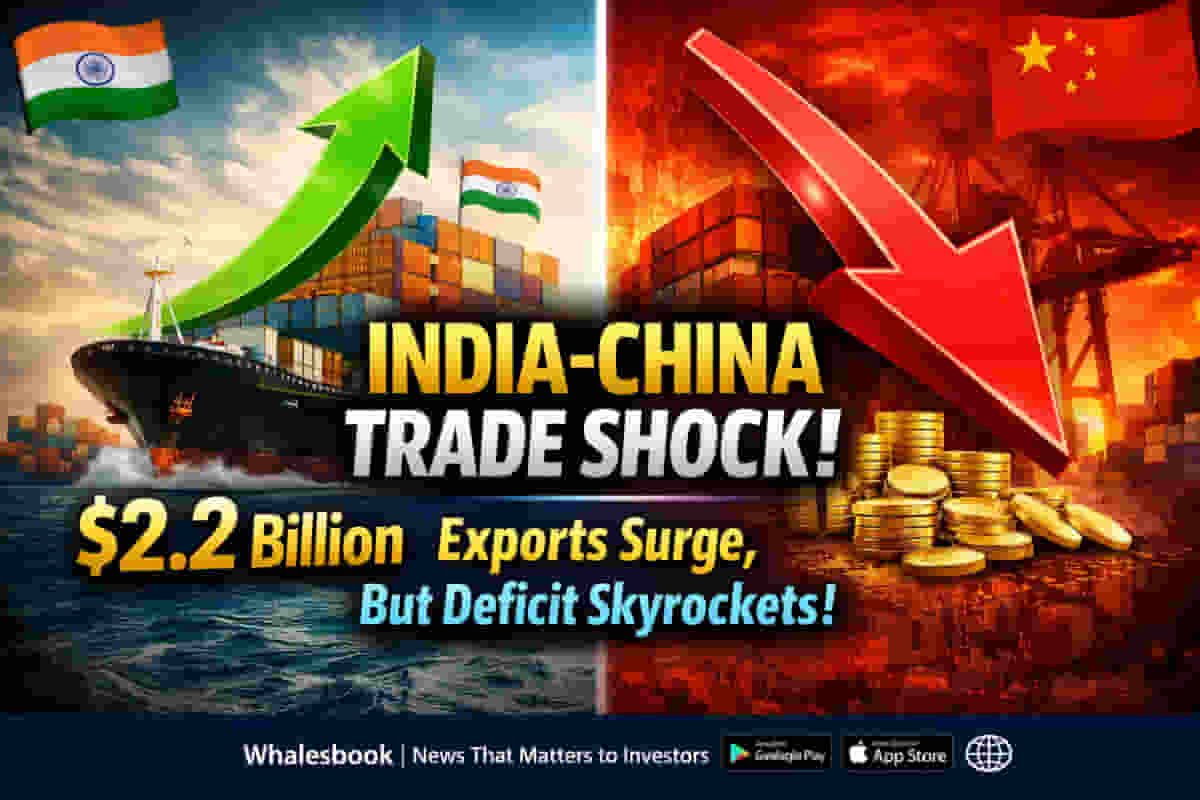


India's Trade with China: A Paradox of Surging Exports and Deepening Deficits
India's economic relationship with China has entered a period marked by stark contradictions, according to a new report by the Global Trade Research Initiative (GTRI). While Indian exports to China registered a significant surge, reaching $2.2 billion in November, this headline figure masks a worrying trend of import dependence and a widening trade deficit that continues to escalate. The GTRI analysis highlights that the recent export growth is not broad-based but concentrated in a few volatile product categories, raising concerns about the sustainability of this performance.
The report underscores that India's trade with its largest trading partner is increasingly imbalanced. Despite efforts to diversify supply chains and boost domestic manufacturing, the nation's reliance on Chinese machinery, electronics, chemicals, and plastics remains exceptionally high. This persistent imbalance, characterized by weak and volatile exports against rapidly growing imports, is pushing the bilateral trade deficit to record levels, presenting a significant economic challenge for India.
The Core Issue: Sharp Contrasts in Bilateral Trade
The GTRI report paints a picture of two diverging trade realities between India and China. On one hand, India's export figures show a remarkable year-on-year spike, particularly in November. However, a closer examination reveals that this growth is driven by a narrow range of products, making it susceptible to fluctuations in Chinese demand and policy.
Conversely, India's import bill from China continues to swell, anchored in critical sectors essential for industrial and technological development. This asymmetry means that while export numbers might show short-term gains, the underlying dependence on Chinese goods is growing, contributing to a structural trade imbalance that is difficult to rectify quickly.
Export Surge Driven by Limited Sectors
The recent impressive growth in India's exports to China is largely attributed to specific products rather than a diversified export basket. Naphtha, a key petrochemical feedstock, saw its exports surge by a staggering 512% in October, contributing $1.4 billion from April to October. Similarly, exports of printed circuit boards experienced an extraordinary year-on-year increase of 8,577% in October, with shipments from April to October rising over 2,000% to $418 million. Mobile phone component exports also saw an unusual 82% increase.
In contrast, India's traditional export strongholds have shown mixed or declining performance. Exports of iron ore, a significant commodity, declined by 30% from April to October. Shrimp exports, another key item, displayed only modest growth. This concentration means that any shift in Chinese demand for these specific items can dramatically impact India's overall export performance to the country.
Deepening Reliance on Chinese Imports
India's import basket from China is heavily concentrated, with machinery, electronics, plastics, and organic chemicals accounting for nearly 80% of the total. From January to October, electronics led the imports at $38 billion, including vital components like mobile phone parts, integrated circuits, laptops, solar cells, and memory chips. Machinery imports reached $25.9 billion, with transformers alone valued at $2.1 billion, highlighting India's need for Chinese capital goods.
The pharmaceutical intermediate sector also shows significant reliance, with organic chemical imports touching $11.5 billion, largely due to $1.7 billion in antibiotics. This dependence on imported raw materials and finished goods from China is a persistent feature that makes it challenging for India to reduce its overall trade deficit.
The Widening Trade Deficit
The GTRI report underscores the alarming growth of India's trade deficit with China. The deficit widened from $64.7 billion in 2021 to an expected $106 billion in 2025. Data from China suggests an even larger gap, with its figures pegging India's exports lower and imports higher than reported by Indian authorities. This divergence raises questions, including the possibility of under-invoicing of imports to reduce customs duties, a practice that warrants investigation.
The report notes that normally, import values are higher than export values due to CIF (Cost, Insurance, Freight) versus FOB (Free On Board) accounting. India reporting lower imports than China reports as exports is unusual and could indicate deliberate undervaluation. This discrepancy further complicates the assessment of the true bilateral trade imbalance.
GTRI's Cautionary Outlook
"Without a sustained strategy to expand competitive manufacturing, reduce import dependence in key sectors, and strengthen trade monitoring, short-term export spikes will do little to alter the fundamentally imbalanced nature of India–China trade," the GTRI analysis concludes. The initiative emphasizes that current export gains lack consistency and are heavily influenced by shifts in Chinese demand, prices, and policies, rather than reflecting stable market access or diversification.
The report urges a focused strategy to build competitive manufacturing capabilities and reduce reliance on critical imports. Strengthening trade monitoring mechanisms is also crucial to ensure accurate valuation and compliance. The current trajectory suggests that without proactive measures, the trade imbalance will likely persist, impacting India's economic stability.
Impact
This GTRI report has significant implications for India's economic policy and business environment. The persistent widening of the trade deficit with China could strain India's foreign exchange reserves and affect the competitiveness of domestic industries. Investors may react cautiously to sectors heavily reliant on Chinese imports or those facing intense competition from Chinese goods. Policymakers will likely face increased pressure to implement measures that boost exports, promote indigenous manufacturing, and diversify import sources. The report serves as a critical alert for stakeholders to re-evaluate trade strategies and economic vulnerabilities.
Impact Rating: 8/10
Difficult Terms Explained
- Global Trade Research Initiative (GTRI): An organization that conducts research and analysis on international trade policies and trends.
- Exports: Goods and services sold by one country to another.
- Imports: Goods and services bought by one country from another.
- Volatile: Subject to rapid and unpredictable changes.
- Naphtha: A flammable liquid hydrocarbon mixture derived from petroleum, used as a solvent or feedstock in the petrochemical industry.
- Printed Circuit Board (PCB): A board used to mechanically support and electrically connect electronic components using conductive pathways.
- Petrochemical Feedstocks: Raw materials derived from petroleum or natural gas used to produce chemicals.
- Trade Deficit: The amount by which the cost of a country's imports exceeds the value of its exports.
- Machinery: Machines or machine systems, often industrial or heavy-duty equipment.
- Electronics: Devices and components that operate by the flow of electrons, such as semiconductors, computers, and consumer gadgets.
- Organic Chemicals: Carbon-containing chemical compounds, used in a wide range of industries including pharmaceuticals and plastics.
- Antibiotics: A class of drugs used to treat bacterial infections.
- PVC Resin: Polyvinyl chloride resin, a common plastic used in pipes, window frames, flooring, and cables.
- Under-invoicing: Declaring a value for imported or exported goods that is lower than their actual market value, often to evade customs duties or taxes.
- CIF (Cost, Insurance, Freight): An Incoterm where the seller arranges and pays for all costs, insurance, and freight necessary to bring the goods to the named destination.
- FOB (Free On Board): An Incoterm where the seller fulfills their obligation to deliver when the goods are loaded on board the vessel appointed by the buyer; the buyer bears all costs and risks thereafter.