 Whalesbook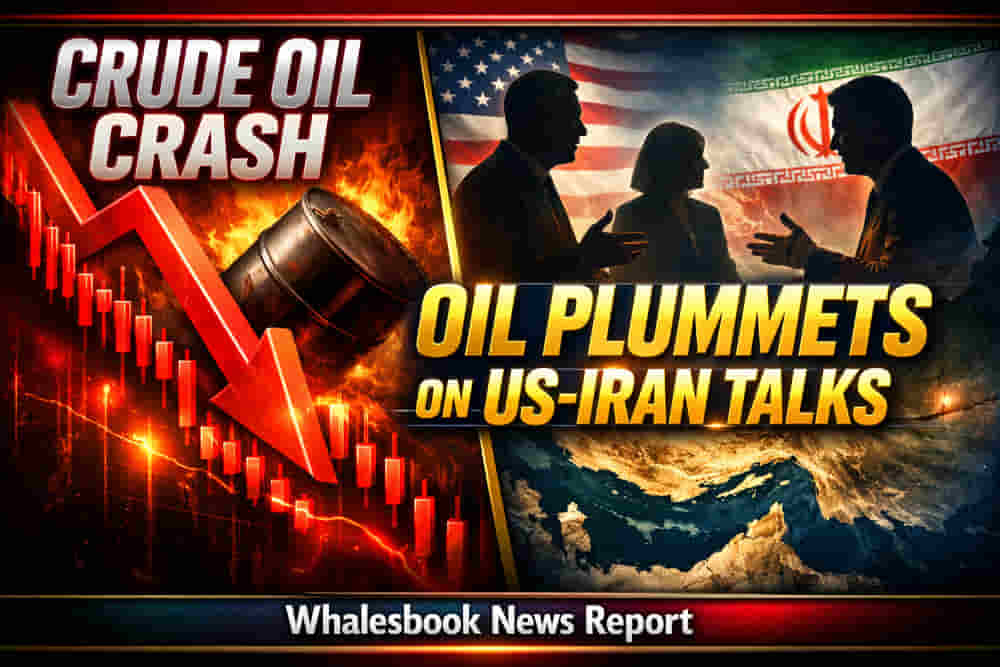
### The Fragile De-escalation
Crude oil benchmarks saw modest declines early Monday, as diplomatic channels between the United States and Iran appeared to be opening, reducing near-term anxieties about a regional conflict that could disrupt vital energy flows. Brent crude futures shed 0.72% to $67.56 a barrel, while West Texas Intermediate (WTI) crude was down 0.66% at $63.13. Reports indicated that indirect nuclear talks held in Oman were described as a "good start" by Iranian officials, with plans for further discussions. This diplomatic engagement has led to an erosion of the geopolitical risk premium previously embedded in prices. However, this relief is tempered by the inherent volatility of the region. Iran's foreign minister reiterated threats to strike U.S. bases if attacked, a stark reminder that underlying tensions persist. The market's focus remains sharply on the Strait of Hormuz, through which approximately 20-25% of global oil trade transits, a critical chokepoint where any escalation could have swift and severe consequences. The ongoing framework talks are a long way from resolving core issues, and broader U.S.-Iran relations remain complex.
### Sanctions Reshape Global Flows
Beyond the immediate U.S.-Iran dialogue, the global oil market is navigating significant structural shifts driven by international sanctions and evolving trade patterns. The European Commission's proposed ban on services supporting Russian seaborne crude exports continues to influence trade routes. Concurrently, India, a major energy consumer, is increasingly diversifying away from Russian oil. Its imports from Russia have declined, with its share in India's crude basket falling, while its sourcing from the United States has risen. This recalibration, potentially linked to trade agreements with the U.S., could see India replace Russian barrels with U.S. or Venezuelan crude, altering supply dynamics. Despite sanctions, Russian production saw a rebound in December, highlighting the market's resilience and adaptability.
### The Bear Case: Lingering Risks and Supply Signals
While immediate geopolitical fears have subsided, several factors suggest underlying price volatility and potential upside risks. Iran's defiance on uranium enrichment and the continued presence of U.S. military assets in the region underscore the persistent threat of escalation. Future talks between the U.S. and Israel will also focus on Iran, adding another layer of complexity. A scenario involving direct military action against Iran could propel oil prices significantly higher, potentially to the $80 per barrel range, according to some analysts.
On the supply side, U.S. energy firms have added oil and gas rigs for the third consecutive week, with the oil rig count reaching 412. While the U.S. Energy Information Administration (EIA) projects a slight decrease in U.S. crude output for 2026, this sustained increase in drilling activity signals a potential for robust production. The EIA forecasts global oil production to exceed demand in 2026, leading to inventory builds and moderating prices, with Brent averaging $56 per barrel and WTI $52 per barrel. However, this outlook is contingent on OPEC+ maintaining current production policies and the absence of major supply disruptions. Recent forecasts from J.P. Morgan suggested Brent could average $58 per barrel in 2026, though other projections anticipate higher prices within 12 months. The market's current sentiment appears to favor containment over confrontation, yet the historical precedent of rapid price surges during Middle Eastern tensions cannot be ignored.
### Future Outlook
Analysts anticipate that the surplus in the oil market is likely to be sharper than previously expected in 2026, driven by rising global production outpacing demand growth. The EIA projects global supply to increase by 2.5 million barrels per day in 2026. This forecast is sensitive to OPEC+ policy and potential disruptions. Despite the current price dip, the complex interplay of geopolitical sensitivities, evolving sanctions regimes, and the underlying strength of U.S. production suggests that oil markets will remain susceptible to swift price movements should tensions re-emerge.