 Whalesbook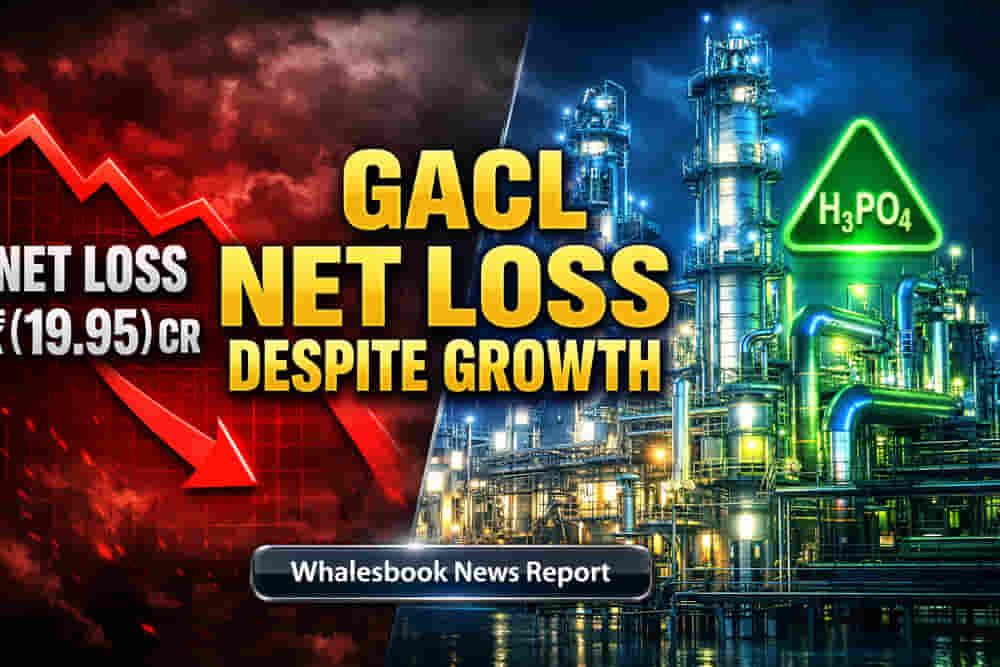
GACL Navigates Q3 Loss Amidst Significant Expansion Plans
Gujarat Alkalies and Chemicals Limited (GACL) has unveiled its Q3 FY2025-26 financial results, revealing a complex picture of operational gains offset by a net loss, alongside ambitious expansion projects.
📉 The Financial Deep Dive
- The Numbers: For the third quarter ended December 31, 2025, GACL reported consolidated revenue of ₹1044.46 Crores, a marginal year-on-year increase of 0.70% from ₹1001 Crores in the corresponding period last year. EBITDA demonstrated robust growth, climbing 19% to ₹135 Crores from ₹113 Crores YoY. However, the Profit Before Tax (PBT) figures presented a mixed trend: consolidated PBT stood at ₹3.83 Crores, while standalone PBT was ₹12.62 Crores. Crucially, both consolidated and standalone Profit After Tax (PAT) were negative, registering ₹(19.95) Crores and ₹(11.16) Crores respectively.
- The Quality: A significant inventory valuation adjustment for 'Spent Palladium (Pd) catalyst' contributed a profit increase of ₹18.29 Crores for the quarter. Despite this substantial one-off gain, the company registered a net loss. This divergence between positive PBT and the substantial net loss, even with the one-off boost, raises questions about underlying operational costs or other charges impacting the bottom line.
- The Grill: Analysts are likely to question the stark contrast between the reported PBT figures, the positive one-off adjustment, and the final negative PAT. The sustainability of the business model will be under scrutiny, given the marginal revenue growth and the persistent net loss in a quarter that saw operational improvements at the EBITDA level. The company's strategy to manage these losses while embarking on significant capital expenditure will be a key focus.
🚀 Expansion and Future Outlook
The Board of Directors has approved major expansion projects with an aggregate estimated cost of approximately ₹949 Crores:
- Boilers Installation: Four Bio-fuel/Coal fired boilers at Vadodara and Dahej complexes for an estimated ₹389 Crores, aimed at reducing steam costs and generating power.
- Phosphoric Acid Plant: A 33,870 TPA Food Grade Phosphoric Acid Plant at Dahej for ₹560 Crores, projected to add annual revenues up to ₹350 Crores.
- KOH Capacity Enhancement: Phase-wise enhancement of KOH production capacity from 120 TPD to 200 TPD at Vadodara for ₹80 Crores, expected to boost annual revenue by ₹130 Crores.
These initiatives signal a strong commitment to diversification and scaling up production, particularly into higher-value products like food-grade phosphoric acid.
🚩 Risks & Outlook
Specific Risks: The primary risk for investors is understanding the fundamental reasons behind the net loss despite positive PBT and a considerable one-off profit. Execution risk for the large capital expenditure projects, along with market acceptance and pricing for new products, are also key concerns. The company is also securing a ₹250 Crores Line of Credit from Gujarat State Financial Services Ltd (GSFS).
The Forward View: GACL's future performance hinges on the successful commissioning and profitable operation of its new expansion projects. The company's continued focus on operational efficiency, cost reduction, and increasing the share of renewable energy (currently at 35.7%) are positive indicators for long-term sustainability. Investors will closely monitor the next few quarters for a reversal in the PAT trend and the tangible impact of the new production capacities.