 Whalesbook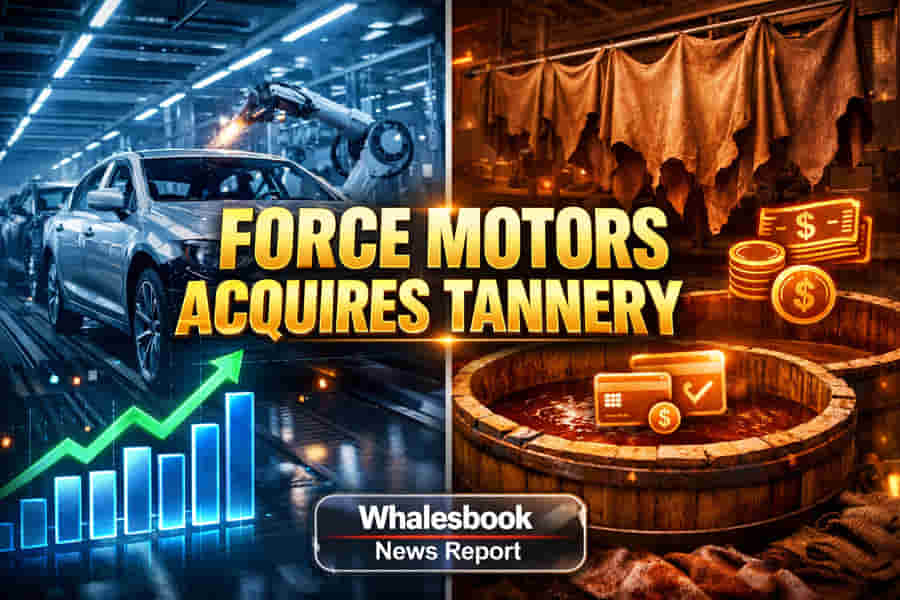
The Tannery Gambit
Force Motors Ltd. has announced a significant strategic pivot, entering into a Memorandum of Understanding (MoU) to acquire 100% of Veera Tanneries Private Ltd. (VTPL) for ₹175 crore. This acquisition, pending due diligence and regulatory approvals, signals a move beyond its core automotive manufacturing business. Veera Tanneries, established in 1978 and operating as a LWG Gold Rated tannery with zero effluent emission, specializes in chrome-free and organic finished leather from sheep and goat skins, serving the leather goods, shoe, garment, and glove industries [12, 17, 18, 24, 28]. The acquisition cost, while substantial, represents a diversification play rather than a transformative revenue injection for Force Motors, which boasts a market capitalization of approximately ₹28,205 crore [4]. This move diverges from typical automotive sector consolidation, which often focuses on platform sharing or technological integration, raising questions about Force Motors' long-term strategy.
Q3 Profit Engine
The acquisition announcement coincides with Force Motors' robust third-quarter financial performance. The company reported a consolidated net profit of ₹406.1 crore, a substantial increase from ₹115.3 crore in the prior year's corresponding quarter [2]. Revenue from operations grew by 12.6% year-on-year to ₹2,128 crore. Operating performance saw a significant boost, with EBITDA climbing 61.4% to ₹373.8 crore, leading to an expanded EBITDA margin of 17.5% from 12.3% a year ago [2]. This margin expansion reflects improved operating leverage and cost efficiencies. However, the reported net profit was significantly bolstered by a one-time gain of ₹211 crore during the quarter [2, 5]. Excluding this exceptional income, the underlying operational profit growth warrants closer scrutiny to assess its sustainability. The market responded positively, with Force Motors' shares closing at ₹21,418.85 on February 6, 2026, marking a 1.63% increase on the BSE [2]. This modest gain suggests investors are absorbing the news, perhaps weighing the acquisition's strategic implications against the strong, albeit partially exceptional, quarterly results.
Valuation and Peer Comparison
Force Motors currently trades with a P/E ratio around 29.4x based on its TTM earnings and a market capitalization of approximately ₹28,205 crore [4, 22]. This valuation places it within a range comparable to other major automotive players; for instance, Maruti Suzuki has a P/E of approximately 31.86, while Tata Motors trades at a P/E of 0, reflecting its different financial structure and operational focus [3, 30]. Mahindra & Mahindra has a P/E of 20.5 [23]. Competitors like Ashok Leyland and M&M show P/E ratios of 34.81 and 31.23 respectively, suggesting Force Motors' valuation is not an outlier within the sector [4]. However, the acquisition of a tannery could introduce new valuation metrics and risk profiles not typically associated with automotive manufacturers, potentially impacting future P/E multiples if the diversification is significant.
Sectoral Currents and Historical Play
The Indian automotive sector is undergoing a transformation, with a growing emphasis on electric vehicles (EVs) and a recovery in demand for commercial and passenger vehicles [11, 16, 27]. The industry is projected to reach $300 billion by 2026 [11]. Force Motors, with its established presence in light commercial vehicles, multi-utility vehicles, and agricultural tractors, is positioned to benefit from this recovery [4]. Historically, Force Motors' stock has demonstrated strong performance, delivering a 224.72% return over the past year [6]. However, its performance around past M&A activities or significant earnings events is less documented in the immediate search results, suggesting that such diversification into non-automotive sectors is a novel development. Recent analyst sentiment indicates a downgrade from "Strong Buy" to "Buy" for Force Motors due to valuation concerns, despite strong financial trends [15, 26]. This suggests a cautious outlook from analysts, balancing the company's operational strengths against potential integration risks and market-wide sector caution observed in early February 2026 [23].
Future Trajectory
The immediate future for Force Motors involves navigating the integration of Veera Tanneries while maintaining momentum in its core automotive operations. The success of this diversification will depend on management's ability to extract synergies, manage new operational complexities, and align the tannery business with the company's overall growth objectives. While Q3 results were impressive, the significant one-time gain means sustainable profitability will be closely watched. The "Buy" rating from analysts suggests a belief in continued operational strength, but the strategic rationale behind the tannery acquisition will be a key factor in long-term investor perception.