 Whalesbook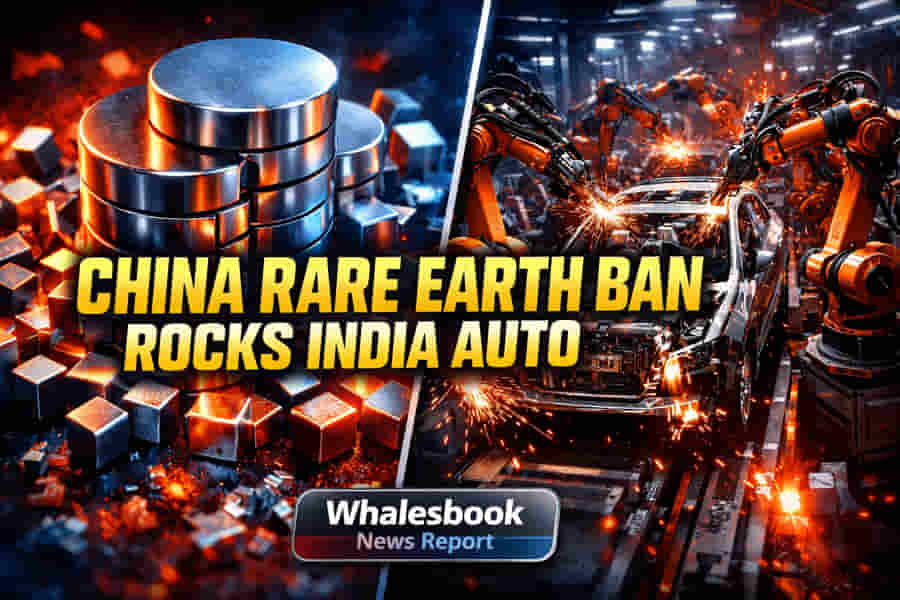
China's Rare Earth Magnet Export Ban Sends Shockwaves Through India's Auto Sector
In April 2025, China's decision to impose an export ban on rare-earth magnets, a critical component in virtually every vehicle, created significant turmoil for India's automotive industry. Initially underestimated as a temporary measure, Beijing's refusal to ease export licensing soon revealed the sector's deep-seated vulnerability to geopolitical dependencies, forcing a reckoning across boardrooms and policy corridors.
The Geopolitical Chessboard
Rare-earth magnets are indispensable for modern vehicles, including electric cars, as well as renewable energy technologies and consumer electronics. China's dominance in this sector is profound, accounting for approximately 60% of global rare-earth mining and nearly 90% of the refining and processing required to convert these raw materials into usable magnets. This strategic control allows China significant leverage in global trade.
Corporate Tremors
The export restrictions on rare-earth magnets were not an isolated incident. Concerns escalated following Beijing's earlier restrictions on semiconductor exports to automakers by Nexperia, a subsidiary of Chinese firm Wingtech Technology. With India lacking a domestic semiconductor supply chain, and major European auto-component suppliers like Bosch flagging potential impacts, the twin scares underscored the fragility of global supply chains.
Companies like Bajaj Auto warned of potential month-long halts in electric vehicle production, while Ather Energy projected a seven-day hit to factory dispatches. Maruti Suzuki reportedly staggered production of its new electric vehicle, e-Vitara. Tata Motors and its subsidiary Jaguar Land Rover explicitly cited supply chain risks in their annual reports for the first time.
Navigating the Crisis
Many auto executives view addressing supply chain crises as a competitive advantage, keeping their specific solutions confidential. Rajesh Jejurikar, executive director and CEO of the auto and farm division at Mahindra and Mahindra, confirmed that the company's production remained undisrupted, attributing it to successful supply chain derisking, though the methods remain proprietary.
Suppliers are actively working on alternatives. Sona BLW Precision Forgings Limited (Sona Comstar) has shifted to alternative motor designs using light rare-earth magnets and developed rare-earth-free motors. Bosch India is exploring non-heavy rare-earth magnet motors and non-ferrous magnets. Bajaj Auto is considering ferrite magnet motors for its scooters to reduce reliance on China.
Policy Reinforcement
Recognizing the systemic risk, the Indian government approved a ₹7,280 crore package to incentivize private sector investment in setting up five rare-earth magnet plants within India. The scheme aims to boost the country's magnet production capacity to 6,000 tonnes per annum from the current 1,500 tonnes, produced solely by IREL (India) Ltd.
The government is also encouraging automakers to invest in research to explore options for moving entirely away from rare-earth magnets, a longer-term strategic shift. Furthermore, import restrictions under EV incentive schemes, like the PM E-Drive scheme, have seen deadlines extended, reflecting the evolving supply chain landscape.
Charting a New Course
The crisis has been a powerful lesson for India's auto sector, emphasizing the critical need to diversify supply chains and reduce dependence on any single country. Companies are actively pursuing 'China+1' strategies, exploring multiple technologies and components to build resilience.
Impact
This crisis has a significant impact on the Indian automotive sector by compelling strategic shifts in supply chain management, driving innovation in material science and motor design, and potentially influencing the pace and cost of electric vehicle adoption. It accelerates the push for self-reliance in critical components.
Impact Rating: 8/10
Difficult Terms Explained
- Rare-Earth Magnets: Powerful permanent magnets made from rare-earth elements, crucial for electric motors in vehicles, wind turbines, and electronics.
- Processing: The industrial steps required to refine raw mined materials into usable forms, like magnets.
- Semiconductors: Materials used to make microchips, essential for the electronic systems in vehicles and other devices.
- Supply Chain: The network of organizations, people, and activities involved in producing and delivering a product, from raw materials to the final customer.
- Geopolitical Risks: Potential threats to business or investment arising from political events, policies, or conflicts between countries.
- Localization Requirements: Government regulations that mandate a certain percentage of a product's components or manufacturing processes must be sourced or performed within the country.
- Traction Motors: Electric motors that provide the primary drive force for electric vehicles.